
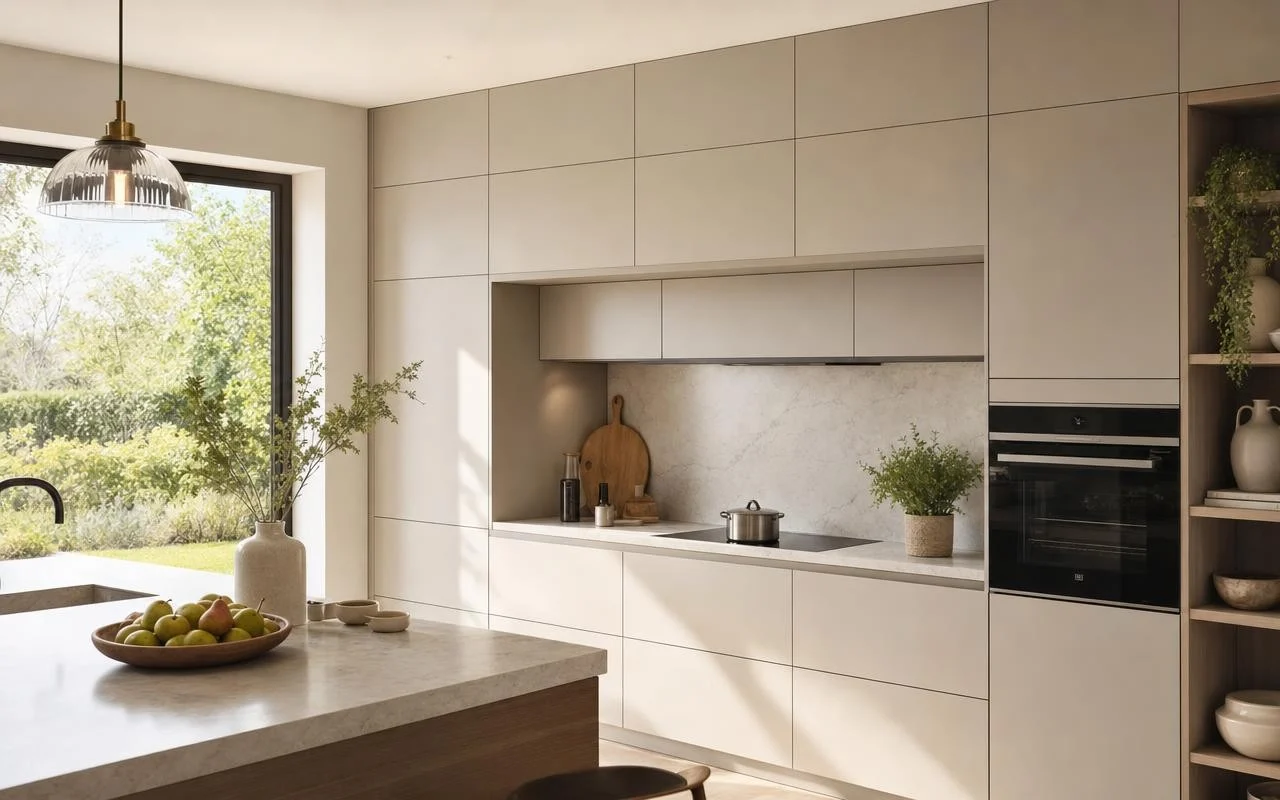
For years, the top of my kitchen cabinets served as an invisible dust trap. On the floor everything looked clean, but every climb onto a step stool revealed a greasy layer that was nearly impossible to remove without strong cleaners. This lip wedged between tall units and the ceiling, far too high for daily cleaning, always ended up spoiling the impression of a well-kept kitchen.
That infamous gap, typically 15 to 40 centimeters wide in many fitted kitchens, has been singled out as one of the most dreaded corners in the room. Cooking fats rise, fix themselves, dust clings, and no one dares to look there anymore. Until the day I looked for a radical way to never again have to wipe it. A simple idea changed everything.
Why the space above kitchen cabinets becomes a dust nest
Most manufacturers offer tall wall cabinets at standard heights, not taking into account the actual ceiling height. Result: there is almost always a gap left, neither large enough for real storage nor small enough to disappear. This improvised ledge collects the greasy vapors that escape from pots; as they cool, they settle and trap ambient dust, until a sticky film forms.
The nuisance also comes from the height. To reach this space you need a stool or ladder, sometimes move the hood or lighting fixtures, or even remove some decorative objects. This constraint explains why people keep postponing the cleaning. Design specialists even refer to it as a zone that many end up “forgetting,” even though it remains visible from the living room or the family area.
Shelves and decor: the false good ideas to fill the space
To camouflage this annoying gap, ideas abound in the decoration sections. Some add open shelves to display pretty plates or jars. Others stack wicker baskets, artificial plants, or knickknacks of all kinds. There are also added cornices that hide the top of the cabinets, or a simple band of colored paint to “finish” the wall above the tall units.
These ideas make the whole setup more decorative, but they leave the core problem intact. Dust and grease continue to settle behind a cornice, on top of the shelves, on each basket or trinket. Instead of a single hard-to-reach surface, you end up creating several. Recent design guides insist: to remove this dust nest, you must remove the space itself.
Close the space up to the ceiling without weighing down the kitchen
The most effective approach is to close off the space above the kitchen cabinets with elements that run up to the ceiling. Kitchen designers offer additional cabinets, sometimes bespoke, that align with the existing units. Once these modules are installed, there is no exposed edge anymore: dust can no longer settle there, and you gain closed storage that is less frequently used. Depending on the configuration, three common options often come up:
- a finishing band to cover a small gap of roughly 5 to 30 centimeters;
- a lightweight paneling enclosure to hide an irregular ceiling or service conduits;
- cabinets closed up to the ceiling to eliminate the dust nest and add storage.
To keep the kitchen visually light, simply coordinate the color of the new façades with those of the existing cabinets or opt for a few glass doors that let light through. A slight setback of the cabinets from the base units creates a discreet shadow that breaks the blocky look, especially with a matte finish and integrated lighting under the cabinets. Before ordering, it’s useful to measure the height at several points and to locate ducts, cables or hood conduits to adapt the installation, perhaps planning a localized soffit.
Sources
- JLM
“At keeps his old kitchen furniture, but changes this detail: the result gives the impression of a tailor-made layout.”
