
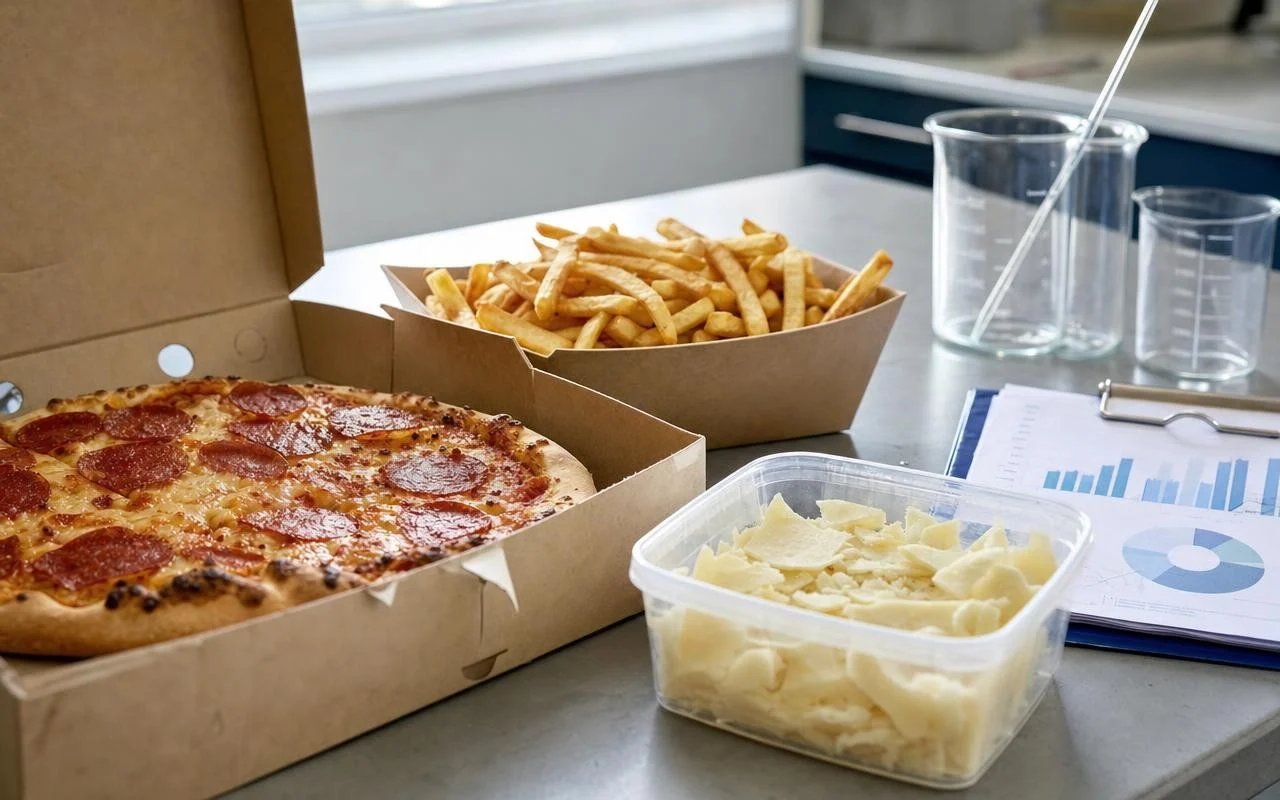
Pizza reheated in its cardboard box, fries in their tray, cheeses stored in an old plastic container: in the kitchen, fatty foods are often paired with packaging without much thought. These containers, called “materials in contact with foodstuffs” (MCDA), are nevertheless strictly regulated, because certain substances can migrate into our plates.
On October 16, 2024, the DGCCRF reminded of this vigilance after a broad inquiry. In 2022, its inspectors checked 1,254 establishments and analyzed 350 MCDA samples: 27% were non-compliant, including 33 posing potential health hazards. Not all foods react the same to these migrations.
Migration of packaging: what happens with a fatty food
Migration is the passage of molecules from the packaging into the food. Regulation (EC) No 1935/2004 requires that MCDA do not release substances in dangerous quantities nor degrade the odor or taste. Plasticizers, printing inks, adhesives, metals, manufacturing residues can be involved, even at very low doses. These substances are evaluated by the European Food Safety Authority (EFSA) before being authorized.
The amount that migrates depends on temperature, contact time, the exchange surface… and the type of food. The lipid-rich products attract the so-called lipophilic molecules, which dissolve better in fat than in water. Studies compiled by several authorities show that substances such as phthalates, used in certain plastics such as PVC, are found mainly in oils, margarines or fatty meats. These same studies also mention emerging families such as PFAS.
Fatty foods: when packaging and misuse stack up
In practice, it is precisely fatty foods that end up in the most sophisticated packaging: trays for meats and prepared dishes, films for cheeses, greaseproof papers and cartons for pizzas, burgers or pastries. During its investigation, the DGCCRF noted exceedances of overall migration or heavy metals in some recycled papers, but also excess levels of volatile organic compounds in molds and silicone utensils.
Another difficulty: misuse. The DGCCRF recalls that MCDA are tested for a specific use: a tub of ice filled with fatty sauce, a water bottle transformed into an oil dispenser, hot soup in a cardboard cup or a tray microwaved when it does not indicate so; all of this falls outside the validation framework and can increase migration. Some products even carry the label “BPA-free,” while bisphenol A is already banned.
Six simple reflexes to limit migration with a fatty food
Without turning everything under a microscope, a few habits already protect a lot, especially with very fatty foods such as saucy dishes, charcuterie or cheeses.
- Check the glass + fork pictogram and read the usage restrictions.
- Avoid heating a fatty dish in disposable packaging not indicated for cooking.
- Do not reuse trays, cups, papers or ice trays for storing fatty preparations.
- For long-term storage of oils, rillettes or confits, prefer glass, stainless steel or unchipped ceramic.
- Replace damaged, enamelled or decorated crockery, more prone to metal migrations.
These tips do not replace authority checks, but they complement the work of the DGCCRF, which continues to remove the most problematic MCDA from the market. Metals, ceramics, glass, silicone or cardboard do not present the same risks, especially with a fatty dish stored for a long time. When in doubt, the fattier the food, the higher the vigilance on its packaging should be.
