
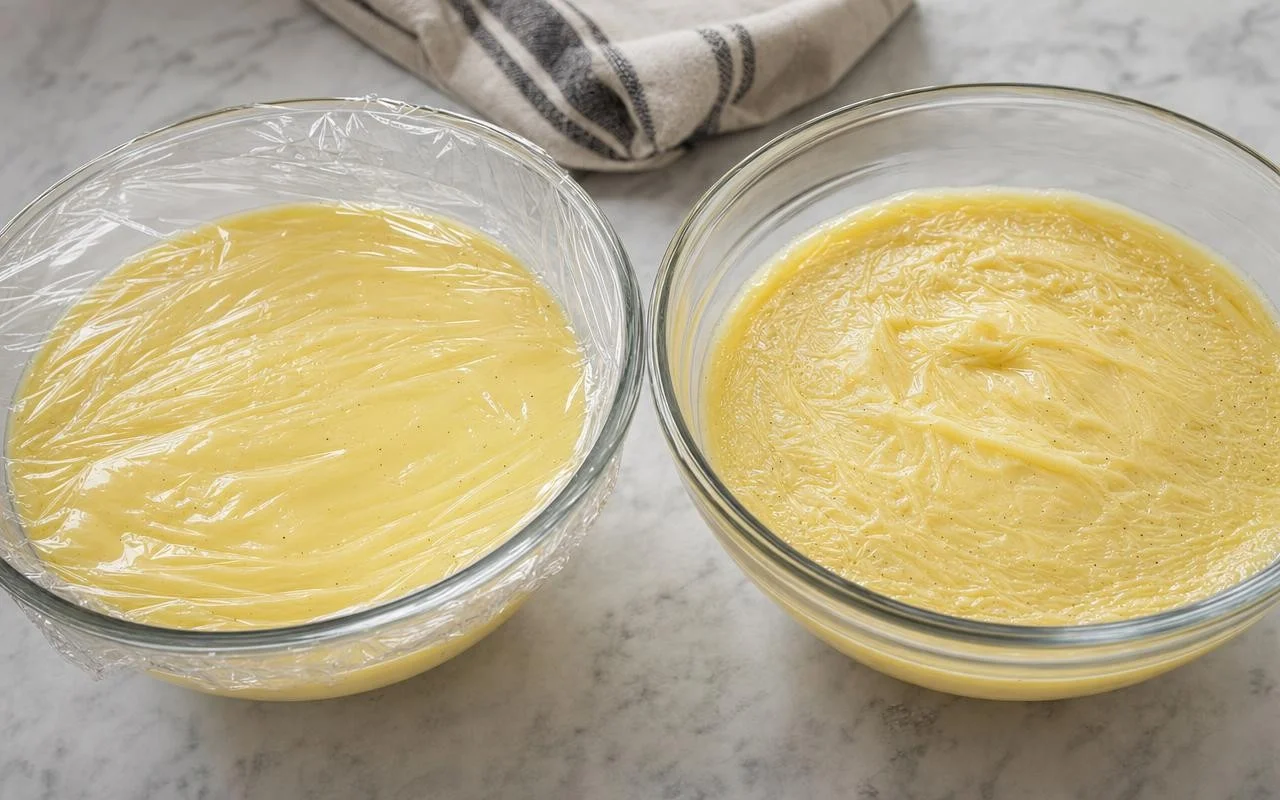
A perfectly smooth pastry cream, gliding over the spoon, is left to cool slightly before lining a tart. Everything seems flawless until you return to the bowl: a thin, thick skin has formed on the surface, a touch elastic, not very inviting. Many cooks remove it or whisk it back into the mass without asking questions, even if that compromises the original texture.
In professional patisserie, there is a small gesture that completely prevents this phenomenon: placing a piece of plastic wrap directly on the hot cream. We are talking about preparing the cream by filming it at the surface. Behind this seemingly banal action hides a precise physical mechanism, which explains why a simple cling film is enough to bid farewell to the infamous skin.
Filming a cream by contact: the principle and the related preparations
Filming a cream by contact means applying a piece of plastic wrap directly on the surface, tracing every contour, without leaving air pockets between the film and the cream. Unlike a simple lid placed on the bowl, the film actually touches the preparation, isolating the upper layer from the surrounding air and significantly limiting exchanges with the outside.
This gesture appears as soon as one works with dairy- or egg-based heated preparations: pastry cream, custard, ganache, lemon curd, but also certain sauces. Patisserie technical sheets emphasize it, because a simple surface film is enough to hinder homogeneous cooling, trap moisture, and, at the moment of mixing, create small unpleasant bits on the palate.
Why a cream forms a skin without contact film
Without contact film, the surface of a cream remains directly exposed to the air. During cooling, the water contained in the upper layer evaporates faster than in the rest of the preparation. This evaporation concentrates sugars, any starch, and especially the milk proteins, which yields a denser, stronger area ready to become skin as the cream cools.
The milk proteins, such as casein and those from whey, bind together under the influence of heat and then of progressive cooling. They form a network that traps this concentrated surface layer and binds it to the rest of the cream. Once the skin is established, whisking to incorporate it often creates lumps, difficult to remove even with vigorous mixing.
Bien filmer au contact sa crème et éviter les erreurs courantes
Setting a film by contact acts like a lid glued to the cream. The plastic blocks air, limits moisture loss, and keeps the surface as supple as the heart of the preparation. To do it correctly, a few simple reflexes suffice.
- Film the cream while it is still hot or warm, as soon as it is poured into its clean container.
- Cut a piece of film slightly wider than the bowl, place it at the center, then push the air toward the edges with your hand.
- Make the film adhere to the entire surface, without deep folds or bubbles, then refrigerate.
If a skin still appears, it is often that the film has not been pressed down properly or it was punctured. A film simply laid on the rim of the mixing bowl, or leaving a large hole in the center, does not protect the surface of the cream. Some pastry chefs prefer, for a pastry cream, to pour a thin layer of melted butter over the surface while it is still hot: that butter plays the same insulating role, preventing air from touching the cream directly.
