
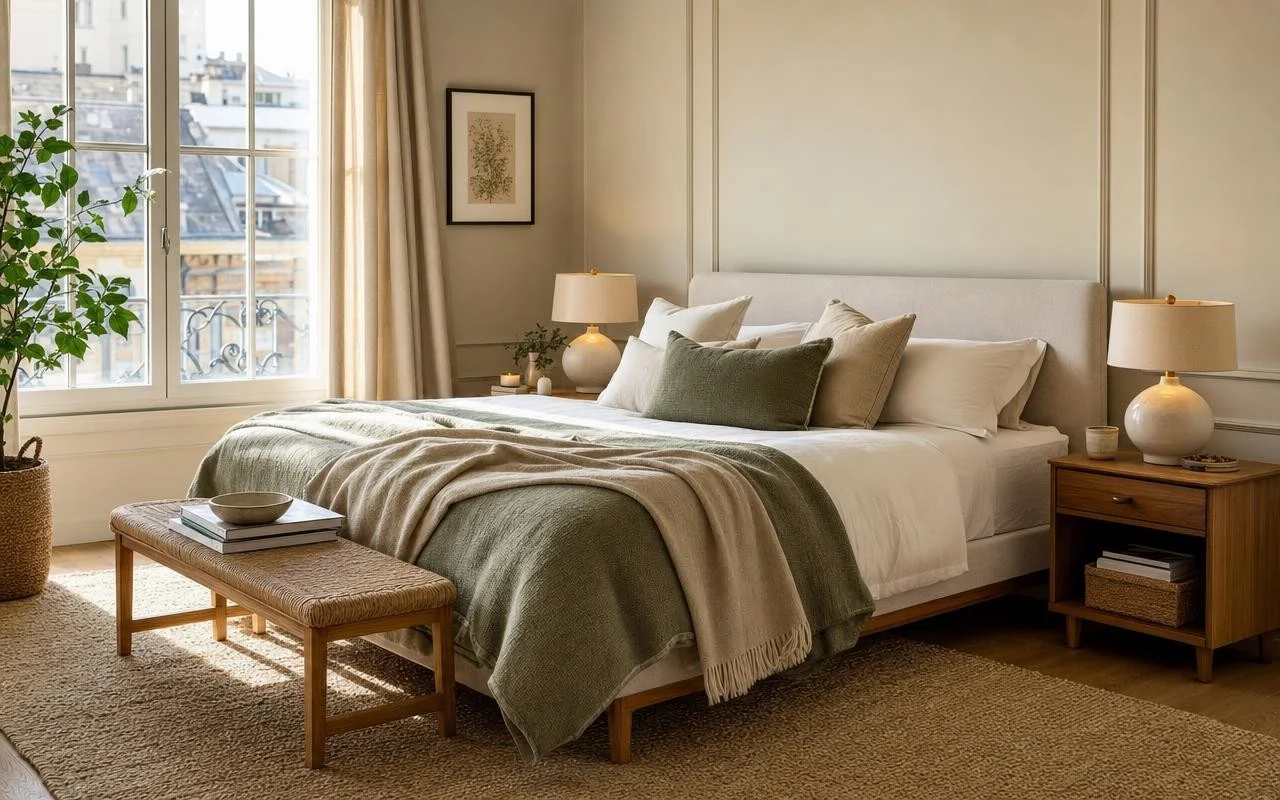
A bedroom that no longer reflects you, a bare wall behind the bed, furniture you hardly notice anymore: many readers dream of changing everything, then back away from the work and the budget. Redoing the floor, repainting all the walls, or buying a new wardrobe isn’t the only way to refresh your bedroom.
Decorators such as Esther Ellard, Bryan Frost, or Suzan Wemlinger remind us: the biggest visual shocks often come from targeted micro‑changes, easy to test and adjust. Their approach, shared in several interviews, involves tackling a few key elements rather than the whole room. Seven levers, and no more, are enough to transform the atmosphere of an ordinary bedroom into a more personal retreat.
Refreshing your bedroom: start with the layout and the bed
To begin to revamp a bedroom without renovations, designers recommend rethinking the layout before buying anything. Esther Ellard recalls: “When I was a little girl, I used to frequently change the furniture in my room, live with it for a few weeks, then start over if I didn’t like it,” says the decorator, founder of Effortless Interiors. “Move the bed to another wall, remove one of your nightstands, or move some of your secondary furniture, then live with it to see if it works.”
Once the bed is well placed, the linens become your best ally. Esther Ellard advises planning at least two sets of covers and sheets: “I recommend having a darker, more enveloping set for autumn and winter, then a lighter set for spring and summer,” the decorator notes. “Your bed is one of the most important elements in your room, so changing the bed linens mid-year can bring you the renewal you need.” Choosing fabrics suited to the season strengthens both comfort and the ambiance.
Textiles and walls: the details that change the bedroom’s mood
The cushions complete this bed‑arranging work without needing a large budget. Bryan Frost, head of Bryan Frost Interiors, especially likes vintage kilim cushions: “There are never two identical ones, and that weathered, imperfect texture gives a room the impression of having been built over time,” explains the designer. “Finish your bed with an affordable throw or blanket whose texture matches the season.”
On the floor, American designer Suzan Wemlinger offers a simple trick: place a large jute rug, then layer another rug on top, flat and patterned if possible vintage. On the walls, she recommends a gallery wall mixing photos, illustrations, and a few empty frames to personalize a large expanse at a low cost.
Lighting and nightstands: the final touch to modernize a bedroom
For lighting, Ellard recommends replacing at least one element that you no longer like: a basic ceiling light, a bedside lamp that’s too slim. Playing with multiple sources, adding lamps with broad bases, or simply changing the lampshades often suffices to warm up the room.
Nightstands finally offer a visible change without replacing all the furniture. Wemlinger suggests daring with pieces that have a more architectural silhouette, not necessarily identical but coordinated. In practice, designers often recommend this order: first the layout and the bed, then the textiles and the rugs, and finally the lighting and the nightstands.
