
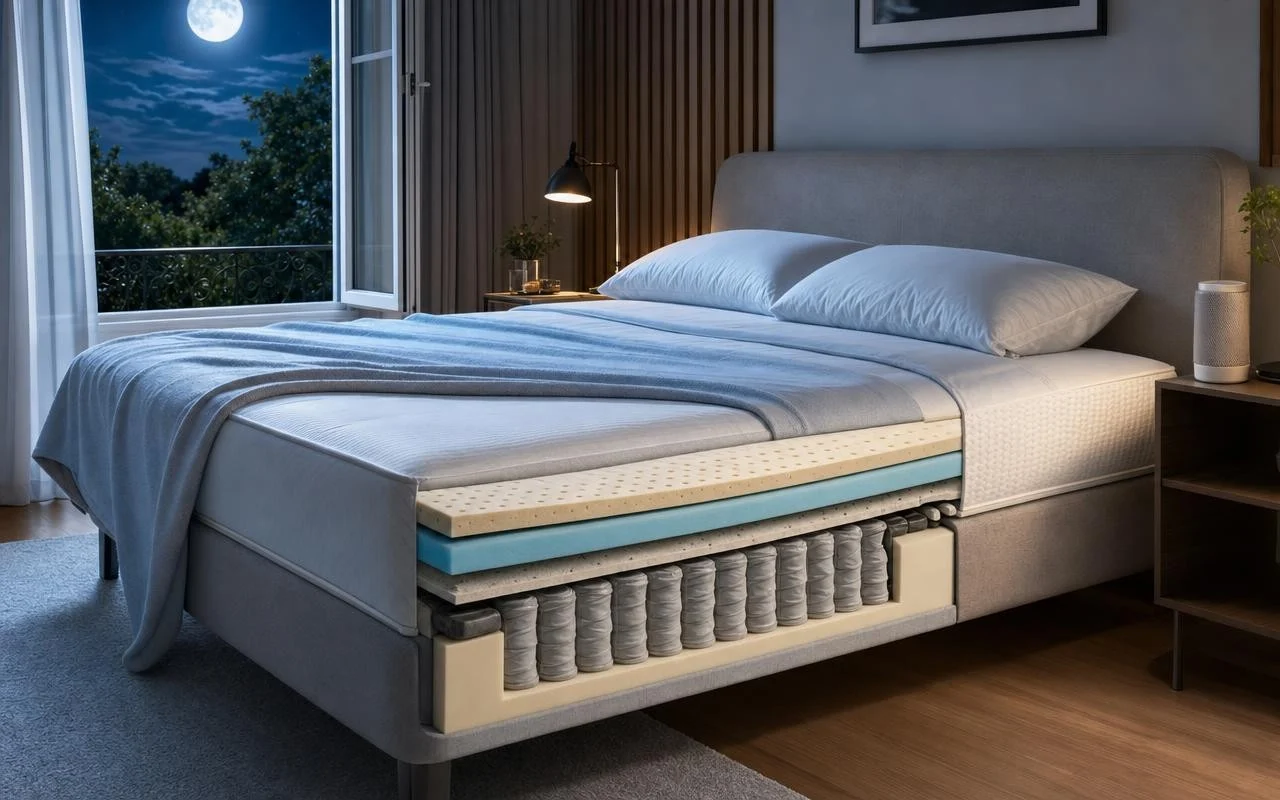
Many people know the feeling of waking up with pajamas clinging to the skin, the sheets damp, and that suffocating sensation even with the window open. Some immediately blame the room temperature, switch the duvet, or lower the heating, without lasting results. And what if the real source of heat came from beneath you, from the mattress that accompanies you every night?
An adult loses on average nearly 300 milliliters of water per night. If this humidity remains trapped in the bedding, the furnace-like sensation appears, even with a room at 19°C. The role of the mattress becomes central: it can either allow air and sweat to escape, or behave like a hot sponge. It is precisely here that the choice of materials and fabrics makes all the difference. But one must know what truly vents, and what stifles.
Why your mattress makes you hot at night
When the body stretches out, it seeks to keep a stable temperature around 37 °C. A poorly ventilated mattress disrupts this setting: warm air and humidity get trapped in the “core” of the bed. Materials with a very dense structure, such as certain foams, leave little room for circulation. The deeper you sink, the larger the contact surface becomes, which reinforces this sensation of a warm envelope.
The problem doesn’t originate only from the foam block or the coils. The fabric that covers the mattress, called the ticking, the comfort layer, and the mattress protector play a decisive role. A highly impermeable protector, with a continuous plasticized face, blocks sweat evaporation and creates a sauna effect. A solid bed base or a box spring further limits ventilation under the bed, especially if the mattress sits directly on top of it.
Mattresses that stay cool: a comparison of core bed materials
For a mattress that stays cool, pocket springs come out on top. Each spring is wrapped in a small pouch, but the overall assembly leaves a lot of space between the metal parts. Air can move freely inside, helping heat dissipate as the night goes on. This type of mattress also offers solid support and good sleeping independence, useful when two people share the bed.
Another ally for hot sleepers is perforated natural latex. Its micro-perforations cut through the material and create small air channels. Comfort remains elastic, with progressive support that limits pressure points without trapping you in the bed. By contrast, the memory foam, viscoelastic and thermo-sensitive, softens with body heat, hugs the contours, and markedly reduces ventilation. The thicker and denser the memory layer, the greater the risk of overheating, especially for those who sweat a lot according to UFC-Que Choisir. Some very dense foams, even without memory, have the same flaw: a closed structure that traps hot air inside.
Fabrics, mattress protectors, and the bed base: the winning combination for sleeping cool
On the surface, the ticking immediately influences the sensation of heat. A cover made of Tencel or breathable cotton helps absorb moisture and release it into the air, with a generally cooler touch in summer. Tencel, a fiber derived from wood pulp, handles sweating very well. Beware of certain fabrics with a cool touch: they give a cold impression at first, but do not solve the ventilation issue.
The choice of the bedding protector and the support also matters. A waterproof protector with a fine micro-porous membrane lets water vapor pass much better than a rigid plasticized model. A slatted bed base open beneath the mattress further improves the overall breathability. When combined with pocket springs or perforated natural latex and a Tencel or cotton cover, these choices foster a cooler bed.
