
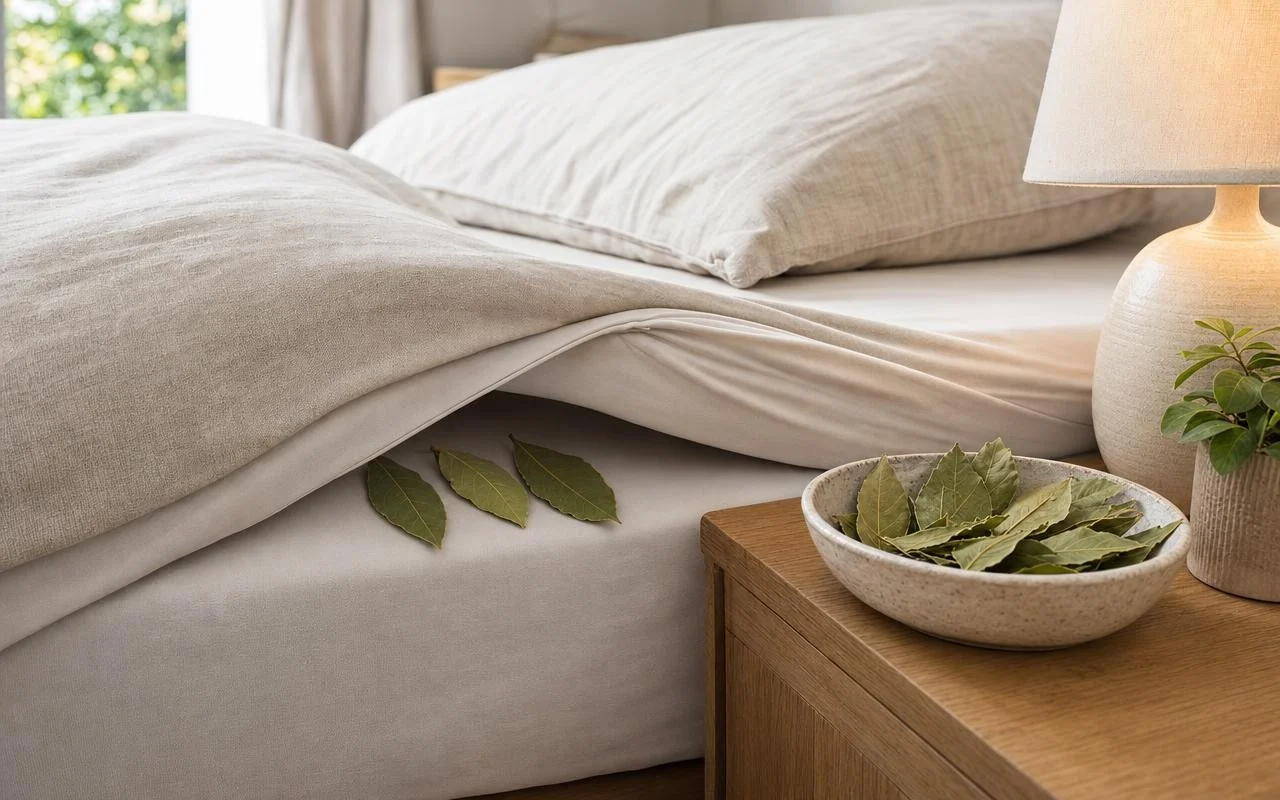
Make your bed as usual, slip three bay leaves under the mattress, and forget them until the next morning. This little scene circulates across social networks, often accompanied by promises of a calmer night, a purified room, sometimes even a bed protected from invisible little pests. At first glance, it looks like an old wives’ tale among others, almost too simple to be taken seriously.
The bay laurel, or Laurus nobilis, already scents our stews, our bouquet garni, and even, for some, the air emitted by the vacuum cleaner thanks to its dried leaves rich in essential oils. Under a mattress, the promise shifts: we’re not just seeking a pleasant smell, but also bedding that is less inviting to dust mites and a room ambiance that feels more pleasant. The question remains: what can these 3 bay leaves under the mattress really bring?
3 bay leaves under the mattress: the origin of the trick
In ancient writings, laurel already appears as a protector: it crowned Roman emperors, and Pliny the Elder mentions mattresses stuffed with brim and leaves to ward off vermin. Today, the setting has changed but the idea remains: make the bed less attractive to what disturbs us. Dust mites, for example, favor a temperature around 20 °C and humidity around 70 %, which is exactly what you find in a mattress used every night.
The leaves of the bay laurel contain volatile compounds such as 1,8-cineole, linalool, and eugenol. Some essential oil analyses show up to 50 % 1,8-cineole and 5 to 10 % of eugenol, two molecules studied for their odor effects and their action on small organisms. The body’s heat, around 37 °C, is enough to slowly release these compounds through the fibers of the mattress. The expected result remains modest: a faint herbal fragrance and the impression of bedding that feels healthier than before.
Choosing your bay laurel and placing it under the mattress
For this ritual, only one candidate fits: the bay laurel, with tough, aromatic leaves. The laurel-rose, Nerium oleander, and the cherry laurel, Prunus laurocerasus, are ornamental shrubs that contain cardiotoxic glycosides; their leaves should never end up under a mattress nor within reach of children or animals. Another key rule: use leaves that are well dried, after at least 72 hours of drying, because fresh leaves containing about 60 % water create a humid microclimate conducive to mold. People with asthma, allergies, babies, and pregnant women should proceed with caution and stop the experiment at the first sign of a headache.
Specifically, for a standard bed, this tip boils down to a few simple steps:
- Dry bay leaves for at least 72 hours in a well-ventilated place.
- Choose three whole leaves, each weighing around 1.5 grams, or six for a double bed.
- Place them directly on the bed frame, under the mattress, spaced about 40 cm apart.
- Replace the leaves every two weeks to maintain a minimum level of fragrance.
What 3 bay leaves really change in the bedroom
The effect remains primarily olfactory: the volatile compounds in bay laurel slightly reduce the sense of stuffiness and give the impression of a bed that feels fresher. Some studies on 1,8-cineole and eugenol also suggest a negative effect on dust mites.
These three leaves do not replace anti-dust-mite covers, nor daily airing, nor washing the bedding at 60 °C, and they have no proven impact on bedbugs. They offer a sensory plus and a nighttime ritual.
