
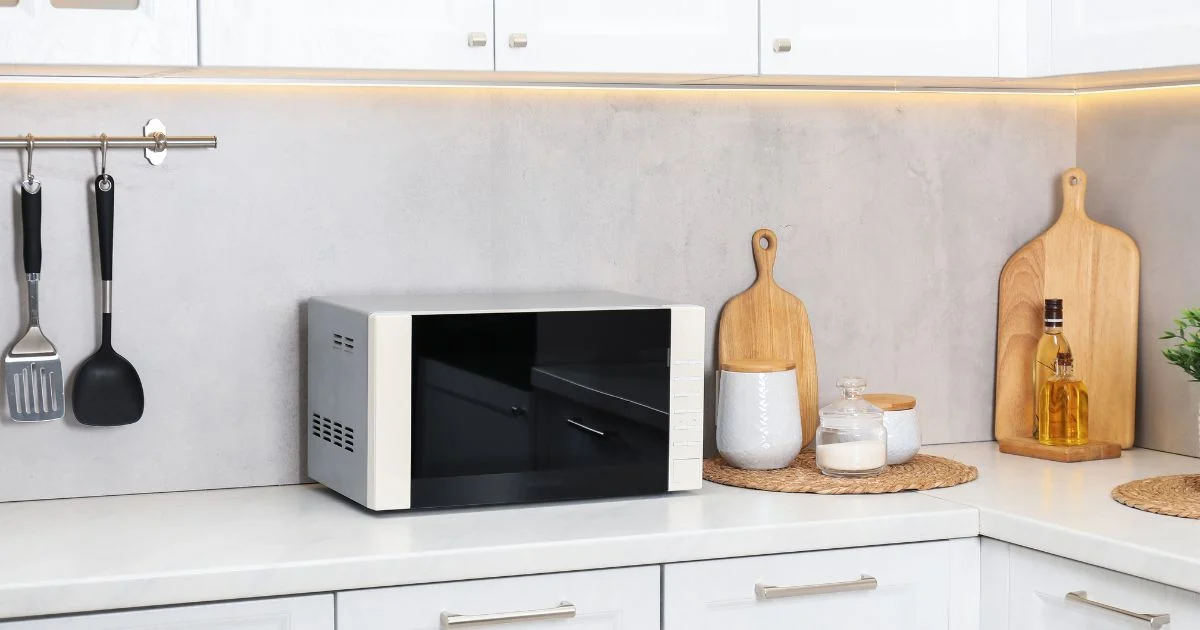
A microwave that looks slightly tilted, a coffee maker that shifts when you press a button, or a small appliance that is never perfectly steady: the issue does not necessarily stem from the device itself. The countertop, table, or shelf on which it rests may have a tiny irregularity almost invisible to the naked eye. To spot it, a very simple trick can be used: one or more coins. Slipped temporarily under one of the appliance’s feet, they help reveal a potential level difference and estimate its magnitude.
The coin technique to realign the microwave
The principle relies mainly on the regular thickness of coins. When an appliance sits properly, each of its feet should normally be in contact with the surface. If it wobbles slightly when pressure is applied to one side, there may be a small gap beneath one of its support points. A coin can then serve as an improvised gauge. If it exactly fills this gap and the appliance stops moving during the test, that indicates that a height difference does exist at that spot. The goal is not to permanently fudge the setup, but to identify precisely the source of the instability.
This method can notably be used with a coffee maker, a small microwave, or certain relatively light and easy-to-move household appliances. It is enough to place them in their usual spot, then gently check whether they wobble. When one of the feet seems slightly detached from the surface, you can slide a coin underneath and observe the result. If the movement persists, a second coin can help assess an slightly larger gap, according to the site El Cronista. The number and thickness of the coins thus provide an approximate indication of the compensation needed to bring the appliance back to a perfectly horizontal position.
The right support to permanently stabilize your microwave
This check might seem trivial, but an uneven surface can prove troublesome in use. A coffee maker that is poorly positioned can move when handling its reservoir or its filter holder, while a small device set askew may shift slightly with each use. Before blaming the feet or the structure of the equipment, the coin test helps determine whether the problem simply stems from the support. A slightly warped table, a misaligned work surface, or a worn surface can be enough to create this small imbalance.
However, coins should be considered a diagnostic tool rather than a permanent solution. Even if the appliance appears stable once a coin is slid under its foot, it is wiser to then correct the issue with a device truly designed for this purpose. An appropriate shim, an adjustable foot, or a non-slip pad can offer better long-term stability. A metal coin can indeed slide, move during cleaning, or eventually fail to support the foot properly. Its main value remains to quickly measure the space to be corrected before opting for a more reliable installation.
A method reserved for lightweight devices like microwaves
Caution is also warranted depending on the type of equipment involved. This method is best suited for small, relatively light devices that stay stationary during operation. It is much less suitable for heavy equipment, machines that generate strong vibrations, or devices prone to moving. In such cases, it is preferable to directly use the adjustment systems provided by the manufacturer or accessories specifically designed to support the appliance’s weight. After any adjustment, the device should remain perfectly stable, with no perceptible tilt and no foot left without solid support.
Placing a few coins under a microwave or a coffee maker is not meant to create a makeshift installation. This trick mainly aims to reveal a small level difference that would be hard to identify otherwise. Easy to find and of constant thickness, the coins provide a practical reference to evaluate the space under a foot and understand where the wobble comes from. Once the irregularity is identified, they can be removed in favor of a shim or proper adjustment. A rudimentary test, but useful before carrying out a more durable correction.
