
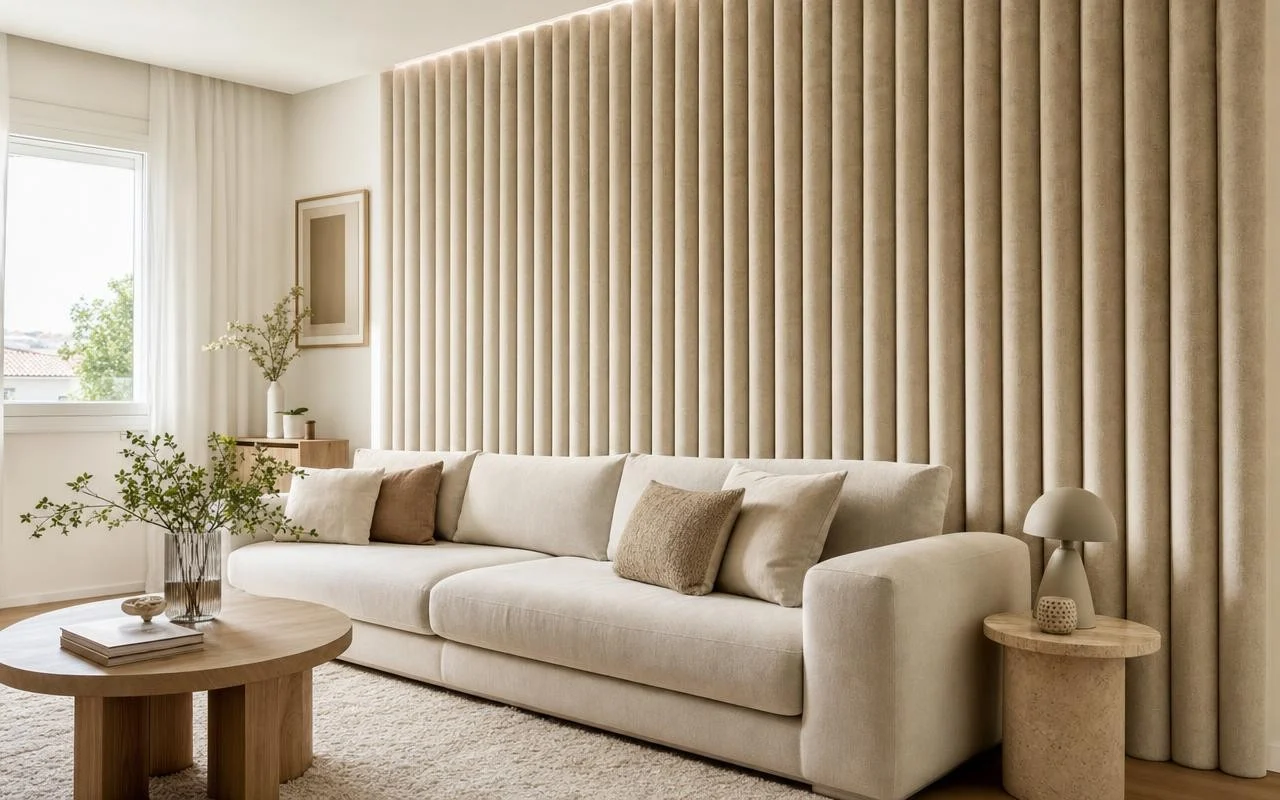
A simple pool toy that transforms into magazine-worthy decor: that’s the idea, a touch audacious on paper, which is making waves on TikTok and at design sites. By attaching pool noodles to a backing and then covering them with fabric, some creators achieve a pool-noodle accent wall that echoes the fluted walls of luxury hotels, without heavy renovations or carpentry.
This trick, popularized by creator @lebeautyandrags and shared by outlets like Hunker or Homedit, works just as well behind a bed as in a reading nook or a home office. The idea appeals to both renters and homeowners, because the wall remains removable and modular. It all comes down to how these famous noodles are used.
Why this pool-noodle accent wall looks so chic
The principle rests on a very simple effect: pool noodles cut to the same height and aligned vertically create a regular relief, like half-columns. Once covered with a taut velvet fabric, they form a softly ribbed wall that feels lush to the touch, catches the light, and casts pretty shadows. Visually, it resembles high-end wood panels, but with lightweight and affordable materials.
Another advantage is that this system is built on a large thick cardboard panel or a similar rigid backing, which is then mounted to the wall. The décor becomes almost a large padded panel that can be moved or removed if you move. Tutorials show that gluing the noodles, then applying the fabric, can be completed in a weekend, yielding a result that’s hard to distinguish at first glance.
Materials and preparation for the pool-noodle accent wall
To succeed with this type of wall, it’s best to prepare the ground properly. Tutorials advise buying standard pool noodles in bulk, a large rigid cardboard panel (or an equivalent light panel), as well as two types of adhesive: a spray adhesive for large surfaces and a stronger glue for the recesses. For the textile, velvet provides an immediate cozy and sophisticated touch, but cotton or linen give a more natural look, while a sturdy nylon can suit a playroom. The authors warn against overly thick upholstery fabrics, which are hard to drape neatly.
- Sufficient quantity of pool noodles, all of the same diameter
- A large rigid cardboard panel or equivalent backing
- Spray adhesive and a strong multipurpose glue
- Fabric by the yard (velvet, cotton, linen, or another soft fabric)
- Utility knife or serrated knife, scissors, measuring tape, level, flat metal tool for tucking the fabric
Once the wall is measured, transfer the height to the panel and cut each noodle to the correct dimension with a craft knife or a serrated kitchen knife, as the guides suggest. The noodles are then glued side by side on the cardboard, tightly pressed to avoid gaps. When everything is dry, the panel is fixed to the wall according to the nature of the surface. Some tutorials propose a more comfortable variant: dress the noodles with fabric while the panel is laid flat on the ground, to limit climbs up and down a step ladder.
Lay the fabric and elevate the pool-noodle accent wall
For the finish, creators often begin by firmly gluing the top edge of the fabric, then let it drape down the full height. A caulk gun or a bead of glue along the top of the wall helps to secure the textile. They then smooth it over the noodles, spraying more spray adhesive, before tucking the fabric between each noodle using a flat metal tool. A stronger glue is used to secure the textile neatly in the recesses, so that it does not protrude over time.
Once the surface is covered, the excess fabric is trimmed at the bottom with scissors, then the edge is glued for a clean finish. Some DIYers, noted by Homedit, add slim wooden moldings around the perimeter to frame the panel, which enhances the “custom-made room” effect. Deep colors for a hotel vibe, natural tones for a living room, a half-wall behind a bedhead, or a full panel—the concept remains the same. With a few pool noodles, a nice fabric, and a little patience, a plain white wall can dramatically change its look.
