
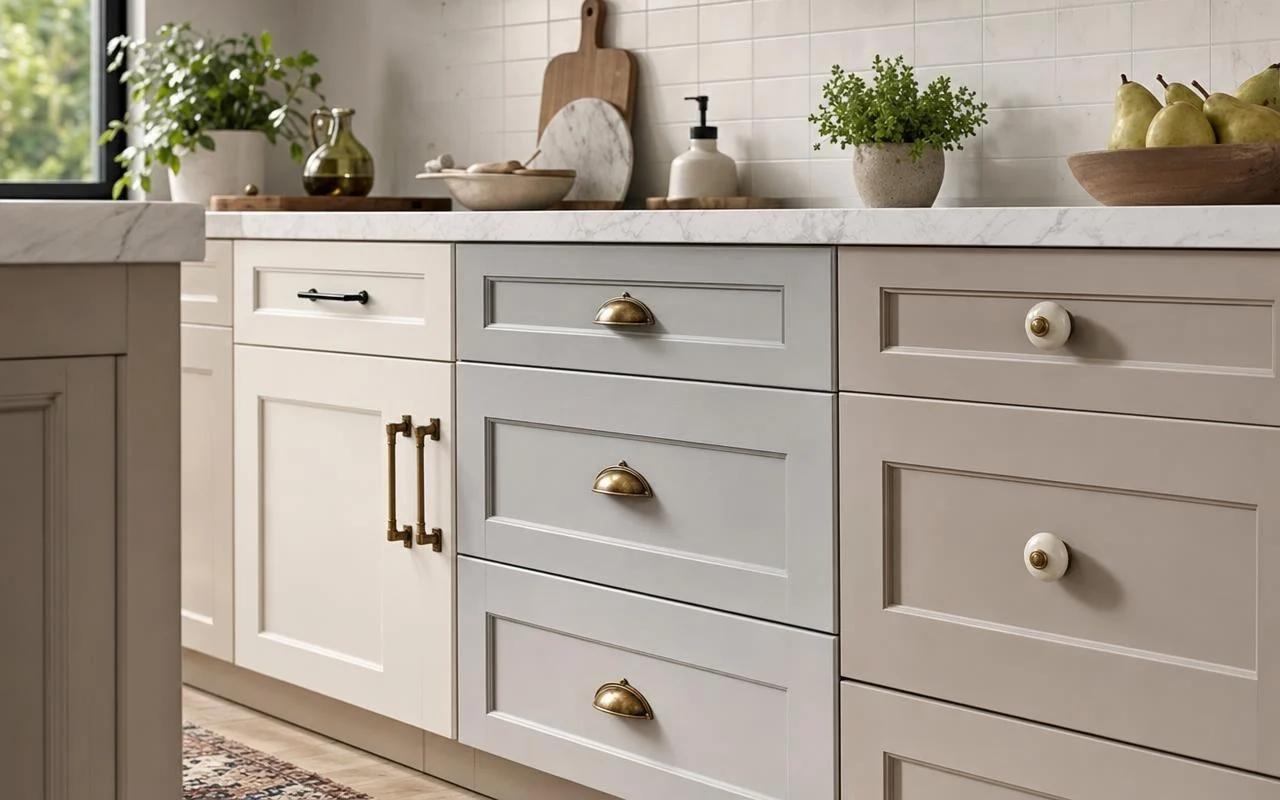
Replacing the handles in a kitchen may seem trivial, until the day you end up with a blend of knobs, bars, and mismatched handles that don’t quite go together. The result can quickly resemble a homemade fix rather than a deliberate décor decision. Yet, this mix is very fashionable: the challenge is to make it intentional.
For a long time, kitchens were designed around the principle of everything matching, with every hardware element strictly identical. Times have changed: people now seek more personality, warmth, and even that hint of eclectic charm that animates the space. “Handles can fade into the background, but it is they who affirm the style of your kitchen,” notes Ecocuisine, which offers more than 40 models. And that’s where it all begins.
Mismatched kitchen handles: diagnosing the right approach
The question isn’t whether you can mix handles, but how to avoid a patchwork look. A random jumble stacks up too many shapes, metals, and size gaps without a clear logic. An eclectic result, on the other hand, rests on a few simple rules: repetition, coherence, and visual rhythm. In other words, your handles should feel selected together, even if they aren’t identical.
A first step is to take in everything that already exists in the room: faucet finish, visible appliances, lighting, chair legs. Many specialists advise not to exceed two different metals within a single kitchen. One metal becomes the base, the other a highlight. Profiled handles or handleless fronts, offered by Ecocuisine, can even act as breathing spaces.
A guiding thread and proper proportions for mismatched handles
For mismatched handles to remain harmonious, there must be a guiding thread. The most accessible is the finish: all brushed brass, all matte black, or all satin stainless steel, even if the shapes vary. You can also choose the same overall silhouette, for example slender bars, and simply vary the length or orientation. The idea is to belong to the same visual family.
Size also plays a major role. A good rule of thumb is to pick a pull that measures about half, or a little less, of the drawer width, and not more than a third of the height of a cabinet door. On large pot drawers, a longer handle is more comfortable; on small doors, a simple knob suffices. Testing by sticking paper templates helps verify balance before drilling.
Zone the kitchen to give meaning to a mix of mismatched handles
The final lever to ensure your mismatched kitchen handles are clearly intentional: organize the hardware by zones. A common layout is to place knobs on the upper cabinets, horizontal pulls on the lower drawers, and perhaps a bolder model on the central island. This layout immediately tells a story, preventing the impression of a random lot of handles bought without a plan.
To go further, you can draw inspiration from a few proven pairings. Country-house vibe: white porcelain knobs on the upper cabinets, aged brass handles on the pot racks. Industrial style: brushed stainless bars on the drawers, matte black knobs on the columns. In a very contemporary kitchen, you can combine discreet integrated profiles with minimalist knobs, all in the same finish, for a highly controlled result.
