
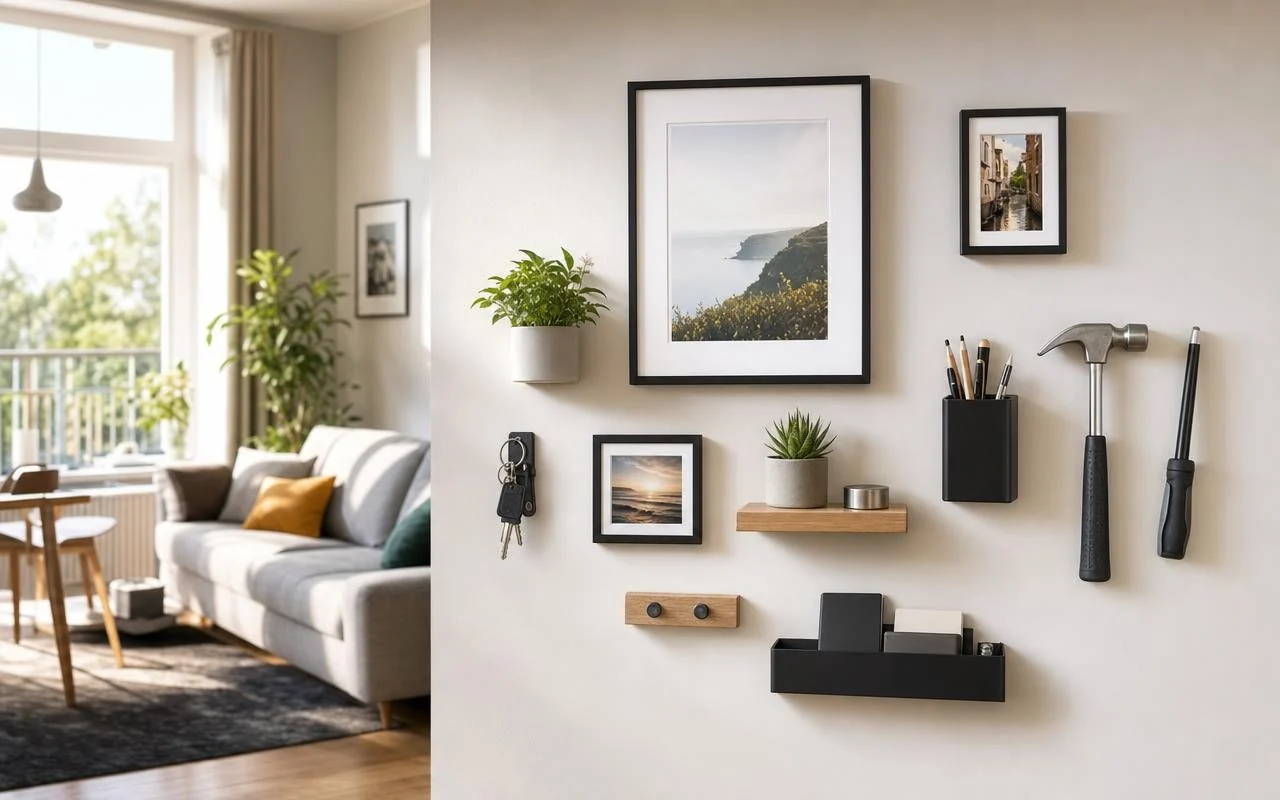
Getting out the drill, covering the furniture, vacuuming the dust, and re-plugging holes at the next move… hanging a simple frame can quickly turn into a construction project. For many tenants, even contemplating a single anchor is out of the question, for fear of losing a deposit that is already quite fragile.
Argentine industrial engineering student, Marco Agustín Secchi, 29 years old, wants to change this daily routine with IronPlac, a magnetic cement that turns the wall into a magnet-friendly surface. The idea: fix and move objects and accessories without drilling, nails, or screws. The question remains how this magnet-friendly wall actually works in a home.
IronPlac, a magnetic cement that makes the wall ferromagnetic
IronPlac presents itself as a ferromagnetic coating close to a traditional plaster. In powder form, it blends minerals and iron particles; you mix it with water, then apply it to a brick or plaster wall with the same technique used for conventional plaster. Once dry, it leaves a smooth surface that can be painted or covered like any interior surface.
The Argentine press mentions two formats under consideration: a plaster-for-construction “wet” version and drywall panels integrating IronPlac for dry walls. In all cases, the difference with magnetic paint is the thickness of the coating. Where paint creates a thin layer, IronPlac forms a thicker layer, with many more metallic particles available for magnets.
How to hang without drilling: the role of magnets and the possible loads
The treated wall does not become a giant magnet. It remains a passive ferromagnetic surface, meaning it responds to the field created by magnets attached to the objects. The adhesion force mainly comes from these magnets, which “catch on” to the iron particles contained in the coating. This avoids a permanent, intense magnetic field in the room.
According to initial laboratory data cited by specialist media, IronPlac has allowed objects to be supported up to about 2 kg per anchoring point, including hand tools. The technical objective announced is to reach 10 kg per point. This result depends on the type of magnet used, often strong neodymium magnets, the contact surface, and the number of support points distributed on the object.
A project still in development, with limits before it reaches you
The IronPlac project remains in the development phase. Marco Agustín Secchi collaborates with teams from the Universidad Católica de Salta and the Universidad Nacional de Salta to characterize the material: mechanical strength, behavior under humidity, corrosion resistance, and compatibility with existing systems. Patents have been filed and international protection is being considered, while the student seeks funding to move toward industrial production.
Before imagining a magnetizable wall in every living room, several obstacles are clearly identified:
- Obtaining approvals and complying with building standards in each country.
- Offering a cost per square meter that is competitive with traditional coatings.
- Equipping objects with supports or magnets suitable for the back of frames, shelves, or tools.
- Validating on-site the maximum loads supported and safety guidelines.
IronPlac remains for now a promising innovation rather than a product available in stores. If these steps are overcome, this technology could interest both tenants and workshops and offices, transforming whole wall sections into reorganizable surfaces at will, without a single drill hole.
