
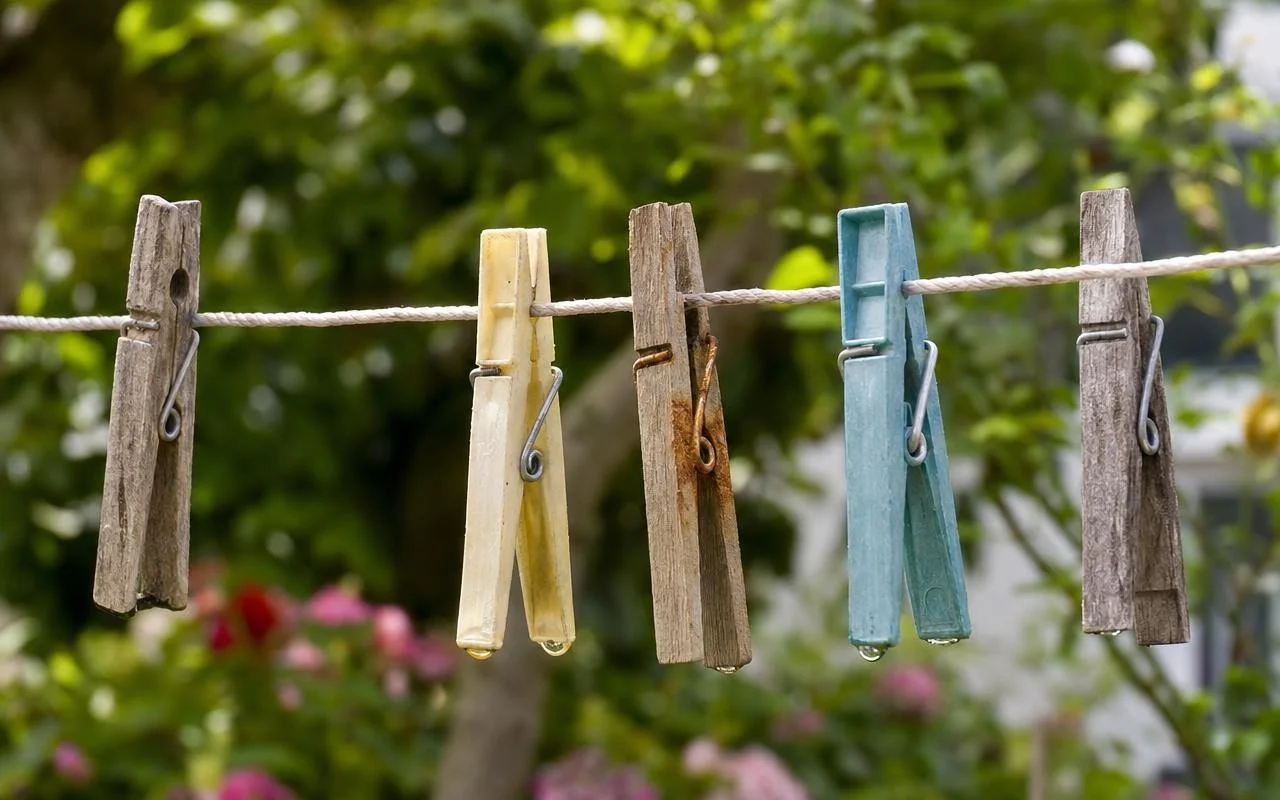
Do you leave your clothes pegs on the line, telling yourself it will save time for the next laundry? Many households have this habit, especially when the drying rack stays outside year-round. Yet, between the blazing sun, frequent rains, and the winter frost, these little accessories are far from indestructible.
Laundry brands, manufacturers, and even press articles have looked into the question: should you really bring the clothespins inside after every wash? Sun, humidity, material type, and the presence of a metal spring all change the situation. The answer isn’t the same for every pin or for every season.
Putting away clothespins: a good idea in most cases
Opinions converge: in the vast majority of situations, laundry-care specialists recommend bringing the pins inside after use. According to a 20 Minutes article, sunlight weakens plastic, humidity damages wood, and metal springs eventually rust. Guides for laundromats likewise remind that ultraviolet rays accelerate the aging of materials that are continuously exposed.
The instructions of certain manufacturers align with this. They advise against permanently storing the pins outdoors, to avoid direct light, and to regularly check their condition and temperature after exposure. A guide published by the Speed Queen laundries network notes that a wooden pin left outside all year may last about six months, whereas a pin kept dry indoors will last several seasons. The payoff: fewer breakages and fewer purchases in succession.
What concrete risks arise if you leave your clothespins outside?
For plastic models, long exposure to sun and UV makes the material harder and more brittle. The jaws can crack when pinching a garment, or even snap entirely during use. For wooden clothespins, humidity is the problem: the wood swells, stains, and eventually deforms or splits, especially if it endures repeated rain-sun or freeze-thaw cycles.
The most sensitive point is often the metal spring. Humidity and air cause rust, sometimes very quickly. The site La Buanderie directly links certain rust stains on clothes to rusted spring clothespins. These marks are hard to remove and can require a specific stain remover, or even render a textile unrecoverable. A corroded spring also becomes sharper, increasing the risk of a small cut when pinching or opening the clothespin.
How to store your clothespins easily after every wash?
Specialized sites in line-drying, such as Étendoir & Co or Aeraly, suggest a mini-routine that takes less than a minute. At the end of the drying cycle, you remove the laundry, take off the pins as you go, and group them immediately. A quick visual check helps identify those that snag, are cracked, or show early signs of corrosion, so you can set them aside before they stain the garments.
To make this habit automatic, several tips are frequently mentioned:
- keep the pins in a small basket or fabric bag, hung near the clothesline but sheltered from rain and direct sun,
- bring them inside systematically at the same time as the clothes, without waiting,
- group the pins with a string or ring to prevent them from falling or getting lost, as recommended by the site Maison-Initiative,
- set aside as soon as you notice cracked pins or those that are rusty clothespins.
There remains the question of pins advertised as “rust-proof” or “outdoor-grade.” Even for these models, the manuals generally recommend storage in a sheltered place during periods of non-use. Forgetting your pins outside for one night may not change everything, but dew or a sudden storm adds moisture: better to let them dry and then check the spring before placing them back on a light garment. In the long run, bringing the clothespins in after every wash clearly extends their lifespan and reduces the risk of surprises on your laundry.
