
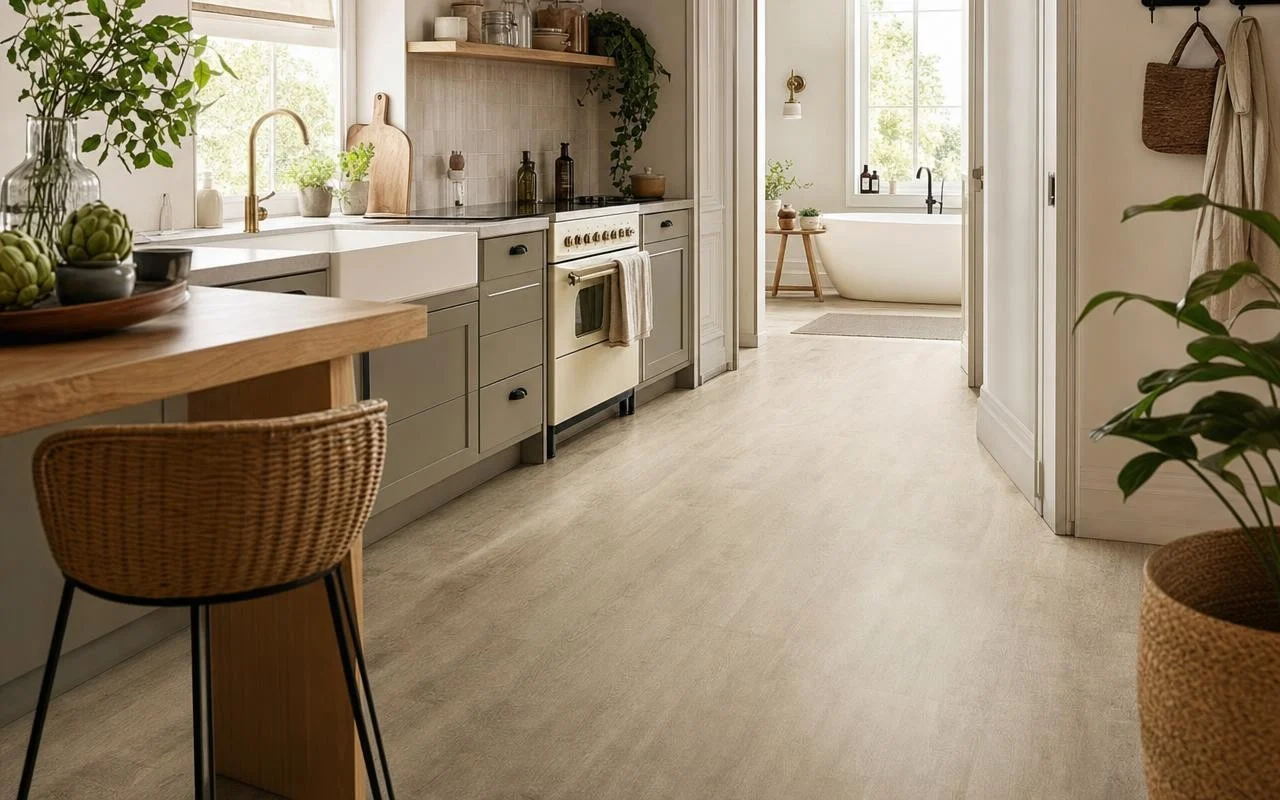
In many interiors, the same scenario repeats itself: a wood-look laminate floor laid everywhere, practical yet fragile as soon as water comes into play or the kids play a little too hard. In recent years, another flooring option has quietly taken its place, driven by kitchen and bathroom renovations.
This newcomer, the vinyl flooring (often referred to as PVC flooring, LVT or SPC), promises better moisture resistance, superior comfort, and very realistic decors. Without turning away from laminate progress, more and more households are turning to this material that better withstands real life.
Vinyl flooring or laminate: a difference in material that changes everything
The divergence starts inside the planks. The laminate rests on a core of high-density wood fibres (HDF) compressed. If water seeps through the joints and reaches this core without proper protection, it can absorb water, swell, and warp the edges. Over time, the floor buckles and the joints fatigue.
The , on the other hand, is mainly made of PVC, much less sensitive to water. Hence its success in damp rooms. Some manufacturers have also evolved laminate. “I think laminate flooring will make a big comeback in 2026. It is very durable, water-resistant, and the new decors look much more realistic than the older versions,” explains Paul Henthorn, president of Slaughterbeck Floors. He estimates its current price between 2 and 5 dollars per square foot, or about 19 to 49 € per m² before installation, recommending AC4 or AC5 ranges for highly trafficked areas.
Why so many households are switching to vinyl flooring
In practice, a portion of homeowners shifts from laminate to vinyl for a simple reason: daily moisture management. Vinyl handles repeated kitchen splashes better, puddles around the shower, or wet shoes in the entryway. Some professionals remind that “moisture resistant” does not mean suitable for a shower or a terrace without careful checking of the technical data sheets.
Comfort also matters in this movement. Many PVC collections offer a warmer and quieter feel underfoot, especially with an integrated acoustic underlay; some products claim a noise reduction of around 16 to 19 dB depending on the manufacturer. Maintenance remains straightforward: mop or wipe with a slightly damp cloth and a neutral detergent, following each brand’s instructions. In terms of style, ranges imitate oak, light stones, or concrete with a wide variety of formats, up to XL interlocking planks.
Going from laminate to vinyl: the right moves for a durable floor
Durability depends not only on the material but also on the chosen wear layer. For laminate, professionals advise a minimum of AC4 for living rooms or hallways, AC5 for high-traffic areas. For vinyl in the LVT or SPC category, you should look at the wear layer thickness (for example 0.3 mm in a bedroom, 0.5 mm in a hallway) and the usage class (series 23, 32, 33 for intense traffic), as indicated by specialized manufacturers’ guidelines.
Before replacing a laminate floor with PVC, the subfloor deserves a thorough inspection. Paul Henthorn cautions: “Moisture is one of the most important elements to keep in mind. Laminate is water-resistant, but very humid areas require particular attention.” Vinyl specialists share the same message and recommend checking:
- the flatness of the subfloor and the absence of cracks or crumbly old skim coats;
- the possible presence of moisture or rising damp;
- compatibility with the old underlayment if it isn’t removed;
- the final floor height relative to doors and skirting boards;
- the need for a perimeter expansion gap to allow the material to move.
The choice of installation system also affects durability. Some vinyl floors come in glued sheets, others in tiles or planks—LVT/SPC clip-together, installed as a floating system like laminate. Clip systems simplify renovation, but their joints remain a sensitive point in the event of significant water damage: water can seep between the planks, reach the underlayment or the slab, and damage the whole structure if the problem persists.
In homes with children, pets, and heavy foot traffic, many now opt for a vinyl floor in the kitchen, entry, hallway, or bathroom, while sometimes keeping a high-quality laminate in bedrooms and drier rooms less exposed to impacts. Some even combine vinyl in wet areas and laminate in chevron patterns in the living room for style. The final check before buying: look at environmental labels such as PEFC, FSC, or EU Ecolabel for wood-based floors, and VOC emissions for PVC coverings, to balance durability, comfort, and healthy indoor air.
Sources
- Maison & Travaux
“Farewell to floating parquet: this laminate flooring of 2026 laid like this makes your home deeper and more elegant”
