
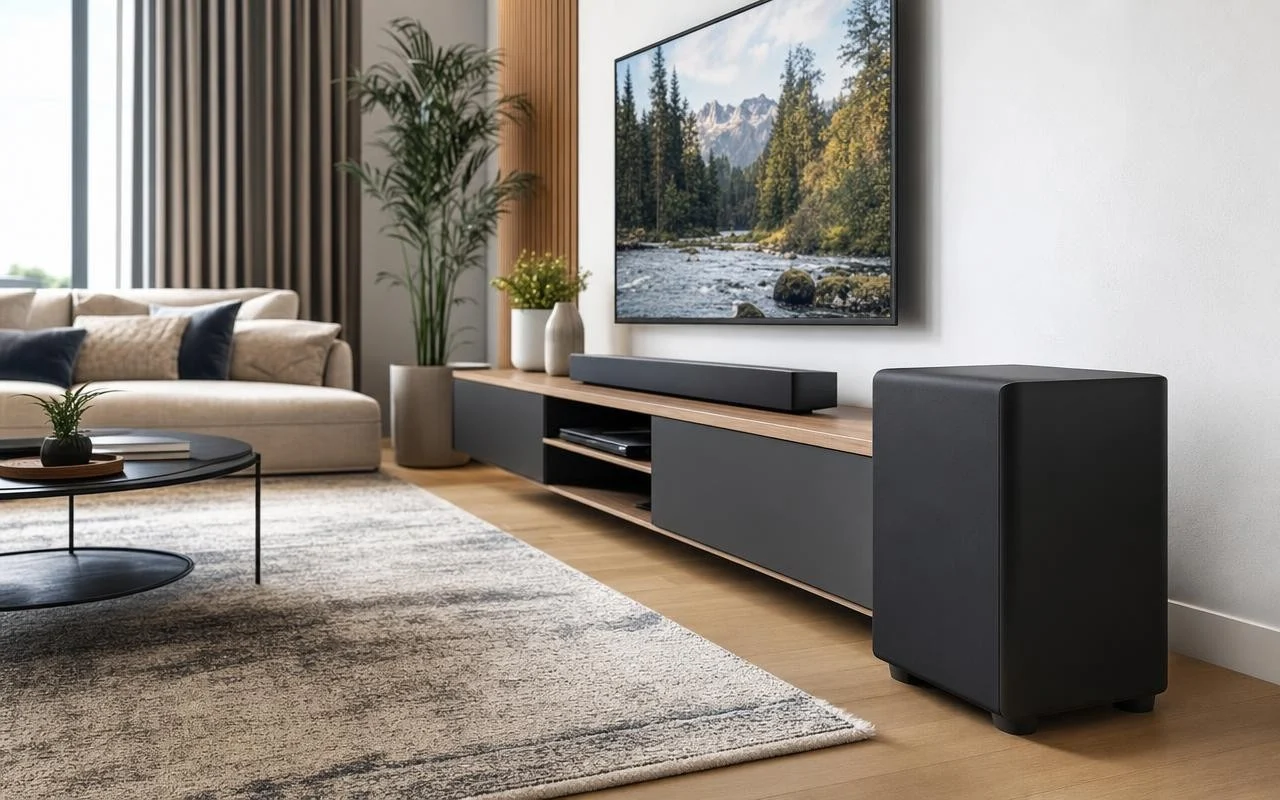
You’ve just installed your new home theater, everything connected… except the subwoofer. Should you place it next to the TV stand, in a corner, facing the sofa, toward the wall? The question of orientation keeps coming back, especially when you want to fully enjoy explosions, engine roars, and soundtrack details without turning the living room into a resonant box.
Domestic audio specialists agree on one point: a subwoofer does not behave like a traditional speaker. Our ears detect the direction of bass far less easily than midrange and high frequencies. And here’s a surprise: the real key isn’t where you’d expect to find it.
Aiming the subwoofer toward the sofa: is it really useful?
At very low frequencies, around 80 Hz and below, sounds become largely non-directional. Klipsch notes that these frequencies are hard to localize, which explains why many subwoofers remain credible even when hidden. BGR sums up this idea by explaining that “generally, most subwoofers are designed to transmit an omnidirectional sound, emitting low-frequency vibrations in all directions.” Pointing the speaker straight toward the sofa therefore often yields only a subtle change.
Another factor: brands specializing in audio, such as Teufel, indicate that orienting toward the listener isn’t a priority compared to choosing where in the room to place it. BGR adds: “As a result, you can usually point a subwoofer in any direction, as long as you leave about four inches (roughly ten centimeters) between the sub and other surfaces to limit reflections.” That small clearance around the unit has more impact on bass clarity than simply turning it 30 or 90 degrees.
Subwoofer placement: what really changes the bass in the living room
Where you place your subwoofer in the room, however, has a massive impact. Manufacturers like Teufel or Bose remind us that walls and ceilings create room modes: in some spots, waves reinforce themselves, in others they cancel out. The result can be huge bass in one corner of the seating area and almost nonexistent two seats away. Focal also notes that a subwoofer pressed into a corner benefits from a natural bass boost, sometimes perceived as several times stronger, but at the risk of a humming sound.
A solid starting point is to avoid both the exact center of the room and tight angles. ZDNET recommends testing a zone at the front of the room, between the front speakers, slightly away from the wall. Teufel suggests that for nearly square rooms, placing it at about a quarter of the room’s length and width helps limit pronounced resonances. These guidelines provide a framework, but your room will always have the final say.
A simple method to properly orient and place your subwoofer
To tailor all this to your living room, several manufacturers, like Bose, describe a highly effective empirical method, often called “subwoofer exploration.” The idea is simple: instead of moving the sofa, you move the subwoofer. Start by placing it at the main listening position, play a bass-rich music excerpt or a continuous test tone, then move around the room to identify where the bass sounds most homogeneous and precise.
- Mark on the floor the zones where the bass sounds both deep and readable.
- Then install the subwoofer at one of these realistic locations (near a wall, not in a doorway).
- Slightly rotate it and adjust the distance to the wall to quiet any buzzing.
- Finally fine-tune the level and phase settings on the subwoofer or the amplifier.
With two subwoofers, specialists like SVS often recommend placements in opposite corners or along the middle of the side walls to smooth the response across the listening area. Again, the orientation of each subwoofer matters less than the symmetry of their placement and keeping a bit of space around them. In practice, a few methodical trials are worth more than hours debating the ideal direction.
