
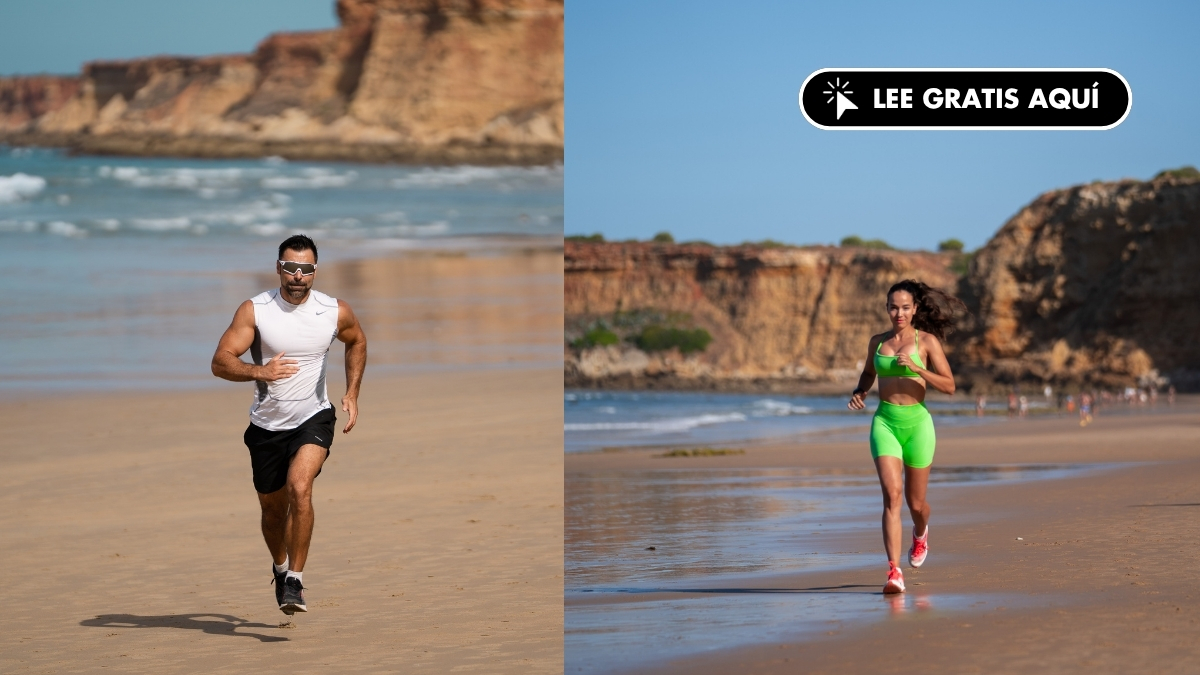
Taking advantage of vacations or beach days to stay fit and active is an ideal idea to ensure you don’t lose the results you’ve achieved during the rest of the year, but it’s important to know that training in the water goes far beyond a simple swim. As coach José Ruiz explained in an interview for THE OBJECTIVE, exercising in the sea offers many health benefits, both physically and mentally, thanks to that change of surface we’re used to.
The benefit of the sea that almost everyone overlooks
Unlike a gym or a pool where the floor is firm and you can perfectly control where you step and what you do, the sea presents a completely different environment where the waves create a continuous movement that makes things somewhat more unstable and unpredictable. And it is precisely in that lack of control where the great benefit that almost everyone overlooks lies: the constant work of balance and stability, since your body is constantly seeking it unconsciously. On this point, coach José Ruiz explains that “in the sea you are not on a surface completely controlled. There are waves, currents, changes of support and small constant disturbances. That forces the body to adjust posture, activate the core, stabilize the hips and better control the movement.” That is why practically all the muscles in your body strive to keep you upright and stable and work without you hardly noticing.
The joints do not get damaged
In addition to improving stability, moving within the water requires your muscles to stay in constant work so that the water does not carry you away too much. Therefore, even if you barely notice it, every time you take a step, move your arms, or try to move, your muscles must exert themselves continuously. Yet, despite the body working much more, the joints suffer almost no harm. As the coach José Ruiz notes, “one of the great benefits is that the joints experience less impact than in exercises like running, jumping, or training on hard surfaces.” For this reason, exercising on the beach is an ideal option for people who are overweight, stiff, or have joint discomfort, with mild osteoarthritis, or simply for anyone who wants to stay in shape in the summer without overloading their knees or ankles.
Six simple exercises to do in the water
To start training on the beach in a very easy way, the expert suggests several simple exercises you can perform in the water. You can walk with the water at waist height to build leg strength, or lift the knees one by one to move the hips and work the core. It’s also very useful to open and close the arms under the water to strengthen the chest and shoulders, take side steps to work the thighs and glutes, or do gentle squats taking advantage of the water to avoid loading the knees. Finally, you can perform gentle, controlled kicks in the water, holding onto a board or the edge of the pool.
Does the sea replace the gym?
Although training on the beach has many advantages, the coach makes clear that the sea does not replace the need to go to the gym. As Ruiz himself clarifies, “I wouldn’t say that the water completely substitutes the gym. The gym allows better control of loads, progressions, specific exercises, and strength stimuli.” Therefore, if what you’re looking for is to gain muscle or prevent your muscles from weakening with age, doing strength exercises remains absolutely necessary. The best option for the summer is to combine both: lifting weights or doing strength exercises two or three days a week and using the rest of the days to swim or take walks by the sea.
