
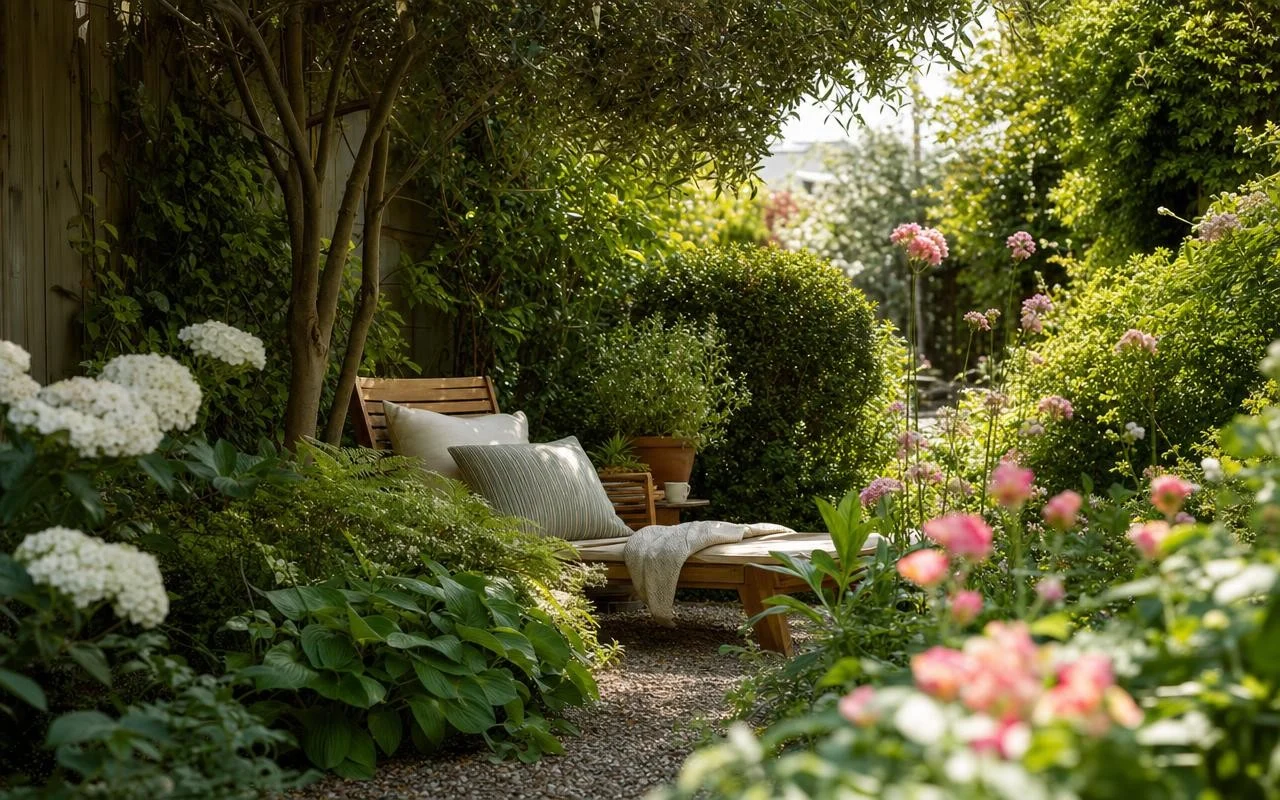
You think that a cozy corner in the garden requires buying plants, new flowerbeds, and a big budget? In many gardens, the ingredients of a true haven are already present: hostas that look bored along the path, shrubs that block the view, perennials crowded against one another. You simply need to see them differently, and above all give them a new role.
Reusing the plants you already own makes it possible to create a refuge in your garden without any digging or expenses. By reorganizing the plants into small clusters, moving those that crowd others out of the way, and paying closer attention to watering with the help of a simple pine cone, you can shape a very personal haven. The question then becomes: where to begin to transform what you already have.
Grouping and Moving Your Plants to Create a Refuge in Your Garden
First step: identify the plants that are thriving. Once you’ve made this selection, group them into small islands rather than leaving them isolated. A cluster of three to five clumps of hostas, lavender, or ornamental grasses catches the eye much more than a solitary specimen. Place these groups near a terrace, a bench, or a simple chair to create an initial nucleus for your relaxation corner.
Next, use the already tall plants to build a true living screen. Shrubs, ornamental grasses, and tall perennials can form a light hedge that blocks the view from the street or the neighboring house. Slide your seating inside this leafy U: you achieve a visual refuge without any renovation, simply by moving what already existed. In this framework, seven steps are enough to structure your haven of peace:
- Group the plants into harmonious islands.
- Create a living screen with the tallest plants.
- Install the seating at the heart of the foliage.
- Divide perennials that spill beyond the borders of the beds.
- Compose layers: back, middle, edge.
- Highlight the garden’s overlooked plants.
- Lighten maintenance with a very simple routine.
Dividing Perennials and Playing with Heights
Many perennials have thickened over the years. Instead of letting them compete, take the opportunity to divide them and expand your refuge. Hostas, daylilies, irises, or ornamental grasses respond very well to this treatment, especially in spring or autumn. With a clean spade, split a clump into several well-rooted pieces, then replant them to strengthen your islands around the resting area.
To emphasize the cocoon effect, arrange your plantings by height. The tallest elements in the background, shrubs or tall grasses in the middle, then the low-ground plants or ground-covering suspects such as thyme, potted mint, or small seasonal flowers at the edge. This layering makes the space feel more enveloping, while keeping walkways clear for easy movement.
Maintaining this Vegetation Refuge Without Spending All Your Time on It
A true refuge should remain pleasant to live in, not become a chore. For watering, keep the plants that handle your natural conditions well, then observe. A simple pine cone planted vertically about two centimeters deep at the base of a sensitive plant acts as a little radar: when its scales spread wide, the air is dry and it’s time to water more generously.
The pine cone mainly responds to air humidity, which can lead to a false alarm on a hot wind while the soil remains cool deeper down. Always supplement this signal with the finger test in the soil or, for more accuracy, a mechanical hygrometer. A regular pass to remove damaged stems, limit invasive plants, and refresh the mulch is then enough to preserve your oasis.
