
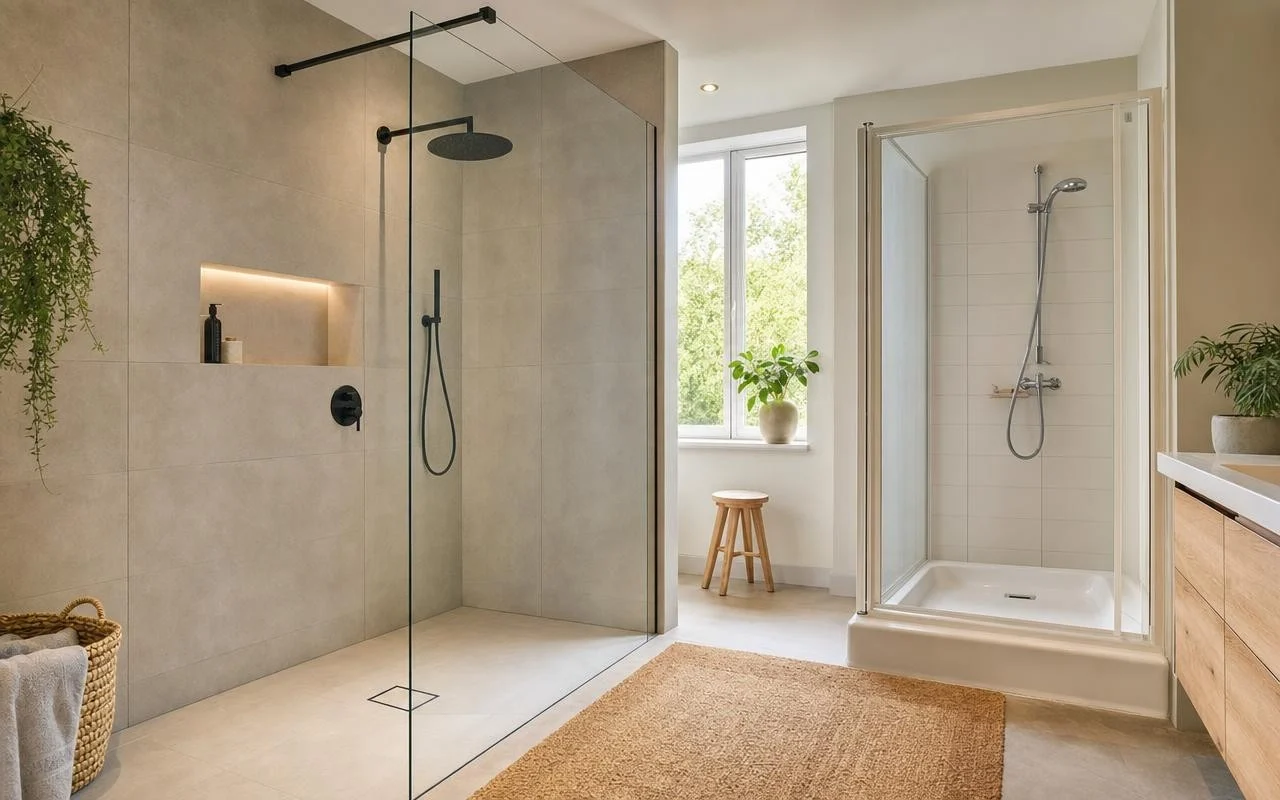
The raised shower tray has long been a staple of French bathrooms: a white tray, a small lip to step over, a glass panel that quickly gets dirty. In 2026, interior designers and builders describe a real turning point. In new builds as well as in full renovations, they are gradually seeing this model disappear in favor of a solution from Italy, deemed safer, more practical, and much more elegant, though not everyone yet knows what it is.
Signals are multiplying. The site Le Tribunal du Net speaks of an unequivocal verdict against the raised tray, caught by its safety and maintenance flaws. The Spanish media Okdiario confirms this trend and describes 2026 as the year when bathrooms massively switch to a level-access shower, flush with the floor, with a continuous tiling that visually enlarges the space. It remains to know whether your own bathroom is ready for this shift.
Why the classic shower tray is losing ground to the Italian walk-in shower
The criticisms directed at the shower tray are mainly about daily use. This small rise of a few centimeters between the floor and the tray causes regular stumbles, especially among those over 50. Le Tribunal du Net also recalls the chore of the glass panel, which quickly accumulates limescale, mold, and soap traces. “Interior designers are blunt about it, this format has had its day,” the article sums up.
The professionals cited by Okdiario share the same view. They explain that new bathroom projects aim to eliminate “unevenness and certain barriers that complicate access,” in order to ease life for seniors, children, and people with reduced mobility. When one must cross a wet threshold after stepping out of a narrow shower, the risk of slipping rises sharply, which pushes interior designers to rethink the whole way the shower space is designed.
How the Italian walk-in shower, the flat-floor model, works in practice
The Italian shower, also called the flat-floor shower or walk-in shower, directly addresses these criticisms. The principle: the floor of the shower area is at the same level as the rest of the room. There is no longer a visible tray, but a continuous surface, slightly sloped, that directs water toward a siphon or a recessed linear drain. Result: fewer obstacles, smoother flow, and a much cleaner look. Its main advantages are clear.
Visually, architects play a lot with the continuity of the finish. Some lay the same tiling throughout the room to enhance the effect, others instead mark the shower zone with a contrasting material. Le Tribunal du Net reports that, for them, the walk-in shower is no longer a luxury reserved for hotels or stylish lofts; it’s a logical evolution of the home. The new construction standards, which already favor low-threshold showers, are moving in this direction.
Budget and space: who is the Italian shower for in 2026?
In the field, masons and plumbers remind that the flat-floor shower remains a technical project. Le Tribunal du Net notes a higher cost than a classic tray, because you must create the slope, embed the drainage, and address waterproofing. Okdiario speaks of a renovation that requires more careful planning, ensuring that water is properly channeled.
That said, the traditional tray does not disappear overnight. Okdiario recalls that one cannot speak of its disappearance, but rather “a shift in the trend of bathroom design.” In small rooms or with a tight budget, it remains sometimes more realistic, even if it means choosing an ultra-slim tray to visually approach the Italian shower.
