
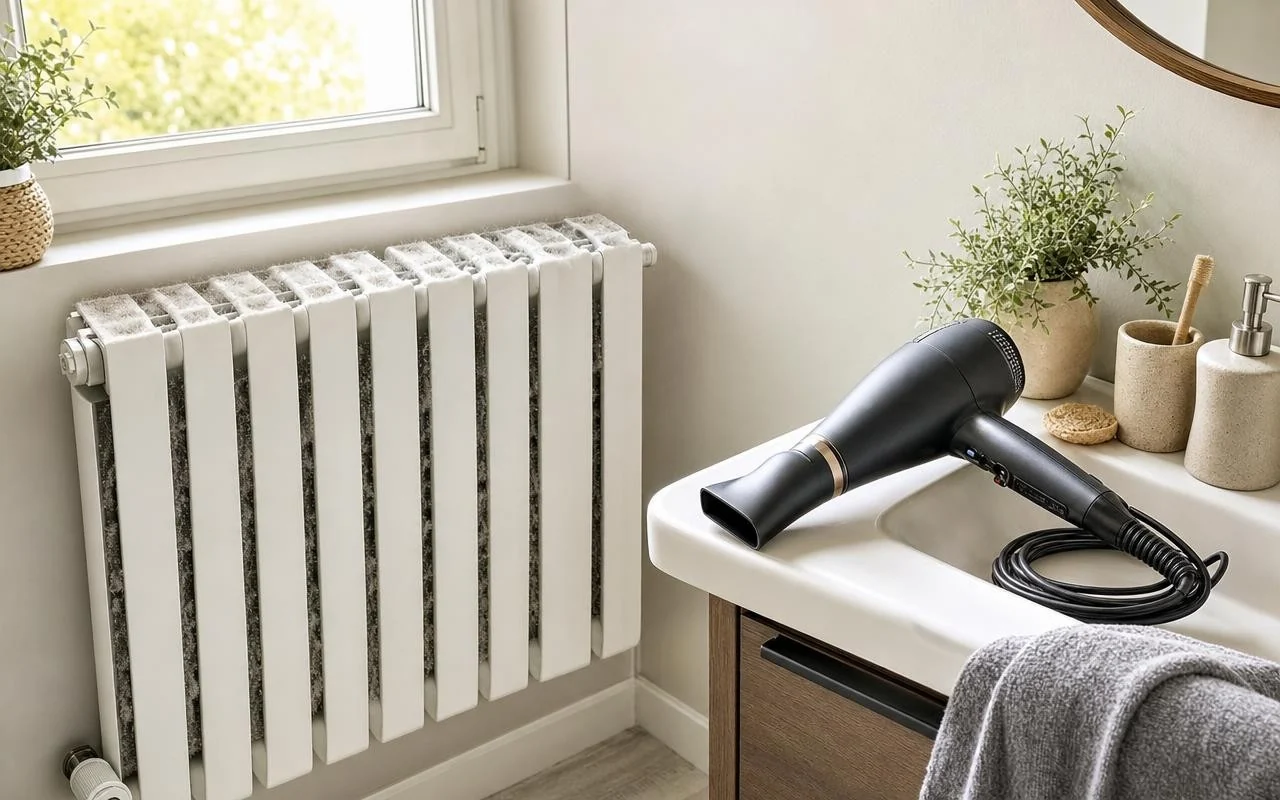
When the first cold spell arrives, many households share the same reflex: switch the boiler back on and consider bleeding the radiators. Yet, many plumbers report in the field that radiators that heat poorly are not always caused by air in the system, but simply… by accumulated dust. A problem far more mundane than a heating breakdown, but one that can really hinder the distribution of warmth.
Tradespeople interviewed by various specialized media explain that before pulling out the bleed key, they often start with a thorough dusting. And their secret is surprisingly simple: a hair dryer set to cold air, found in almost every bathroom, is enough to loosen the dirt stuck between the fins. A quick gesture that can change the situation in the room.
Radiator that heats poorly: what if the real problem is dust?
A radiator, whether it runs on hot water or electricity, heats the room by convection: warm air rises, cooler air descends and warms up upon contact with the unit. When dust, lint, or pet hairs accumulate in the gaps, this circulation becomes disrupted. The layer of grime acts as an insulating barrier, and heat spreads less effectively into the room.
The internal areas, hard to reach with a simple cloth, are the most affected. Several plumbers report that when dismantling an old radiator, they sometimes discover a veritable carpet of dust inside. This phenomenon appears over heating seasons, especially if only the front face is cleaned. Regular maintenance limits this buildup and helps the system operate more efficiently, without major work or complicated adjustments.
Cleaning a radiator with a hair dryer: the quick 10-minute method
To properly clean a radiator, the first rule is safety: the heating must be switched off and the unit completely cold. For an electric model, you also cut the power at the fuse box. Start by placing a large towel or an old sheet on the floor along the radiator to collect the expelled dust. The exterior surface is then cleaned with a slightly damp sponge and a bit of mild detergent, followed by a quick dusting with a feather duster in the accessible areas.
Once this initial pass is done, the hair dryer comes into play. Professionals recommend setting it to cold air and low intensity, to avoid blowing dust everywhere or overheating the metal unnecessarily. Direct the airflow from top to bottom, then toward the back of the radiator, focusing on the gaps and the internal fins. The dust falls onto the towel, which you simply shake outside, then finish with vacuuming around and beneath the unit. A final wipe with a damp cloth, thorough drying, and the radiator can be turned back on.
Bleeding or not a radiator: when the hair-dryer trick is no longer enough
Bleeding concerns only hot-water radiators and aims to drive out air trapped in the circuit. Dusting, on the other hand, targets surface convection. Specialist sites remind that there is not necessarily a need to automatically bleed a radiator every year. This operation is justified mainly in the presence of certain signs:
- bubbling or gurgling noises in the radiator,
- top part cold while the bottom is warm,
- radiator taking a very long time to heat up despite the boiler running.
If, after a careful hair-dryer cleaning, the radiator heats better and more evenly, it is often that the dust was the main enemy. On the other hand, if the top remains cold or if the noises persist, the problem probably lies with air in the circuit and bleeding becomes relevant, even requiring professional intervention. For an electric radiator, no bleeding is possible: if dusting does not change anything, the malfunction is more likely due to the unit itself and requires a technical diagnosis. Proceeding in this order allows you to rule out the simplest cause first before undertaking heavier work.
