
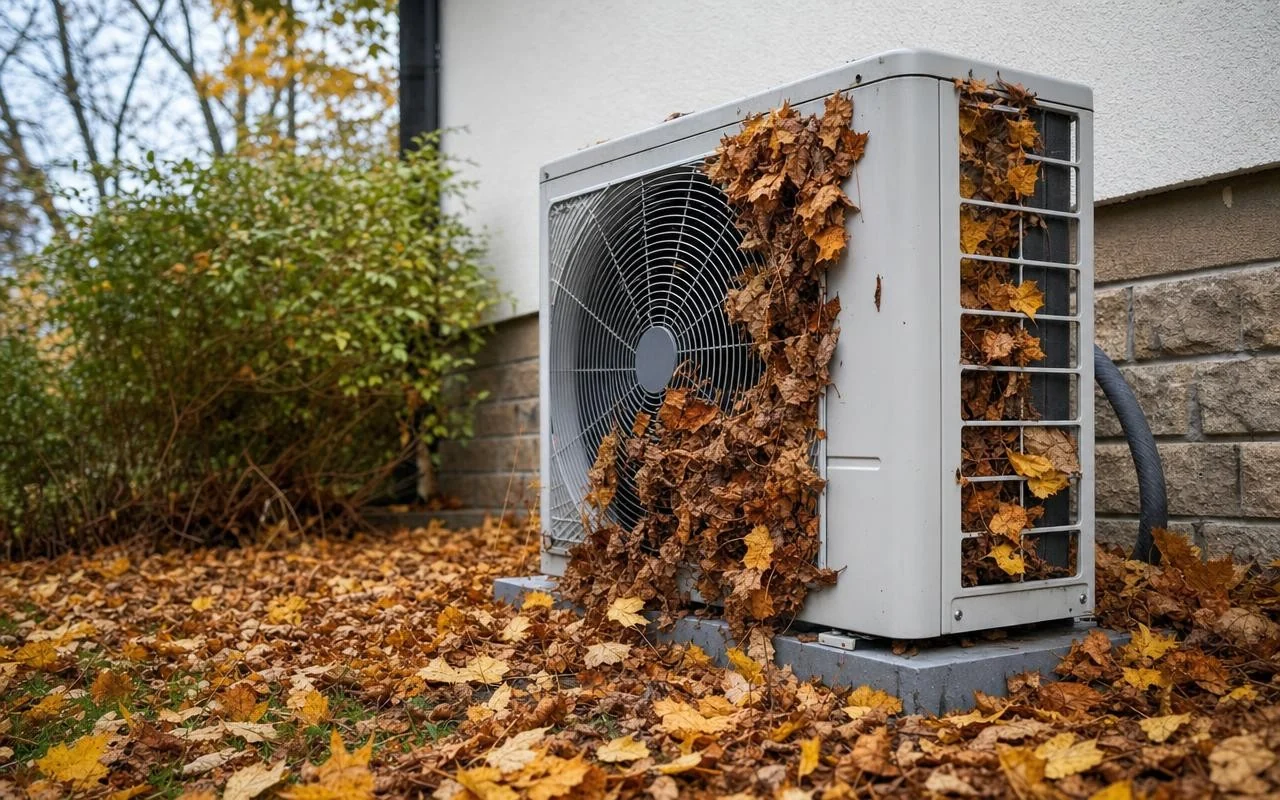
A windy night, branches snapping in the air, bins overturned… In the morning, you walk around the house: everything seems in order. The heat pump is running, the air is warm in the living room, no error message on the screen. Yet, one detail often goes unnoticed: the carpet of fallen leaves and debris stuck to the exterior unit.
Manufacturers and ADEME remind us that a device that is still functioning does not mean it is operating under good conditions. When the outdoor unit breathes poorly, consumption rises and wear accelerates, sometimes without immediate signs. It all happens quietly, around the fins and the fan.
Why leaves around the heat pump quickly become a problem
An air-source heat pump captures calories from outside air through an exchanger and a fan. For this transfer to occur properly, the air circulation must remain free in front of and on the sides of the unit. The guides from ADEME and ALISEE stress this point: air must be able to enter and exit without obstruction around the outdoor unit.
When leaves, conifer needles, or small branches accumulate against the grille, the air flows less well. The fan has to work harder, heating cycles lengthen and performance falls. Educational materials from AFPAC advise avoiding any obstacle around the heat pump, because this hindrance can lead to higher consumption and, in the long run, to malfunctions or to the system’s safety shutdown.
Signs that the outdoor unit is already clogged with dead leaves
First sign, purely visual: a heap of leaves pressed against the unit’s facade, debris lodged in the fins, or an accumulation creeping up to the level of the fan. After a gust or storm, debris tend to settle against such an obstacle. A quick glance after each windy episode helps identify these accumulations before they become problematic.
Other signals can alert you. The unit seems to run much more often than before for the same indoor temperature. The air blown inside seems less warm than usual. A slight rubbing noise may be heard when the fan touches a leaf stuck in place. In cold periods, an area of frost may extend abnormally on the exchanger. Taken in isolation, these symptoms have several possible causes; combined with visible leaves, they clearly point to a clogging issue.
The right actions after a gust of wind to clear the outdoor unit
Manufacturers’ recommendations, such as Atlantic, all align: simple, regular maintenance, doable by the user, is often enough to preserve proper operation. After a windy episode, a few minutes are sufficient to secure the area and clear the surroundings, without complex technical intervention or disassembly.
The basic steps remain very accessible:
- Manually remove, with gloves, the leaves and branches visibly stuck on the grille and at the base of the unit.
- Clear a free perimeter of at least fifty centimeters to one meter all around so that air can circulate properly.
- Avoid temporarily storing furniture, wood, or bins in front of or against the unit.
- Use a soft brush or gently blow dry air on the fins, without bending the blades.
- Skip the high-pressure cleaner, which AFPAC discourages, as it can deform the exchanger or push water into the components.
To limit accumulation, guides also suggest considering the immediate surroundings of the heat pump: avoid very close plantings, install only open, adequately spaced protections, and never enclose the unit in a closed housing. Manufacturers finally recommend monitoring for grease traces on the refrigerant connections or persistent mechanical noises; in these cases, the instruction is clear: a qualified professional should be called.
