
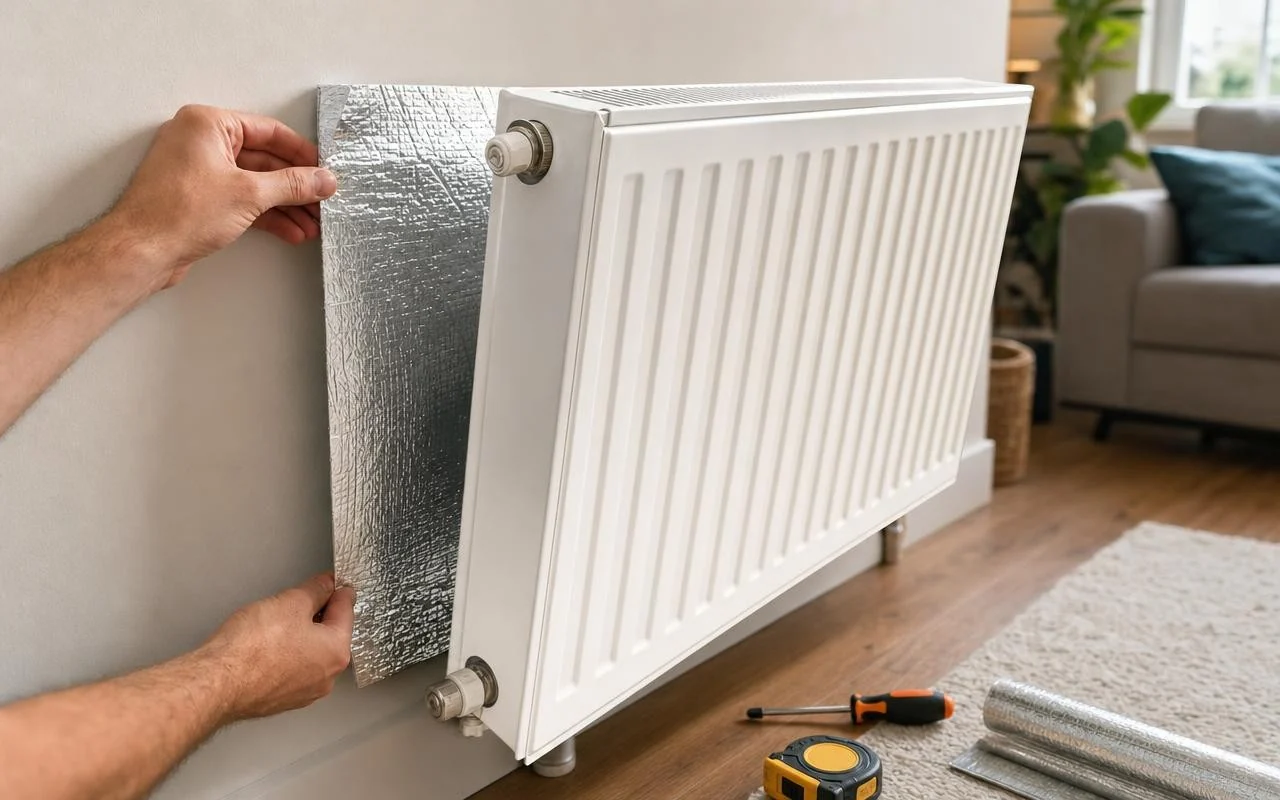
When the thermometer falls, many people study their radiators to figure out how to get more heat without the bill rising. The idea of placing aluminum sheets behind radiators has circulated for years, straddling the line between a genuinely smart move and an old-wives’-tale patched up a bit. Heating and thermal retrofit specialists have looked into it, with data to back up their assessments.
Behind this trick lie real products: reflective panels and films behind radiators, designed to limit heat losses toward the wall, especially when the wall faces the exterior. Several studies and public organizations have examined them, yielding interesting results but far from miracle promises. The key is behind the radiator.
Why a reflective film behind the radiator reduces heat losses
A water-based radiator doesn’t just heat the room’s air. It also emits infrared radiation, part of which is directed toward the wall. A report from the British Department of Energy indicates that a significant portion, up to about 20% depending on the radiator type and the temperature, can go backward toward the wall. If that wall faces outdoors or toward an unheated space, this heat ends up wasted outside despite your thermostat settings.
Reflective panels, typically a sheet of aluminum or metallized material glued to an insulating foam, act as a barrier. Placed between the radiator and the wall, they bounce the heat radiation back into the room and slow conduction through the masonry. The specialists cited by the media OkDiario describe a return of “up to 90% of infrared radiation back to the room.” A British report even calls these panels “infrared mirrors.” The expected result: the room’s temperature stabilizes more quickly at the same setpoint, and the boiler runs for shorter periods.
In which cases does a radiator reflector panel really save money
Energy guides, like PariEnergie in Belgium, agree: the benefit is real primarily for a water-based radiator mounted on an exterior wall that is little or not insulated, or against an unheated space (garage, cold stairwell). In this scenario, the guide suggests a heating gain of about 5 to 10%. The UK’s Energy Saving Trust notes, in its typical house assumptions, savings of around £18 per year in Great Britain and £20 in Northern Ireland, i.e., about €20–€25 per year. By contrast, CEREMA states that a reflector is almost useless on an interior partition or on a wall that is already well insulated.
A few quick questions help decide:
- Is the radiator fixed on an exterior wall or facing an unheated volume?
- Do you know whether this wall is poorly insulated (old housing, no recent insulation)?
- Is it a central heating water-based radiator, and not just an electric convection heater?
- Do you have at least a few centimeters between the back of the radiator and the wall?
If most answers are “yes,” the reflector has good odds of being useful. A study from the University of Sheffield does, however, remind us of an important point: by altering the air exchanges behind the radiator, the plate can slightly modify the convection on the room side. The radiator does not magically become more powerful; the real benefit is mainly seen in consumption at the same set temperature.
Choosing well and installing a reflective film behind the radiator
Not all products are created equal. The Energy Saving Trust clearly warns that “kitchen aluminum foil does not work,” due to its fragility, installation difficulty, and lack of insulating backing. Experts instead recommend a ready-to-use radiator reflector panel: a low-emissivity metallized sheet glued to foam or an insulating film, heat-resistant and durable. The specialists questioned by OkDiario add a bonus advantage: the presence of the panel reduces dark marks on the paint, often caused by the movement of warm air along the wall, and the surface cleans easily with a simple damp microfiber cloth.
Installation remains simple and without major work. Professionals advise first to dust the wall and the back of the radiator so as not to trap dirt. Then comes the precise measurement of usable width and height, to cut the plate so it does not visibly protrude. The panel is then fixed with high-temperature double-sided tape or with suitable magnets, as suggested by the experts cited by OkDiario, ensuring a small air gap between the radiator and the wall. For electric radiators, DIY guides remind to strictly follow the manufacturer’s instructions, not to stick anything to the unit itself, and to maintain safety distances around heating elements.
