
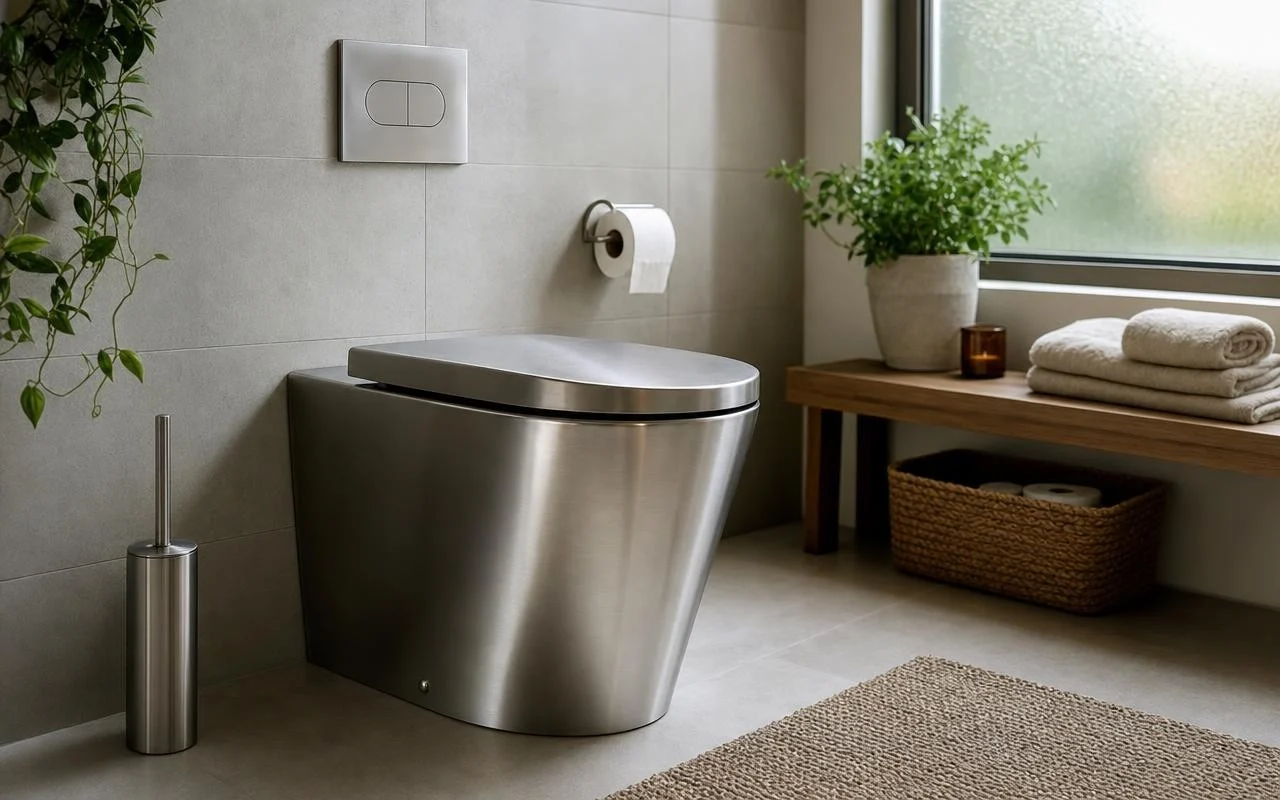
You can spot it in train stations, stadiums, and sometimes in prisons, but almost never behind the door of a family bathroom. Yet stainless steel ticks all the boxes on paper for the ideal toilet: sturdy, hygienic, and practically indestructible. It’s hard to imagine anything more reassuring when you’re looking for a toilet that can endure years, kids, and household cleaners.
Across from that, most of our toilets are made of vitreous china, a glazed porcelain. The site HouseDigest summarizes: “Most toilets you see today are manufactured from a material called vitreous porcelain. It’s a blend of porcelain and ceramic that offers a shiny, smooth surface, looks clean, muffles noise, and blends with most bathroom décors,” but this ceramic can eventually chip or crack. This raises the lingering question: if stainless steel is so robust, why don’t we see it in homes?
Stainless steel toilets: a nearly indestructible material, designed for hygiene
Technically, a stainless steel toilet is the stuff of dreams. HouseDigest recalls that, at heart, a stainless steel toilet would be practically indestructible. Stainless steel is non-porous, doesn’t readily harbor bacteria, and a smooth surface cleans with a simple wipe, without heavy scrubbing. In places where thousands of people circulate, this combination of durability and hygiene is priceless.
Specialist manufacturers, such as DELABIE, rely on AISI 304 stainless steel, described as “bacteriostatic.” Its model S21 P, a wall-mounted stainless steel toilet, uses a 1.5 mm thick sheet, compliant with EN 997 from a 4 L flush, weighing about 14 kg and carrying an advertised 30-year warranty. The indicative public price for 2026 is around €1,117.63 excluding tax, which clearly places this type of equipment in the heavy-duty category of sanitary fittings.
Why stainless steel toilets remain confined to public spaces
On PagesJaunes, stainless steel toilets are primarily presented for public venues: hospitals, prisons, highway rest areas, stadiums. Turkish models, either wall-hung or floor-mounted, are found, often “anti-vandal.” ArchiExpo also lists offerings largely aimed at architects and the tertiary sector, with monobloc bowls designed to resist shocks and attempts at damage.
Prices reflect this focus: about €350 for a stainless steel Turkish toilet, around €1,000 for a suspended bowl alone, up to €1,600 for a floor-mounted model with a tank. The shaping of a bowl from sheet metal of 1.2 to 1.5 mm, deep embossing, and anti-vandal finishes drive up the bill. To this is added the plumbing: many professional stainless steel bowls operate without a tank, using a direct flush of the flushometer type powered by high water pressure. The U.S. EPA notes that this type of device relies on mains pressure, a configuration more common in the tertiary sector than in a single-family home.
Maintenance, comfort and aesthetics: the limits of stainless steel in a family bathroom
The day-to-day reality, often decisive, remains. ISSF/World Stainless points out that products containing bleach and chlorides should be avoided on stainless steel, due to the risk of etching. Yet, in a household, these cleaners are common reflexes for disinfecting toilets. HouseDigest also notes that “human waste and urine generally have a low, slightly acidic pH. Over time, this will corrode a stainless steel toilet, leaving pits, rust, and unattractive halos.” To limit these marks, one would need to use mild products or specific stainless steel cleaners, not always easy to find and sometimes less disinfecting than desired.
Perception also matters: a metal bowl conveys a “prison/hospital” vibe that clashes with the idea of a cozy bathroom. HouseDigest reminds us that splashes, water marks, and fingerprints are more visible on a metallic surface, and the seat, being colder, can put people off. Many homeowners therefore prefer a high-quality vitreous porcelain bowl from a reputable brand like Kohler or American Standard, possibly paired with a soft-closing seat, a bidet kit, or an economical flush. With proper care using non-abrasive cleaners and avoiding harsh chemical overuse, this standard porcelain toilet can, according to HouseDigest, “last up to 50 years,” while remaining visually pristine.
