
On TikTok, a tiny house is making the rounds on screens: a few planks of wood, a simple roof, set in the middle of a plot. Behind these pared-down images, many envision a real life change, far from an overpriced apartment or a house bought on credit for thirty years. The lockdowns reinforced this desire to refocus, even if it means living in far fewer square metres.
This content creator, known by the handle @maddisonmcfie, did not buy her tiny house on Amazon, where micro-homes are now available for a few thousand euros. She chose a model outside those large platforms, delivered in several parts, which she assembled herself. Her videos chronicle the unboxing, the first screws, then the interior taking shape with her baby by her side. Little by little, one can sense that this block of wood hides much more than a mere sleeping space.
Tiny house off Amazon: a craze born from lockdowns
Manufacturers of miniature homes have seen demand climb in recent years. Thomas Longhi, designer of the Cahute, a 10-square-metre tiny house, told Le Monde: “I can only respond to one in fifteen orders now.” For many, these homes priced between 30,000 and 60,000 euros represent a tangible way to gain a roof over one’s head. All of this without going through a traditional construction site or taking on too heavy a loan.
Online, some tiny house kits show much lower prices, sometimes barely a few thousand euros. They inspire dreams, but remind that everything depends on the level of finish and the support offered. For Thomas Longhi, the scale remains reassuring: “It’s a small object that demands a reasonable financial investment. It doesn’t feel as daunting,” he summarizes. Between catalog models and more personalized projects, everyone seeks their balance.
In Maddison’s tiny house: a queen-size bed and a nursery
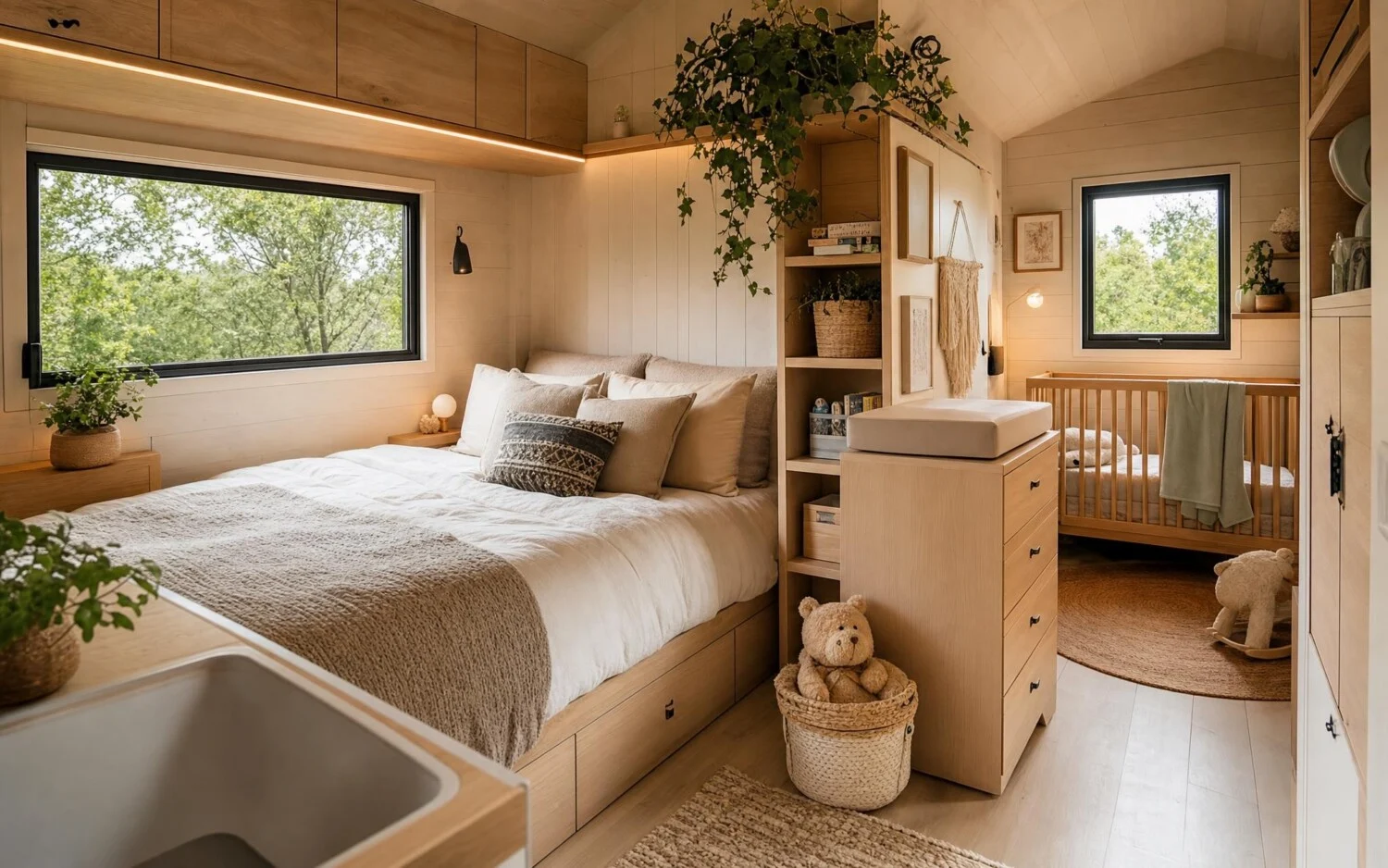
In Maddison’s case, the tiny house arrives in prefab panels and modules that she patiently assembles with her partner. We see her laying the frame, fixing the windows, installing insulation, then moving on to interior finishes. At the end of this human-scale build, the main bedroom offers enough space to place a queen-size bed and move around it. A detail that transforms this micro-living space into a true small family home.
Right next to it, a separate room is reserved for her baby, with a children’s bed and dedicated storage. To offset the space’s compactness, Maddison also opted for large openings that let in plenty of natural light. When a user writes to her: “My husband and I raised our son during the first eleven years in a 70-square-metre house and we loved it,” she replies: “Oh, that’s magnificent! I love that!”
Self-construction and an unconnected bathroom: daily life in a tiny house
Behind these very polished images, Maddison also shows what is less refined. She warns that not everything is finished, particularly the technical side. “Our bathroom won’t be connected for some time, but we’ve been used to that since our van,” she explains. Her past life living in a converted van helps to endure these small constraints, at least until the work is completed.
In the comments, many readers see themselves in this desire to live with less, but better organized. Some dream of installing a tiny house at the end of a family garden, others imagine a mobile retirement, like retirees who pull their lightweight habitat behind their car. Maddison’s videos join this movement where the tiny house becomes a way to have a private, personalized space, sometimes assembled with one’s own hands. And the presence of a queen-size bed in the middle of all this shows that the comfort of a full-sized home remains possible, even in a few square metres.
Sources
- Marie France
“I bought a tiny house somewhere other than Amazon and it’s so large that I have space to fit a queen-size bed.”
