
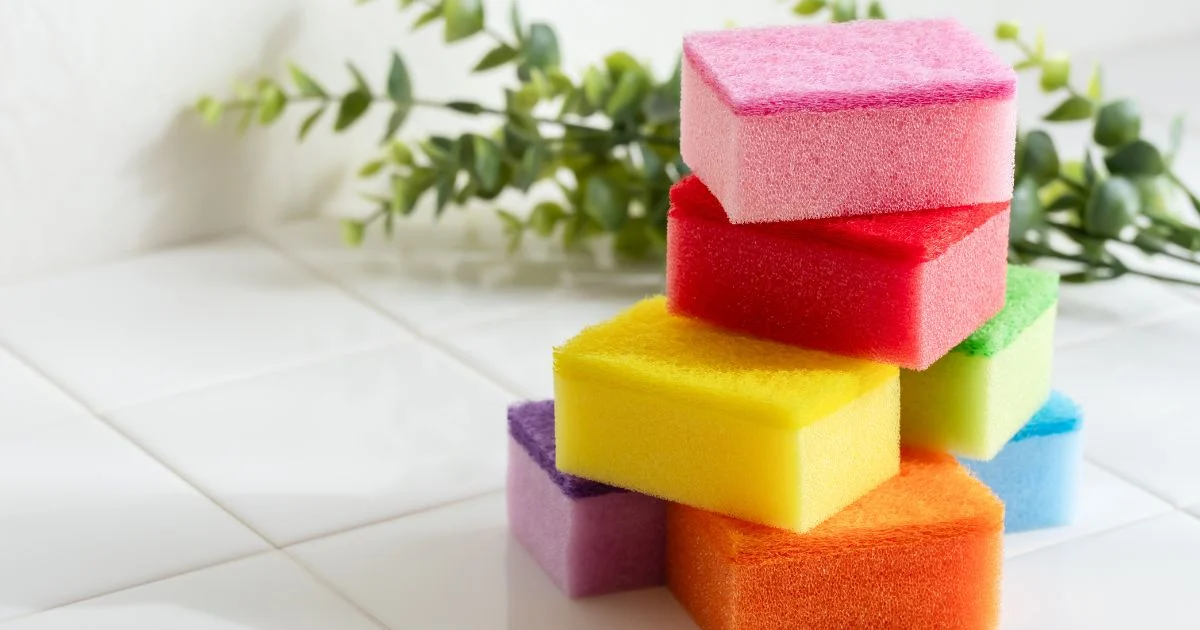
We often choose them out of habit, in bulk, or simply because they sit near the sink. Yet sponges are not distinguished only by their shape or price. Their color can also provide a valuable clue about their use. Behind a green, red, blue or pink scrub pad lies, in fact, a different level of abrasion. In other words, not all sponges scrub with the same intensity, and using them poorly can be enough to scratch a pan, dull a glass or damage a delicate work surface.
Sponges to reserve for the most ingrained dirt
Even before talking about color, you must distinguish two broad families. The washing sponge, often plant-based and highly absorbent, is mainly used to clean, wipe or absorb liquids without harming surfaces. It is useful for chores, small domestic accidents or surfaces that require simple cleaning. The scrubbing sponge, on the other hand, is the one most commonly found in the kitchen. It associates an absorbent part, usually yellow, with a colored pad that is more or less abrasive, tasked with lifting residues, fats or embedded dirt.
It is precisely this colored pad that should attract attention. Green sponges, very common, are also among the most abrasive. They are effective for getting rid of stubborn marks, baked-on stains on gratin dishes, oven grates or pots where food has stuck, reports the site Ça m’intéresse. Their scrubbing strength makes them good allies for tough cleaning, but they are not suitable for all surfaces. On a non-stick pan, a delicate glass or a fragile coating, they can leave micro-scratches, or even alter the material after repeated use.
Delicate surfaces require gentler sponges
The red sponge generally sits in an intermediate category. It is designed to scrub, but with less aggression than the green sponge. It can be useful on certain surfaces that require serious cleaning without putting up with a too-hard pad. Stovetops, some worktops or less ingrained grease traces can thus be cleaned with greater caution. The idea is not to replace the green sponge entirely, but to reserve each color for the right use to avoid unpleasant surprises.
For delicate surfaces, it is better to turn to blue or pink sponges. Their pad is much softer, which makes them suitable for fragile dishware, fine porcelain, wine glasses, crystal or non-stick pans. They are designed to clean without scratching, even if that sometimes requires a bit more patience when dirt is well stuck. A yellow sponge without an abrasive pad can also be suitable for the gentlest tasks, especially when simply wiping or washing without scrubbing.
Mistakes to avoid with kitchen sponges
Choosing the right sponge is not enough: you also have to take good care of it. After each use, it should be rinsed with hot water, wrung out, and left to dry in the air, away from a damp area where bacteria proliferate easily. A regular cleaning with white vinegar or in the dishwasher can help to limit unpleasant odors. It is also possible to microwave a damp sponge for one minute to disinfect it, provided it contains no metallic elements. On hygiene matters, it is also better not to keep it for too long.
A sponge, even well maintained, is not meant to last for months. To maintain good effectiveness and limit health risks, it is recommended to replace it regularly, ideally every two weeks. This small gesture helps prevent a cleaning accessory from becoming a source of dirt itself. Ultimately, the right sponge is not the one you grab at random, but the one whose color matches the surface to treat. Green for strong scrubbing, red for rubbing with moderation, blue or pink for preserving delicate materials: a simple detail, but one that can prevent many damages.
