
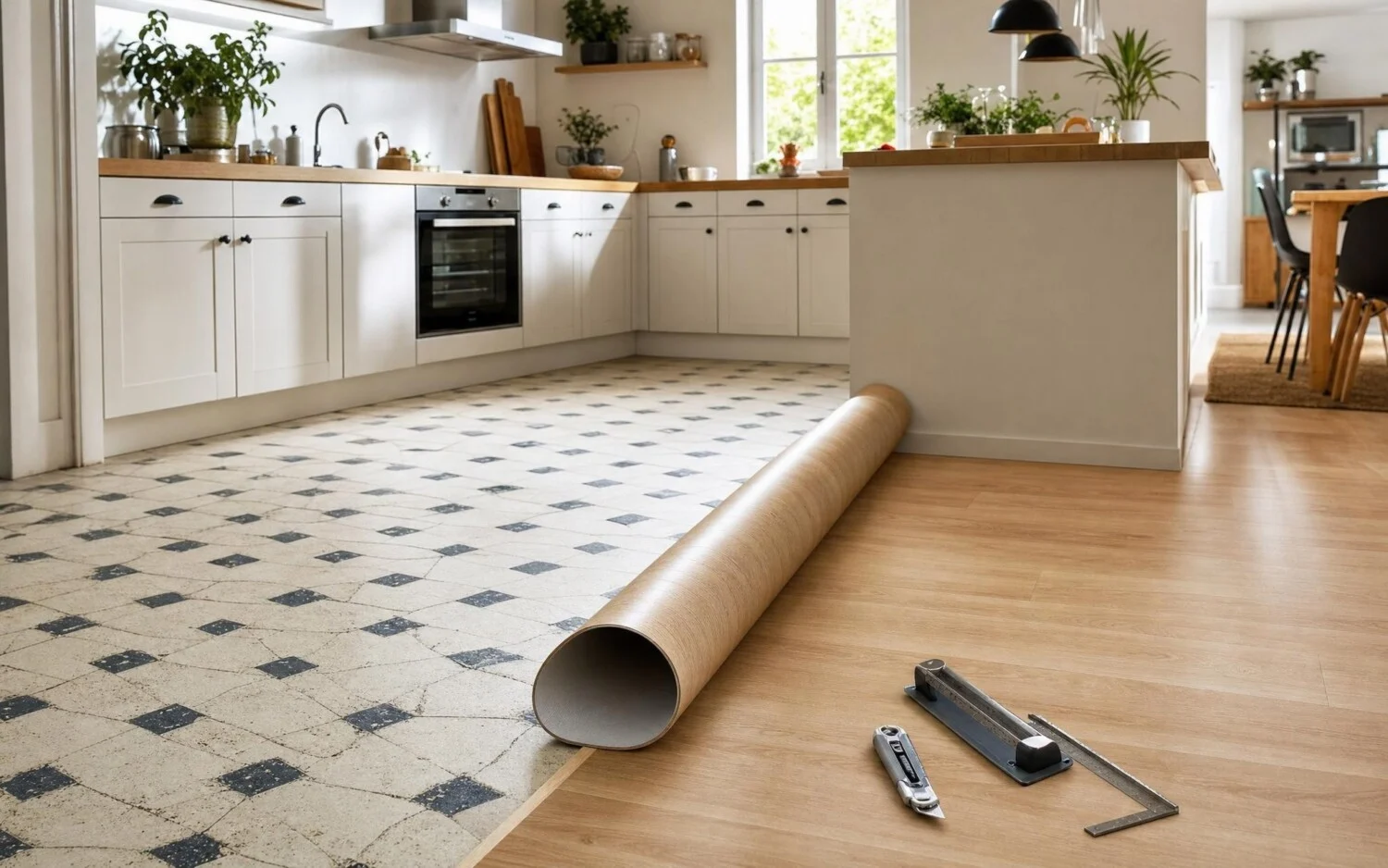
Replacing an entire kitchen floor without breaking a single tile, without dust or weeks of renovation: in 2026, what once looked like a fantasy has become a very real option. The traditional ceramic tiles, long unchallenged, are gradually being challenged by a newcomer that is much more accommodating in daily life. The real novelty? It can be laid directly over the existing surface.
Across Europe, home and interior design media have been publishing since May and June 2026 examples of kitchens transformed in forty-eight hours, without rubble or demolition. The common thread of these rapid projects can be summed up in three words: a floor-over-floor system, featuring a next-generation vinyl flooring that promises time savings, comfort, and visual continuity. This is enough to spark the curiosity of many busy homeowners.
Why kitchen tiles are no longer the sole option in 2026
For a long time, kitchen tiling ticked all the boxes: sturdy, easy to clean, heat resistant. But over the years, grout stains, cracks, and a foot-feel that remains hard and cold have chipped away at its appeal. Moreover, during renovations, breaking tiles means noise, dust, rubble to remove, and sometimes the kitchen can be unusable for several days.
Interior designers are also noting a shift in how we view the kitchen, now a true living space often open to the living room. Visual layouts show a checkerboard of tiles clashing with wood flooring or wood-look surfaces. Spanish articles dedicated to this new 2026 trend emphasize the desire for more continuous, warmer surfaces and a growing fatigue with heavy renovations just to change the floor.
Vinyl flooring over tiles: the new 2026 kitchen trend without major work
The principle of vinyl flooring laid over existing tile is simple: instead of removing the old tiles, use them as a base. As long as the tiles are well adhered, without major cracks, and the surface remains generally flat, a professional can cover everything with vinyl planks or tiles. Trade press explains that a standard kitchen can be transformed in as little as 24 to 48 hours.
This flooring, made of PVC or in a rigid vinyl variant like SPC, withstands moisture, temperature fluctuations, and heavy foot traffic—three typical kitchen constraints. Its limited thickness minimizes door clearance issues, while providing a warmer, slightly cushioned feel underfoot. Finishes mimic wood, stone, or ceramic with impressive realism, allowing you to modernize the room without touching the structure. Before getting started, a few checks are worth making:
- Clean, degreased, and completely dry substrate.
- Tiles firmly bonded, with no areas that sound hollow.
- Acceptable height difference with adjacent rooms and doors.
- Possible thin leveling to smooth overly pronounced joints.
How to successfully install a vinyl kitchen floor laid over existing flooring
All that remains is to choose the installation system. Click-and-lock planks form a floating floor that is easy to dismantle room by room in case of damage, and they tolerate a somewhat uneven subfloor thanks to their rigidity, especially in the SPC version. Adhesive models, thinner, require an almost perfect substrate, but they are discreet under low base cabinets or heavy appliances.
In practical terms, a typical renovation starts with a thorough cleaning of the tile, filling damaged joints, and, if needed, a light leveling compound to restore flatness. Next come the underlayment if required, careful laying of the planks, and finishes with skirting boards and threshold strips. When the original substrate is sound, this method can unify the kitchen floor—and potentially the entire adjacent living space—without definitively saying goodbye to the tiles… but with them fading from view.
Sources
- JLM
“Farewell to bathroom tiles trend joints and hearths 2026”
