
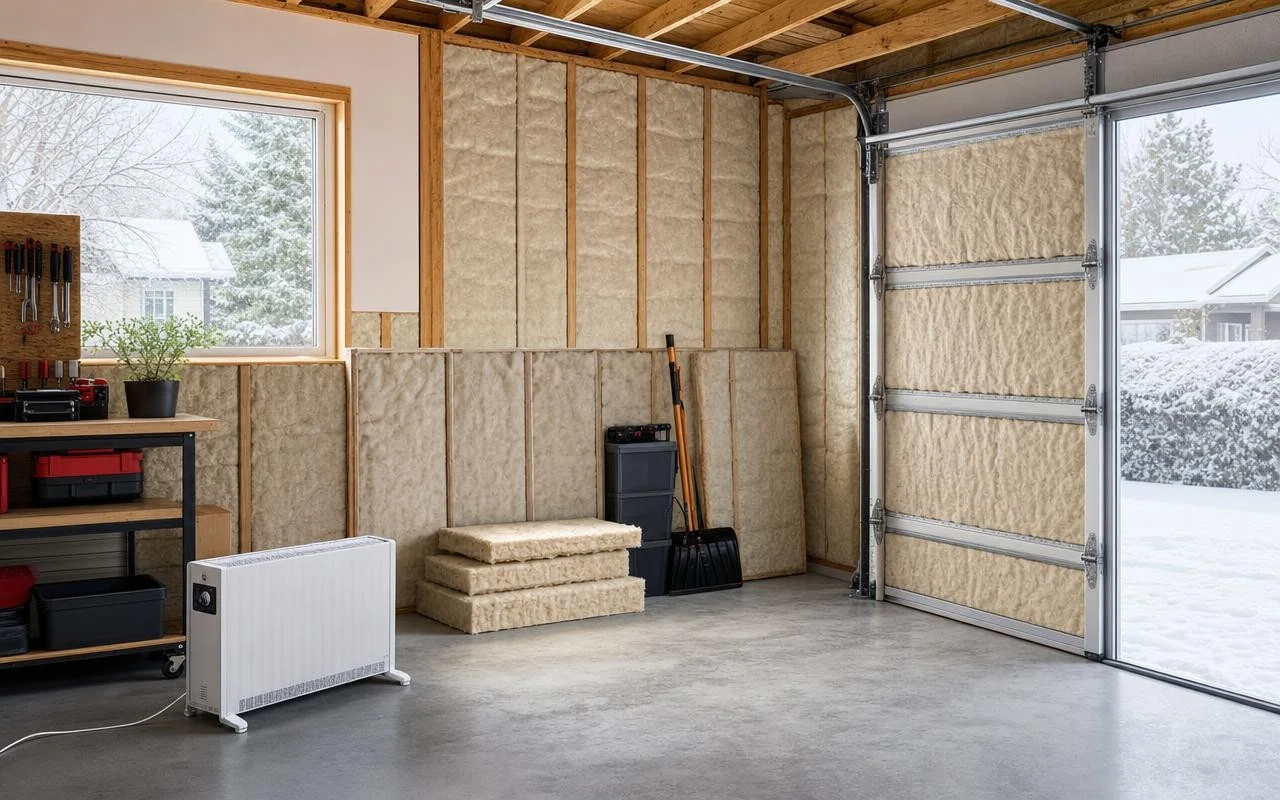
Opening the garage door in the middle of January, feeling the icy air snap your desire to tinker, and immediately reaching for a battered fan heater: this scene speaks to many households. The instinct is logical, especially when you want to make the space usable for a few hours. Yet, this reflex can cost a lot over time, without really warming the area.
Because a typical garage remains one of the most poorly insulated zones of the house: bare walls, a large metal opening, and a cold concrete floor. Heat escapes instantly, and the heater must run at full blast for a middling result. Behind the urge to warm up quickly, the real good deal lies elsewhere, on the thermal envelope. The best expenditure isn’t necessarily the one you imagine.
Why a radiator in an uninsulated garage costs so much
In a space with cold, air-leaky walls, the slightest extra heater works continuously to compensate for the losses. Garages are often barely insulated, or not insulated at all, with bare concrete block walls and a huge steel garage door acting as a thermal bridge. The heating struggles to reach temperature, the air falls back down immediately, and the bill climbs month after month.
When the garage is adjacent, the stakes go beyond the single room. Uninsulated walls that touch the living area or bedrooms draw some of the home’s heat away. The result is visible on the meter: the boiler or the rest of the house’s convectors run more to compensate for the losses on the garage side. Heating without addressing this leakage is like filling a leaky bucket.
Insulating the garage: an investment that really makes a difference
The garage insulation does not generate heat; it simply preserves what already exists. Starting with the door makes a big difference: experts estimate that an insulated door can make the garage about 5 to 8 °C warmer in winter. One can install an insulation kit oneself, taking care to monitor added weight so as not to disturb the springs and rails, or take advantage of a replacement to choose a door that is already insulated.
Next comes the ceiling, especially if a heated room sits above. Target a thermal resistance (R) of at least 4 m²·K/W to noticeably limit losses upward. According to estimates such as those from HomeGuide, insulating a garage door, ceiling, and walls can cost between $800 and $5,100, or about €750 to €4,800, depending on size, materials chosen, and possible professional labor. In France, some of these works may benefit from energy savings certificates, a reduced 5.5% VAT, or a zero-interest eco-loan.
When does supplemental heating become worthwhile in a garage
Once the main leaks are addressed and the door and ceiling are insulated, a small space heater begins to make sense again. It then serves only to raise the temperature by a few degrees in a volume that is already tempered, for a workshop, a laundry room, or a small home office corner. The unit runs less hard, for shorter periods, which limits electricity consumption and avoids the temperature swings.
To achieve this, a ceramic tower heater such as the TRONIC model sold by Lidl illustrates well what a modern device can provide. Priced at €44.99, it offers two power settings of 1,000 and 2,000 watts, claimed to heat up to 20 m², an adjustable thermostat from 5 to 35 °C, automatic oscillation, a 24-hour timer, and safety features to prevent tipping and overheating. In a well-insulated garage, this type of supplemental heater often suffices generously.
