
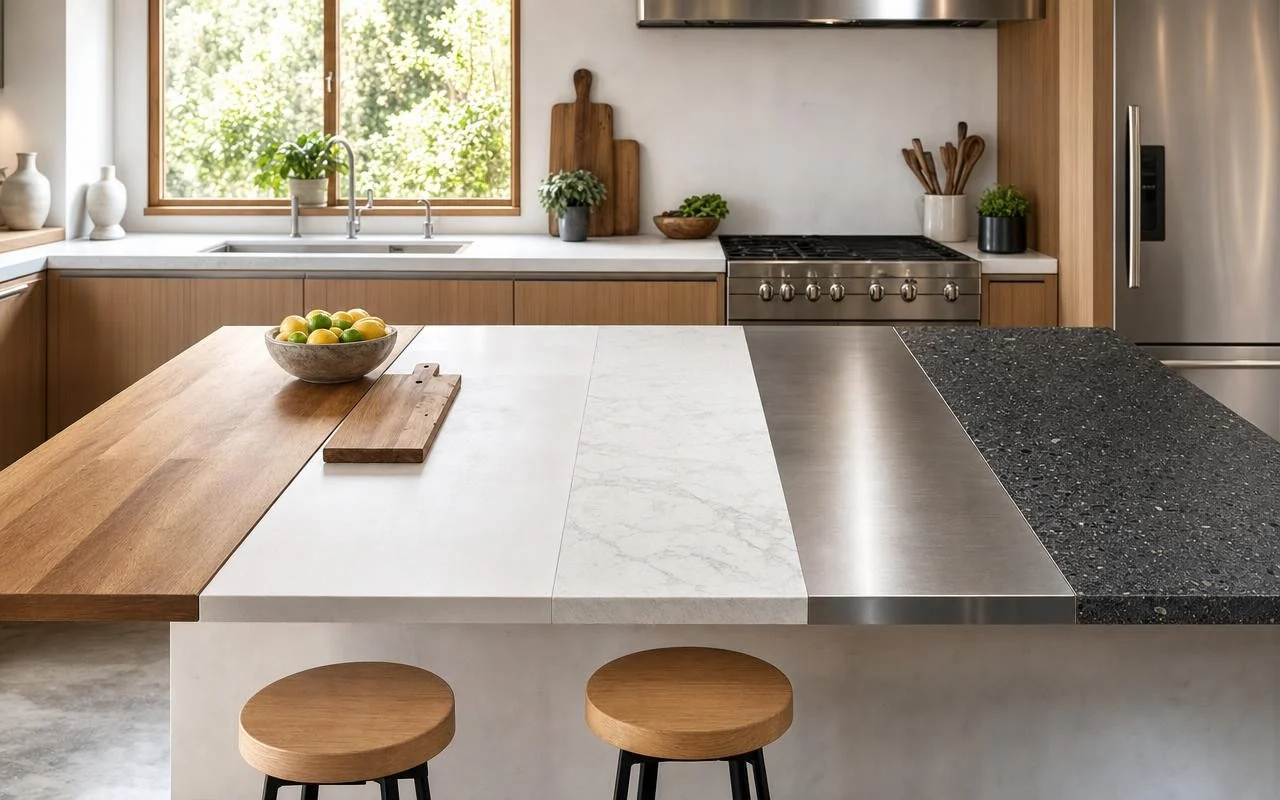
Granite sits at the top of magazine kitchen features: solid, glossy, reassuring. Until the moment the quote lands. With a granite countertop priced in France at around €350 to €600 per m² installed, according to renovation guides, many projects blow the budget at the last moment.
Yet there exists a host of materials capable of resisting knife cuts, water and heat without reaching those figures. Some countertops cost up to ten times less than premium American granite while handling everyday cooking very well. The real question becomes simple: which of these 11 substitutes is really made for your way of cooking?
Avant le granit : trois questions pour bien choisir son plan de travail
First question to ask yourself: do you place hot dishes or pots directly on the countertop? Stone-like materials such as Ceramic, porcelain, slate, travertine, or concrete handle heat very well. Quartz, resin surfaces like Corian, or the Laminate tend to mark more quickly, because they contain resin sensitive to around 150 to 180 °C according to specialists.
Second point: are you ready to manage regular maintenance? Porous stones (granite, limestone, travertine) require a hydrophobic treatment every 2 to 5 years, while wood needs to be oiled once or twice a year. By contrast, quartz, ceramic, paper composite or laminate are non-porous or waterproof, thus requiring no sealing. Last key question: do you prioritize upfront price or cost over 20 years? A quartz priced at about $50 to $200 per square foot can come out cheaper than poorly maintained granite that stains and must be replaced.
Prix : combien coûtent les alternatives au plan de travail en granit ?
In the United States, HomeAdvisor places granite at $15 to $140 per square foot installed. By comparison, ceramic starts at $1, porcelain at $3, laminate at $8, butcher-block wood at $10, travertine at $11, limestone at $10, and slate at $20. Paper composite surfaces run around $45–$70, Corian around $45–$100, concrete between $50 and $100, and quartz between $50 and $200 per square foot.
In practice, this means most of these materials stay below the pricier granites, sometimes by a wide margin. To help you navigate, here are the 11 major families of alternatives to know, all used as kitchen countertops:
- Ceramics: very economical tiling, waterproof, joints to monitor.
- Porcelain: higher-end tiles, customizable, slightly more prone to chips.
- Laminate: unbeatable on budget, easy to install, but heat-sensitive.
- Wood / butcher block: warm, repairable by sanding, regular maintenance essential.
- Slate: modern mineral look, less porous, but edges and chips can occur.
- Travertine: warm stone, highly porous, requires regular sealing.
- Limestone (calcium carbonate): currently trending soft tones, sensitive to acidic foods.
- Paper composite: recycled, non-porous, patinas like wood, heat tolerance limited.
- Corian and other solid surfaces: joints nearly invisible, easily repairable, caution with hot dishes.
- Concrete: highly customizable, durable, but needs protection with a good varnish or wax.
- Quartz: sometimes pricier upfront, but almost maintenance-free and stain resistant.
11 alternatives au granit : quel plan de travail pour votre cuisine ?
For a rugged, all-terrain kitchen where hot items are frequently placed down, ceramic or porcelain tiles, slate, travertine, or concrete are among the most reassuring options, just like granite. Natural stones require yearly or biannual sealing, but they withstand high temperatures well. Concrete, meanwhile, can crack, but those cracks are repairable, and its surface can be waxed to mimic the look of a very high-end natural stone.
If you’re mainly aiming for budget and ease, laminate, ceramic or porcelain dominate the field: very affordable upfront, easy to install in renovations, ideal for DIY. For a warmer ambiance, wood and paper composite appeal, with the advantage: in case of scratch or burn, you simply sand and reseal. Finally, for those seeking a countertop almost maintenance-free and stain-free, non-porous surfaces (quartz, Corian, laminate or paper composite) offer a credible alternative to granite, while leaving more room in your kitchen budget.
