
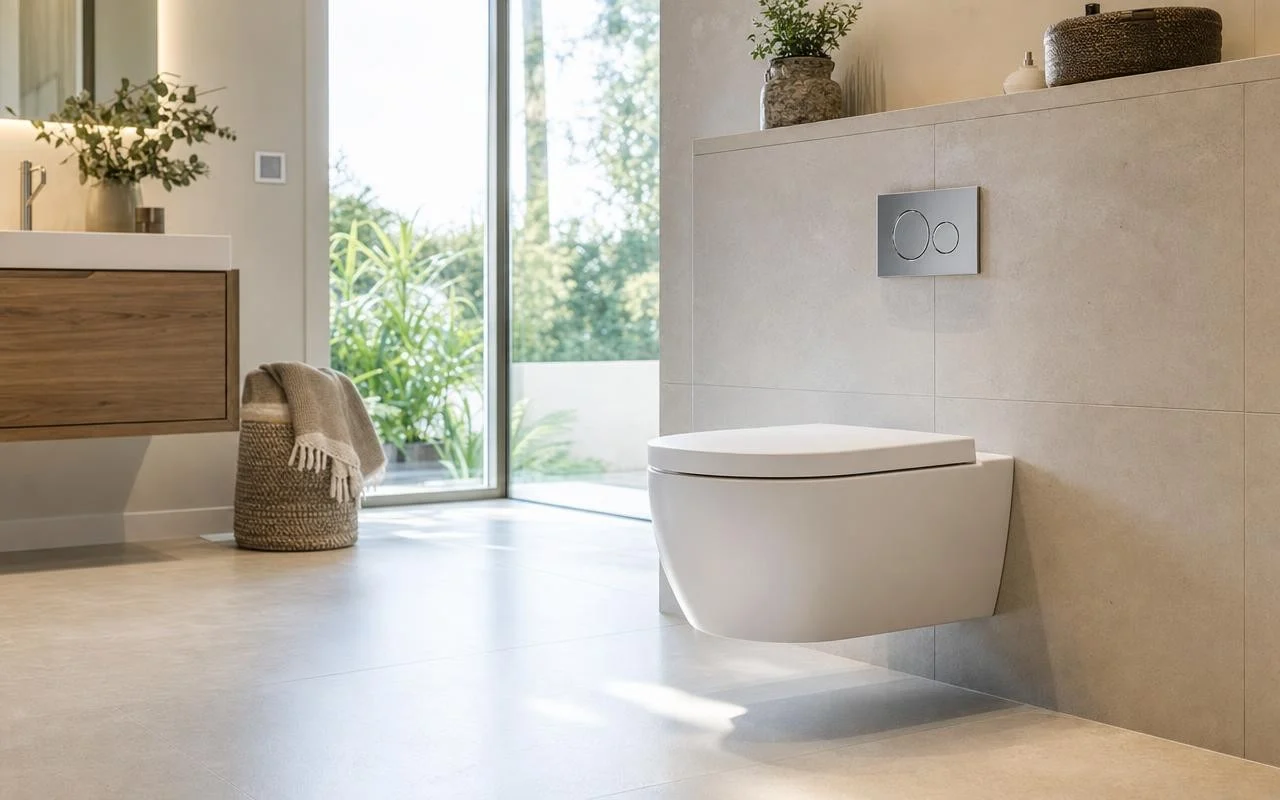
For several months now, a claim has been circulating everywhere: traditional toilets are destined to disappear by 2026, replaced by cutting‑edge models worthy of luxury hotels. On social networks and in certain decor outlets, architects and interior designers keep repeating that the old floor‑mounted toilet would have no place in new constructions.
In practice, the situation is a bit more nuanced: no rule forbids classic models, but professionals agree on a strong trend. New builds and full-scale renovations now favor the wall‑hung toilet, the bowl that seems to float at an adjustable height in front of a smooth wall. The question remains: why is this option so appealing, and under what conditions is it worth it?
Why designers are betting on wall‑mounted toilets in 2026
In an article picked up by the Spanish press, several designers summarize the situation by explaining that the floor‑mounted toilet will gradually give way to the suspended model starting in 2026. In France, it’s estimated that about a third of the 2.6 million toilets sold each year are already wall‑hung models. This isn’t a brutal ban, but a shift in habits: for many architects, choosing wall‑hung toilets has become the default whenever a wall can house the mechanism.
However, designer Rachel Cannon cautions against the downside of these surges: “Because our culture has become obsessed with trends, this can lead to impulsive and costly decisions,” she notes. Applied to toilets, the message is clear: the suspended model dominates the specifications for 2026, but it deserves careful consideration before ruling out traditional toilets altogether.
Wall‑hung Toilets: How They Work, Benefits, and Limitations to Know
Concretely, a wall‑hung toilet rests on a metal frame installed inside the partition. The concealed tank disappears behind a faux wall that sometimes protrudes about 12 cm, especially in renovations. Only the visible bowl is fixed to the structure, which can support up to around 400 kg when installed correctly. Access to the mechanism is via the flush plate, located above the flush valve.
The initial advantages are tangible: with no floor pedestal, you can mop everywhere and avoid those corners where dirt tends to accumulate. The eye gains comfort, especially in a small bathroom: a continuous floor creates a sense of space and a minimalist style. Another argument is that the height of the bowl can be adjusted, easing use for seniors, people with reduced mobility, and taller individuals.
Wall‑Mounted Toilets vs. Floor Toilets: How to Decide
All isn’t rosy, though. A complete package of bowl, wall frame, and cladding typically runs between €500 and €1,300, versus about €200 to €700 for a classic floor toilet, excluding installation. Labor costs also rise, as you need to open the wall, build a frame, and redo the tiling. Some homeowners also fear hidden failures: maintenance would require accessing the mechanism through the panel behind the plate, less straightforward than an exposed tank.
To help decide, several architects remind us that traditional toilets remain a valid option, especially with wall‑slotted models that hide the pipes. The right choice depends mainly on the project. Before signing a quote, professionals advise checking a few key points:
- available thickness to create a false wall;
- ease of access to the mechanism via the flush plate;
- overall renovation budget and not just the toilet itself;
- preferred height according to the main users.
Sources
- Maison & Travaux
“Redoing your bathroom? These 7 choices that designers swear you’ll regret for 15 years”
