
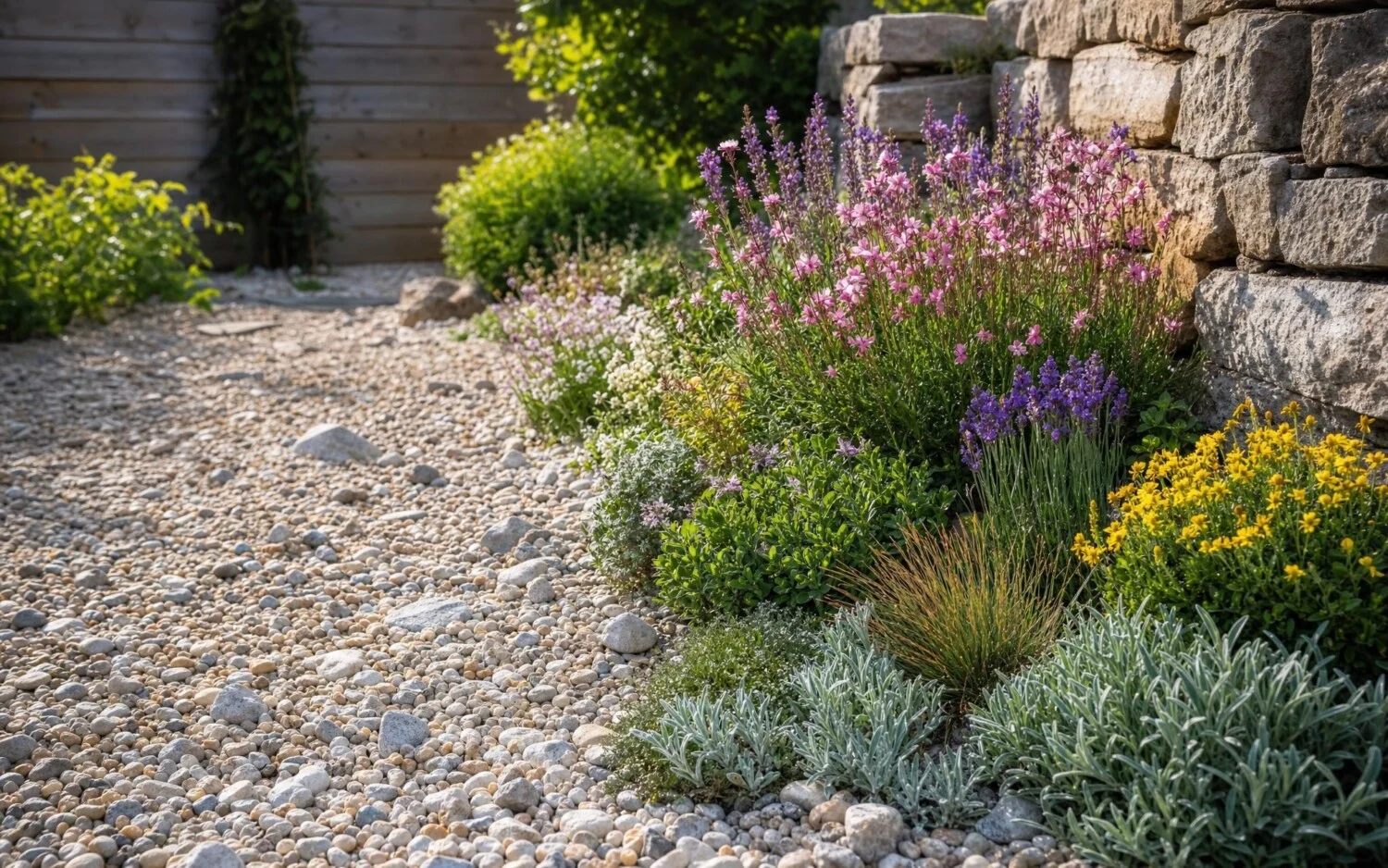
We often imagine a gravel garden as a bare, sun-baked plot, with just a few lonely plants amid the pebbles. Yet, this type of space can become one of the most appealing corners of the garden: almost no weeding, little watering, a Mediterranean vibe, and long-lasting blooms, provided you choose your perennials well.
In a sun-drenched corner, on well-draining soil, the stones hold heat and shield the soil from evaporation. The goal is therefore not to “fill” at any price, but to compose a living decor by playing with heights and textures. With 6 plants to make a gravel garden lush, the décor changes completely.
The principle for a truly lush gravel garden
Before considering the plant list, set the frame. A gravel garden succeeds if it welcomes plants that love full sun, relatively poor and well-drained soil. Gravel-garden specialists recommend alternating upright silhouettes, generous cushions, and fine foliage to break the “parking lot” effect and give the impression of a thriving massif.
In this mineral landscape, a few perennials take the starring roles: lavender, ornamental grasses, achillea millefolium, nepeta, sedum, and agastache. They endure drought once established, structure the space, and attract pollinators. Each has a precise role, which helps avoid multiplying species while giving volume.
6 key plants for a lush gravel garden
Lavender forms the backbone of the bed. Its gray-green tufts prefer filtrant soils, and its purple spikes bring color and fragrance near a path or terrace. Beside it, ornamental grasses, such as blue fescue or stipa, introduce movement: their fine leaves ripple in the wind and soften the angles of walls or large stone blocks. Achillea millefolium, with its upright stems and flat-topped umbels in yellow, white, pink, or red, creates “plates” of flowers that instantly transform a gravel bed into a garden scene.
Lower down, nepeta (catmint) forms bluish-gray cushions that spill over the paths, studded with countless small purple flowers loved by bees. Sedum, for its part, plays with texture: its fleshy foliage fills the gaps between the stones, while its flowering heads color late in the season. Finally, agastache provides erect spikes in violet, pink, or orange tones and aromatic foliage; its tubular flowers are highly visited by insects, bringing even more life to the tableau.
How to arrange and maintain these plants in a gravel garden
To avoid a sparse look, it’s best to think in layers. In the back, place lavenders and large clumps of grasses to provide height. In front, install achillea and agastache, forming the colorful mass at eye level. Along a path edge or at the foot of stones, nepeta and sedums slip between the gravel, like a green carpet that links everything else. The trick is to leave space: these plants spread quickly and eventually touch, creating that sought-after sense of continuity.
When it comes to maintenance, a gravel garden remains understated: a good watering at planting, then regular monitoring during the first year, before significantly reducing the frequency. One then simply trims faded flowers to prolong the blooms. Nepeta, in particular, benefits from being cut back short in late July as gardeners of old did: in less than three weeks it re-forms a lush green cushion and triggers a second wave of flowers toward the end of August. Without heavy fertilizers or major work, these few plants for gravel garden keep the bed full until the first cool spells.
Sources
- Mon Jardin Ma Maison
“Don’t throw away eggshells anymore: these 10 vegetables and garden plants love this free fertilizer”
