
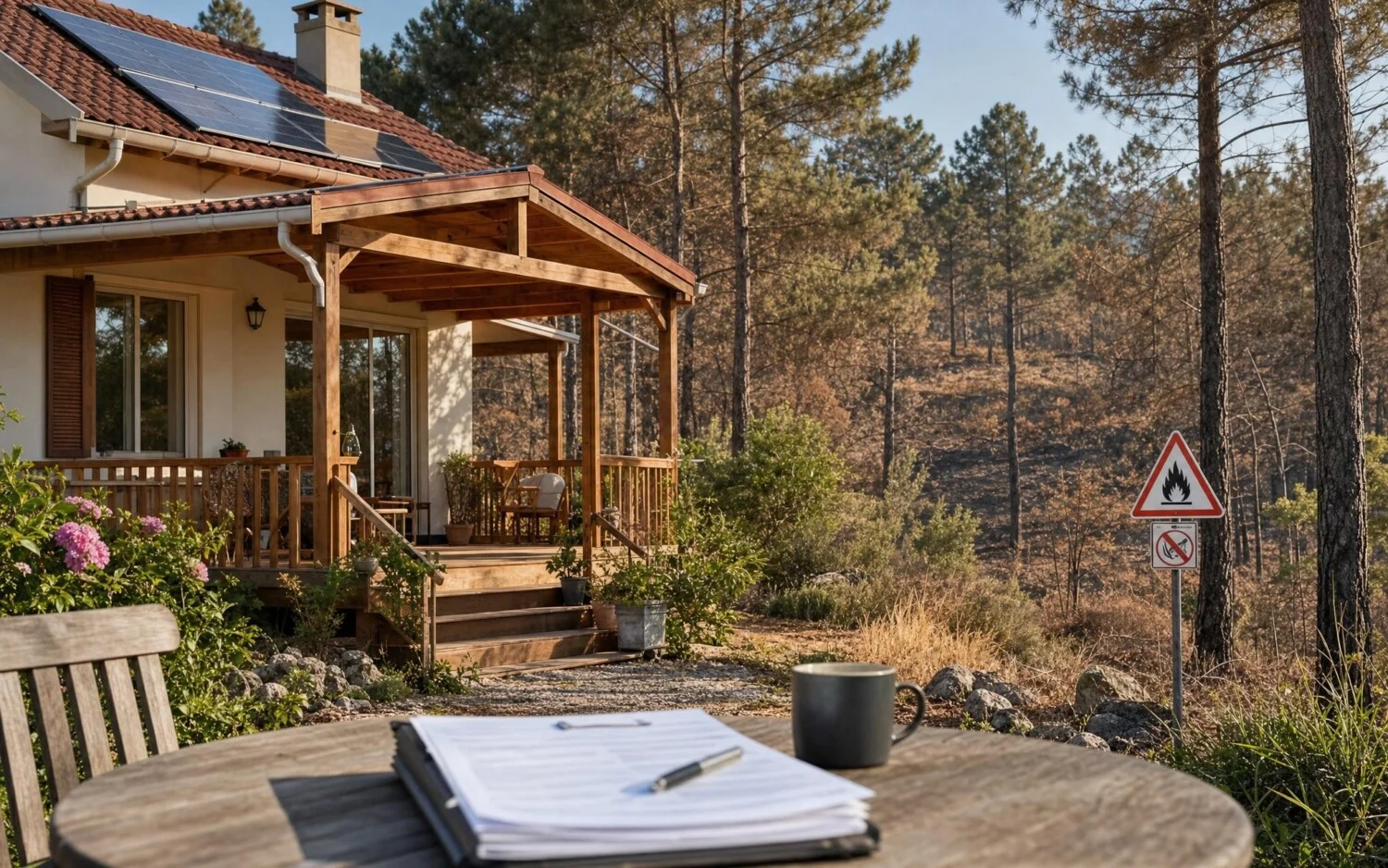
A lovely wooden porch that extends the living room toward the garden is often the dream of homeowners. One imagines summer meals, the hammock in the shade, the view of the trees. What is less visible is how these square meters of timber creep into the calculation of the home insurance premium.
In a context where, according to Argus de l’assurance and the consulting firm Addactis, premiums for Home Insurance Multirisk (MRH) could still climb by around 7.5% to 8% before tax in 2026, every detail matters. And in areas exposed to wildfires, a simple wooden canopy can be enough to push your house into a higher-risk category.
Wooden porch, habitat-forest interface and fire coverage: what insurers see
The Georisques services describe the habitat-forest interface zone as the area where houses and combustible vegetation lie in close proximity. In these sectors, forest fires cast embers – small sparks – that can travel up to about 2 kilometers before falling again. A wooden porch therefore provides a horizontal surface and nooks that are perfect for catching pine needles, dry leaves, and those embers carried by the wind.
Insurers translate this picture into the probability of the facade igniting. A lightweight wooden annex attached to the house increases the “combustible load” at the base of the walls. In the market, it is already seen that a veranda or a large covered terrace properly declared can lead to a surcharge of around 10% to 30% on the premium, according to Assurland, even though nothing is automatic. For a wooden porch in a fire-risk area, the pricing logic is similar.
Undeclared wooden porch: the hidden risk behind the fire surcharge
Building or enlarging a porch, enclosing a terrace with a wooden structure, all of this changes the risk that the insurer covers. Service-Public.fr reminds that any aggravation of risk must be declared to the insurer within 15 days, by letter or registered message. Many homeowners view these improvements as mere embellishments, whereas legally they become, technically, an annex to declare.
If this modification remains under the radar and a fire occurs, Article L113-9 of the Insurance Code comes into play. This provision states that, when the omission is not in bad faith, the indemnity is reduced in proportion to the premium paid relative to what would have been due if the actual risk, including the porch, had been declared. In more serious cases, the insurer may also decide to sharply increase the premium or terminate the contract after discovering the annex.
Limit the surcharge on your wooden porch and exercise your rights
Insurance companies no longer rely solely on paper questionnaires. The insurance sector now uses aerial and satellite imagery to identify pools, extensions, roofing materials, or vegetation too close to houses. This information complements the insured’s declarations, especially in municipalities subject to the Legal Obligations for Debroussaillement within 50 meters of buildings. Dated photos and a clearly well-kept garden become concrete arguments when facing the insurer.
To make your porch appear less “flammable” in the eyes of the fire guarantee, a few actions are particularly noticeable:
- clear brush and break the continuity of vegetation around the house, according to local rules;
- trim the lower branches of trees to at least 2.5 meters when prefectural orders require it;
- install under the porch a fine-mesh metal grid, about 3 mm, to prevent the accumulation of leaves and embers;
- keep invoices and certificates from companies that carried out debroussailment or protection works;
- send these proofs to the insurer requesting a revision of the premium on the basis of Article L113-4 of the Insurance Code, which grants a right to a premium reduction when the risk decreases.
