
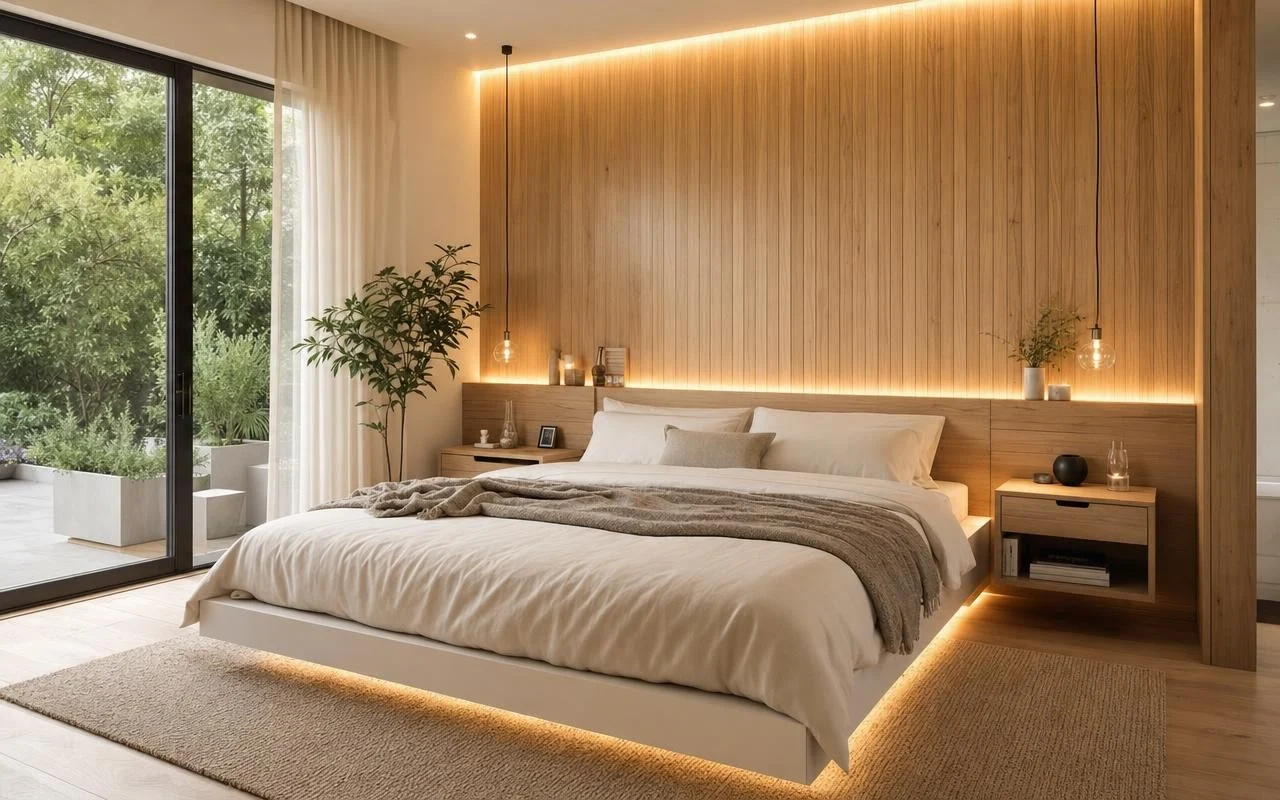
For a long time, the upholstered headboard or the solid wood version stood as the centerpiece of the bedroom, almost as important as the mattress itself. It was chosen tall and imposing to add depth to the wall and to create a cocooning atmosphere. Yet that piece of furniture takes up space, visually encloses the bed, and can complicate layout, especially in small rooms. Looking ahead to 2027, decorators and homeowners are turning away from it in favor of a lighter, more architectural solution.
In an article published in September 2026 about bedroom arrangement, one trend clearly stands out for the coming years: rather than adding furniture, work directly on the wall behind the bed. The principle is simple, yet it changes everything. Instead of leaning the bed against a thick structure, the wall behind becomes a decorative surface—warm, graphic, or mineral. The result is that the bed seems to merge with the room and the bedroom gains airiness. This shift toward the wall-mounted headboard signals a real change in perspective.
Why the traditional headboard is falling out of favor by 2027
At the heart of the trend is the sense of space. A traditional headboard forms an extra block, visually slicing the wall and isolating the bed as a large object placed in the middle of the room. The upholstered headboard walls, by contrast, create a continuity: the gaze moves smoothly, and the room feels deeper. This contrast is even more noticeable in a small bedroom, where every square meter and every volume count.
This approach is especially appealing in urban homes where space is at a premium. The article emphasizes rooms where one wants to transform the main wall without adding bulky furniture. By freeing the floor and slimming the bed’s silhouette, the upholstered headboard wall preserves the support and comfort while giving more room to move or to open a drawer.
The wall-mounted headboard: an upholstered headboard wall that enlarges the room
Concretely, a wall-mounted headboard involves dressing the portion of wall behind the bed, across its full width or just in a band, to turn it into a decorative feature. According to the September 2026 article, this solution works in both houses and apartments. It plays with textures and reliefs rather than increasing the bulk of a piece of furniture. The effect achieved is reminiscent of hotel suites: the bed appears integrated into the room’s architecture, almost custom-made.
On the material side, the possibilities are varied: wood panels to add warmth, vertical slats to give height, textile panels for a softer touch, paint in intense tones to draw a bold accent wall, but also stone-like coverings or cement-effect finishes for a more mineral vibe. Each option shapes the wall differently and allows for room customization without resorting to any traditional upholstered structure.
How to choose your wall-covering for the headboard without getting it wrong
The choice of finish first depends on the room’s size. In a small bedroom, the article clearly recommends light materials and colors that maintain brightness and make the space feel larger. A simple textured paint or thin battens on a limited area are often enough to delineate the headboard without crowding the volume.
Conversely, when you want a real focal point behind the bed, the text highlights the impact of darker or heavily textured materials. An exposed stone wall, a cement-effect panel, or a deep hue instantly turns the headboard wall into a signature zone. Everything then hinges on balancing it with the bed linens and the lighting.
