
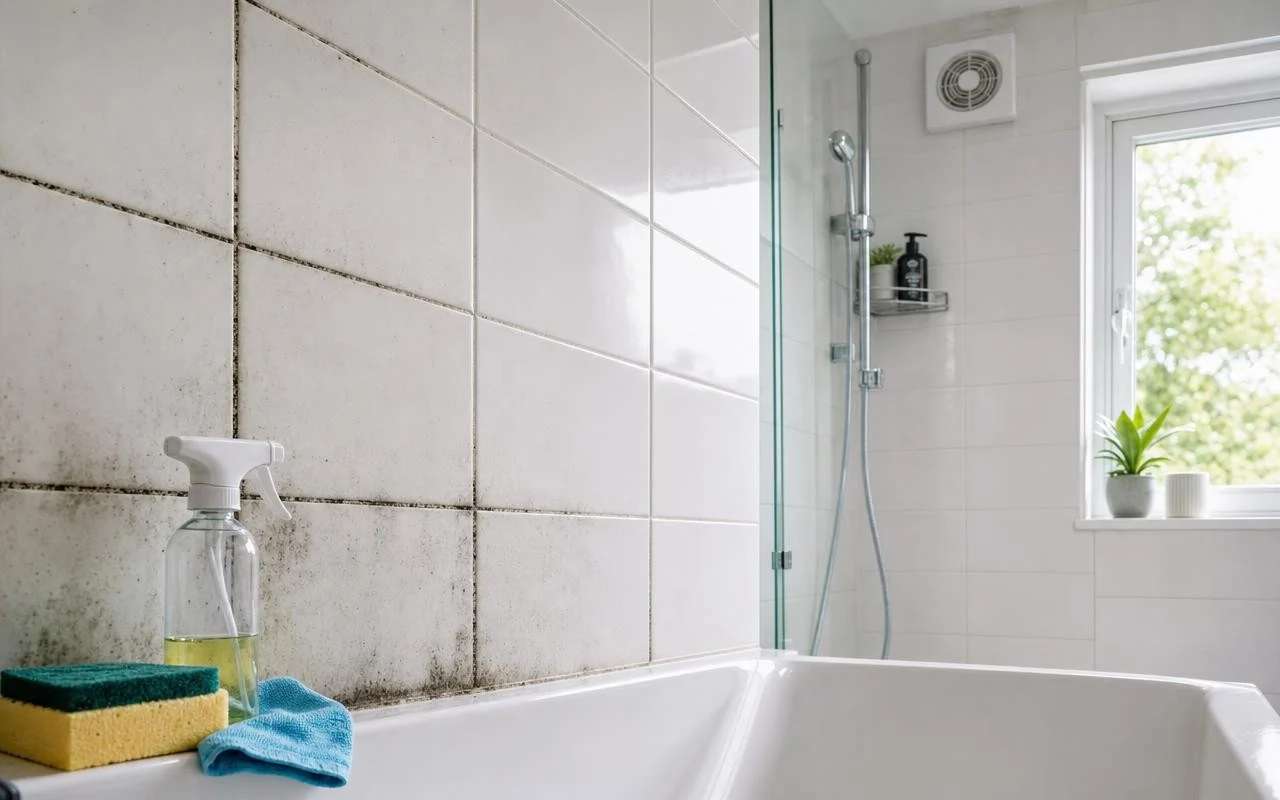
Tile grout that darkens to black around the shower, a gray veil that never fully disappears: many people immediately think it’s a cleaning issue. In most bathrooms, it’s not dirt at play. The moisture produced by showers and baths turns into fine droplets, ready to seep into every nook. What darkens your grout tells, first and foremost, the story of your indoor air.
The bathroom is by far the most humid room in the home, especially when it is small and windowless. Shower after shower, steam clings to cold surfaces, then accumulates in silicone or cement grout. Little by little, dark spots appear in the corners, sometimes despite regular cleaning. Understanding this signal helps determine whether you’re dealing with simple condensation or a deeper installed issue.
Black bathroom grout: when condensation makes an appearance
Physically, condensation occurs when very humid air touches a surface cooler than itself. The glazing of a conservatory on a frosty morning, described by Trucmania, thus becomes coated with droplets once the “dew point” is exceeded. In a bathroom, this role is played by the tile, exterior walls, or an inadequately insulated ceiling. Water deposits, sometimes runs, and ends up saturating the grout, which becomes a true sponge.
In this context, cleaning experts Sanitarios Bolaño warned: “the grout and the black corners that form in your bathroom are due to condensation, but it is recommended to ventilate and to maintain them.” The site Giceleblog notes that “condensation after a shower is normal. It is its persistence beyond 30-45 minutes that signals a ventilation problem.” When the fog lingers, the moisture soaks the materials and mold takes hold.
How to know if your black grout really comes from condensation
The first clue is read on the mirror and the walls. If the fog disappears in less than half an hour and the surfaces dry within 30-45 minutes, the situation remains normal. When condensation persists more than an hour, that the walls stay moist to the touch and a musty smell does not go away, Giceleblog speaks of a “problematic situation.” Your black bathroom grout then translates to a chronic excess of humidity.
The problem often stems from a clogged or undersized ventilation system (VMC). The regulations, recalled by Giceleblog, set a minimum airflow of 15 cubic meters per hour on continuous operation and 30 cubic meters per hour at peak for a bathroom. A simple test consists of bringing a sheet of paper to the mouth of the exhaust: if it does not stay in place, the airflow is insufficient. In a room without a window, any VMC failure will cause mold within a few weeks.
Ventilate, maintain and, if needed, redo the bathroom grout
To limit condensation, the actions after a shower are as important as weekly cleaning. Giceleblog advises quickly drying the shower walls and keeping the door closed while the VMC draws out the moist air, provided that the bottom of the door allows air to pass. Sanitarios Bolaño experts recommend, in bathrooms without a window or with poor extraction, to hang towels outside and leave the door open for the steam to escape.
For the monthly grout maintenance, Sanitarios Bolaño recommends a simple mix:
- 2 tablespoons of baking soda
- 50 milliliters of dish soap
- 250 milliliters of hydrogen peroxide
