
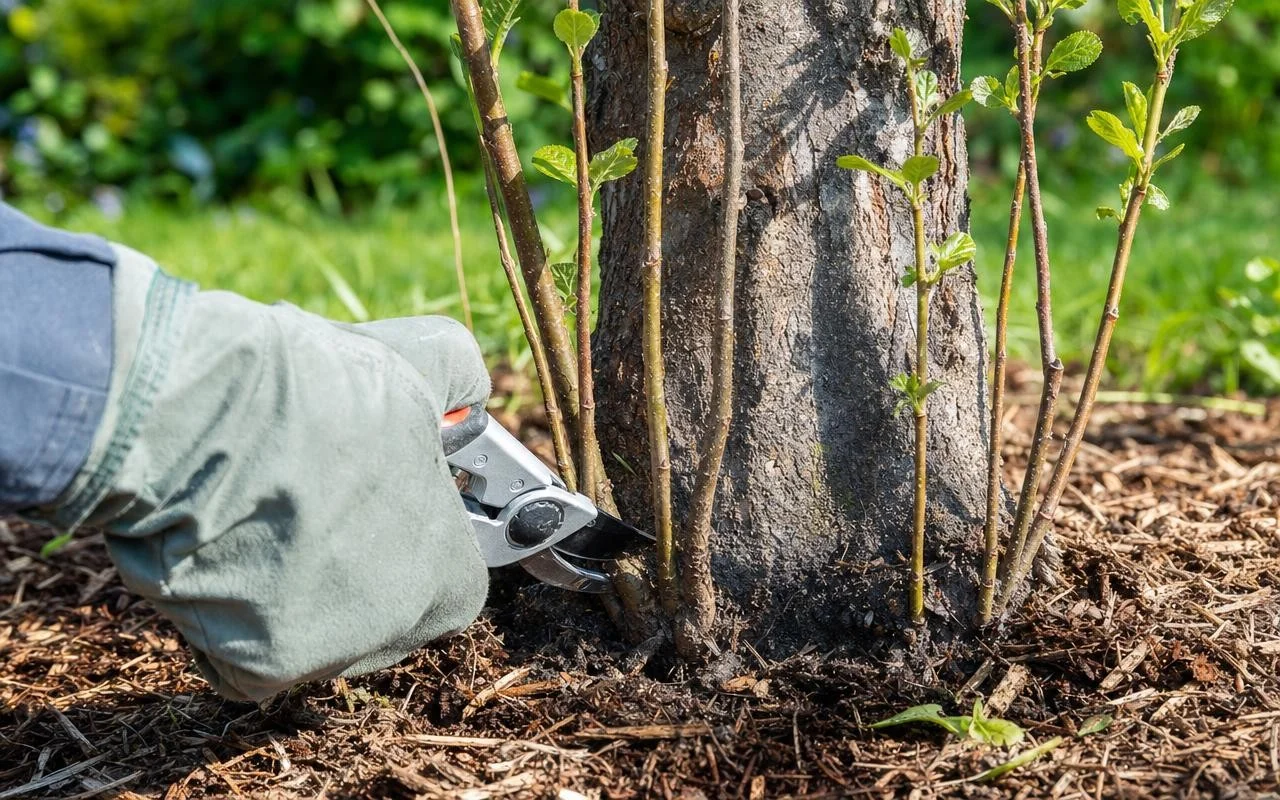
You have noticed small, straight stalks shooting up at the base of your apple tree or along the trunk of your maple, like a miniature improvised forest around the main tree. They look harmless, almost endearing. Yet behind these growths lies a survival mechanism that is very energy-intensive for the tree, something many gardeners underestimate.
These shoots are tree suckers, also called drageons, common on fruit trees, stem roses, or ornamental trees, especially in spring. Specialists from the Iowa State University Extension and the Royal Horticultural Society remind us that they are not mere “weeds” at the base of the trunk, but a signal about the tree’s condition. And sometimes, a true silent warning.
Tree suckers, drageons, and water sprouts: what these growths say about your tree
A sucker, or drageon, is a very vigorous vertical shoot that originates from the roots or the collar of the tree, sometimes a little away from the trunk. The Iowa State University notes that it shares exactly the same roots as the main tree and that it draws from the same reserves. It is therefore not an independent weed. Do not confuse it with water sprouts, these upright shoots that arise higher up on the trunk or branches.
On a grafted tree, the issue is even clearer. The trunk you see corresponds to the graft, the variety chosen for its flowers or fruits, while the roots belong to the rootstock. The CAUE77 reminds us that any sucker located below the graft point comes from this rootstock, often more vigorous but with inferior ornamental or fruit qualities, which can eventually smother the planted variety.
Why you should not let tree suckers develop
For expert Aaron Steil from Iowa State University, these growths are not trivial. He notes that they are “problematic because they can reduce flowering and fruiting, alter the tree’s shape, harbor pests and diseases, and be unsightly,” he explains. concretely, part of the energy that the tree should devote to its flowers, its fruits, or to strengthening its frame goes into these secondary stems.
And if you let them establish themselves, the damage can go much further. “If we let them grow, the suckers can become very vigorous and even dominate the tree,” continues Aaron Steil, who emphasizes that those from the roots are often less decorative than the upper part. The tree then changes its appearance, loses flowering, and some drageons end up colonizing lawns and flowerbeds, as noted by the Lazy Gardener blog. When a previously calm tree suddenly starts to sucker a lot, the Royal Horticultural Society often sees it as a sign of stress (damaged roots, drought, overly severe pruning).
How to remove tree suckers properly and limit their return
To control them, specialists from the Iowa State University and CAUE77 recommend a clear move: cut at the origin, as close to the root or trunk as possible. “Often you need to pull back some soil to find the base and cut when the sucker measures less than 15 to 30 cm,” explains Aaron Steil. If a small stump remains, “it will re-sprout with several new shoots,” he warns.
These growths will come back anyway: Aaron Steil notes that trees that produce them will continue to produce them, hence the value of cutting them regularly at their base. He also stresses: “Never use herbicides to treat or destroy the suckers,” or risk damaging the whole tree. Fewer root injuries, fewer drastic cuts, and spring monitoring are often enough to calm this survival impulse.
