
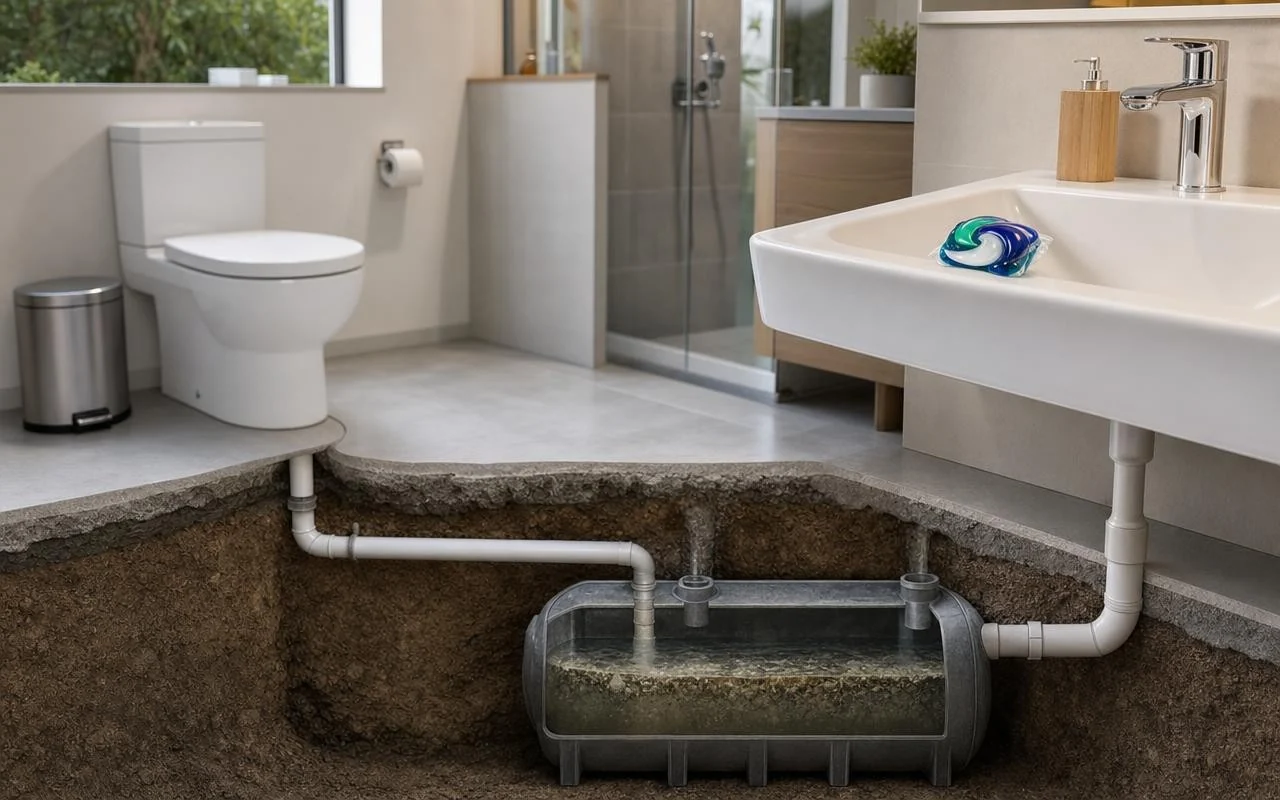
A forgotten laundry capsule, a damaged dishwasher tablet, a toilet bowl tablet dropped on the floor… Many households believe the simplest solution is to vanish them by flushing them down the toilet. The action seems convenient, especially when the capsule is already wet. Behind the toilet lies a fragile network, whether in sewers or in septic tanks.
In the United States, the Environmental Protection Agency (EPA) notes that “One in five households has a septic system.” When such systems receive unsuitable products, the health of the family, the environment, and the wallet can suffer. The Canadian Council of Ministers of the Environment mentions more than 250 million dollars, or about 230 million euros, in annual damages to networks.
Flushing a Capsule Down the Toilet: What Authorities Say
The city of Portland summarizes the rule with the “3P” principle: urine, excrement, and toilet paper, nothing more. The EPA’s SepticSmart program echoes the same idea and reminds that you should “flush only human waste and toilet paper.” In other words, flushing a capsule down the toilet, even if unused, clearly falls outside proper use.
The U.S. Consumer Product Safety Commission (CPSC) recalls that “laundry capsules dissolve rapidly upon contact with water.” This process releases concentrated chemicals. In a sewer system or a septic tank, these substances can disrupt beneficial bacteria or attack pipes. Even unused, a laundry or dishwasher capsule remains chemical waste, not ordinary organic waste.
The Rare Cases Where a Capsule May Go into the Toilet
There is a very specific exception: products designed to treat the toilet bowl or the septic tank, such as certain toilet capsules for septic systems like WC NET. Their instructions indicate throwing them into the bowl so they dissolve in the toilet water. The Canadian Council of Ministers of the Environment defines a product “disposable in toilets” as a product that does not cause damage to the network, nor pollution of the natural environment.
When in doubt, it is best to consider that a capsule is only authorized in the toilet if this statement appears clearly on the packaging. For homes connected to a septic system, caution is even stronger. The EPA reminds that “septic systems do not require any additives to function properly.” Repeated chemical inputs risk upsetting the bacterial balance and shortening the life of the installation.
What to Do with an Unused Capsule Instead of Flushing It
For a laundry, dishwasher, or cleaning product capsule, municipalities recommend treating them as household hazardous waste. The city of Cambridge notes that cleaning or disinfection products should never be flushed down the toilet and should join specialized waste streams. In practice, check with your municipality or your local recycling center to learn the sorting guidelines and the appropriate collection point.
If the capsule relates to a medicine, the EPA also emphasizes not to flush pharmaceutical products down the toilet. The recommended approach is to use local take-back programs and to seek advice from a healthcare professional. And if a household capsule has already been flushed by mistake, the key is not to turn that into a habit, in order to limit the chemical load on the plumbing.
