
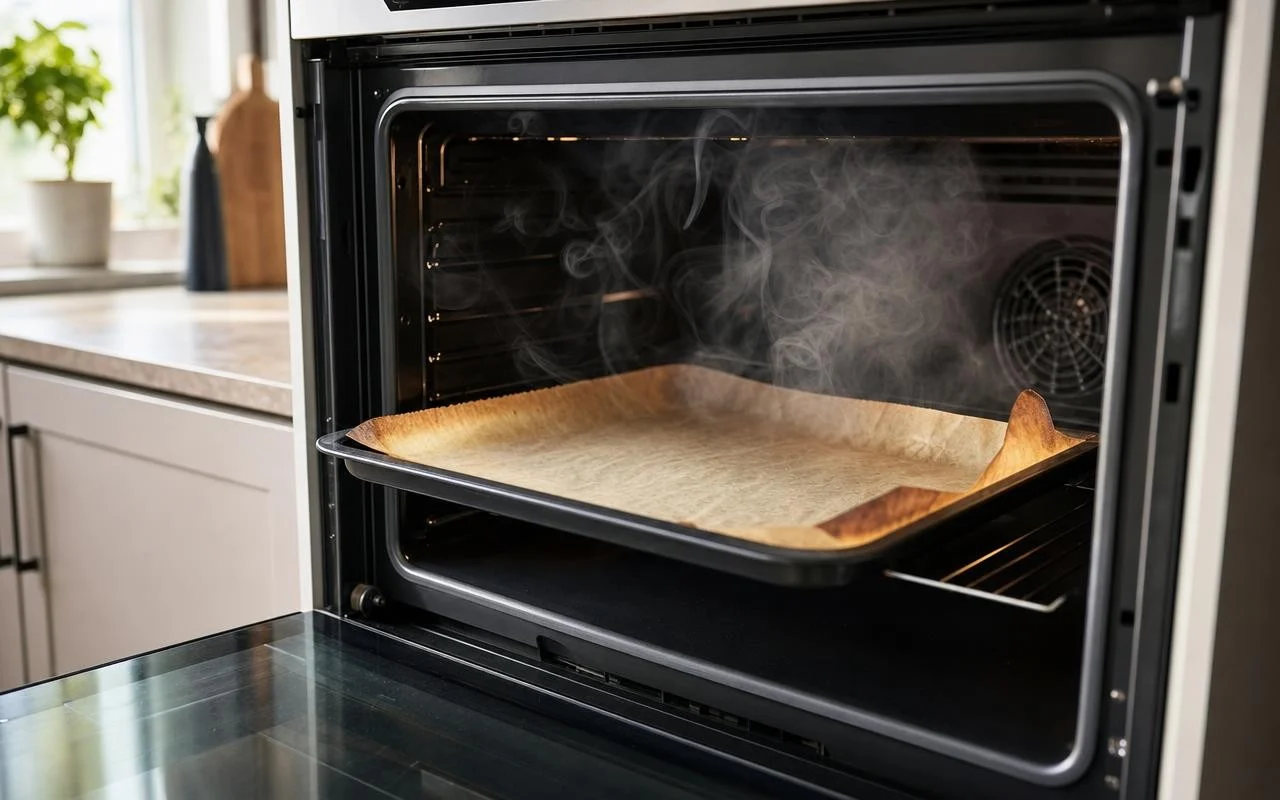
You slide a cake into the oven, everything seems normal, then a thin plume of smoke escapes from the oven and the edges of the parchment begin to brown. The scent isn’t that of a burnt cake, but of something browning on the baking sheet. Many baking enthusiasts wonder whether their parchment paper is truly suitable.
This phenomenon of parchment paper smoking in the oven is impressive, but it is almost always explained by how the sheet is used rather than by a defect in the product. Too-high temperature, contact with a heating element, incorrect cooking mode, or grease splatters can change everything. A simple corner of paper placed incorrectly can be enough to produce this smoke.
Why parchment paper smokes in the oven: temperature and placement
Most parchment papers are designed to withstand a maximum temperature of about 220 °C, a specification provided by several manufacturers who indicate compatibility up to 425 °F, or roughly 220 °C. When the oven is set to 230 or 250 °C for a pizza or a nicely browned loaf, the areas directly exposed to heat, especially the edges, exceed this limit. The fibers of the sulphurized paper deteriorate, the sheet browns and may emit a faint smoke.
Another typical situation: the sheet placed too low in the oven, or directly on the baking stone, instead of being on a tray or a rack. Appliance manuals specify that the paper should remain on an accessory, with the food, in a preheated oven, and never touch the bottom, walls or elements. If an edge sticks out, ends up against the arch-shaped upper element or near a gas burner flame, the temperature climbs locally well beyond 220 °C and the paper begins to smoke, or even burn.
Convection heat, grill and the oven floor: common mistakes
The grill mode deserves particular attention. Parchment paper manufacturers reserve it for traditional oven baking or convection heating, not for grilling. Under the grill element, the temperature and radiation are much more intense: a sheet placed too high, or that moves toward the element, can quickly brown, smoke and then ignite. Official recommendations remind to avoid using parchment paper in grill mode, even for a few minutes to gratinate.
Convection heat creates another trap: the circulated air can lift a light sheet, especially if it overhangs the tray. Technicians explain that this displacement can bring the paper into direct contact with a heating element, which immediately causes browning and a wisp of smoke. Manuals therefore advise trimming the paper to the size of the tray, removing the excess that dangles, and weighing it down with the food or a suitable utensil. Some also remind that grease or sugar drips on the paper or on the tray can, when heated, produce smoke and then flames if you do not clean or if you reuse a sheet that is already heavily stained.
- Cut the paper to the size of the tray or mold, with no edges protruding.
- Always place it on a tray, rack, or drippings pan, with the food, in a preheated oven.
- Respect the maximum temperature indicated on the packaging, around 220 °C.
- Avoid the grill mode and do not leave a sheet alone in the oven during preheating.
Parchment paper smoking or other oven problems: telling them apart
A light smoke, localized to a corner where the paper darkens, often points to an issue with the paper’s position or its temperature. By contrast, heavier smoke that fills the oven with a smell of burnt fat usually stems from grease or residues on the walls, the base, or the heating elements. A major oven manufacturer notes that these fumes frequently come from fats or residues of cleaning products that burn, even when you aren’t using parchment paper. If the smoke persists after you have removed any sheet, the source is likely there.
Another case to know: confusion between parchment paper and wax paper. Wax paper, coated with wax, is not intended for oven cooking; the wax can melt, smoke, or even ignite. Check the packaging to ensure you are using a parchment paper or sulfurized paper, and not a waxed or paraffin paper — it makes a real difference. In practice, if a sheet begins to become very dark, brittle, or soaked with grease, it’s best to remove it and replace it before the next batch to limit odors and smoke.
