
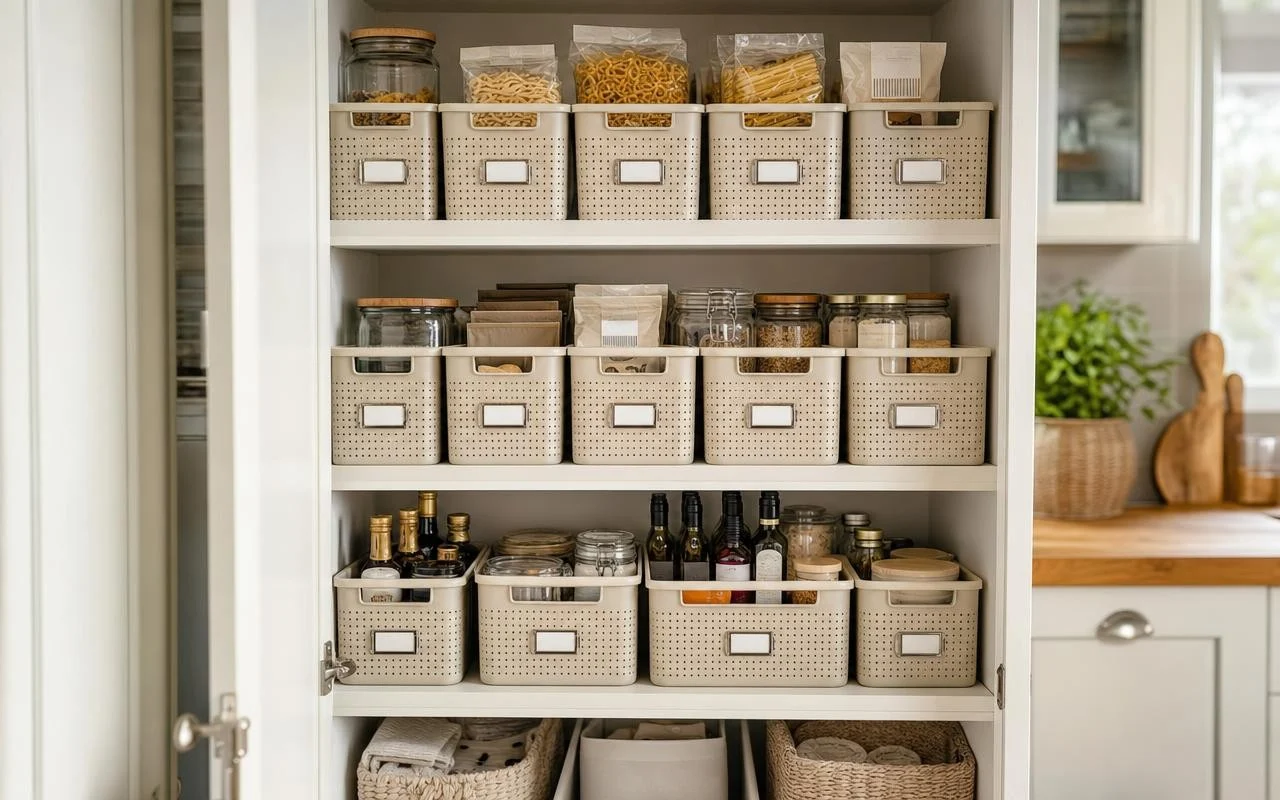
Open a cabinet and come face to face with a pile of boxes, bags, and baskets with no visual anchors—this is a situation many recognize. You rummage, you forget what you already own, you end up buying duplicates. In the midst of this quiet chaos, a tip circulates: clip a label clip onto each storage basket. The idea is simple, almost too simple, yet it promises to transform everyday life.
In numerous tutorials on organizing the kitchen, the pantry, or the laundry room, baskets and bins are now shown with a clearly visible label on the front. Brands like IKEA or decorating blogs even advocate for handled baskets grouped by food families, paired with a clear label. The question remains: in your home, will this label clip on every basket truly make a difference?
Why a clip on every basket can really help to organize the cupboards
One of the most tangible arguments in favor of the label clip is immediate readability. WENKO, for example, markets storage baskets equipped with a labeling clip and an erasable marker, highlighted to allow contents to be identified at a glance. With opaque baskets, as noted by the site Cocon de Décoration, the label simply helps you avoid opening and rifling through each container.
This visual cue also acts as a reminder to return items to their proper place. The site Rangement.net stresses the benefit of labeling when several people share the same cupboards: everyone knows where to pull from and where to put things back. The magazine AD even sums up the method with “Label everything,” citing a study in which 96% of people report feeling better after decluttering their spaces.
Rule 1 basket = 1 category for effective labeled baskets
For the label on each basket to remain useful, the core of the system rests on the rule 1 basket = 1 category. IKEA’s pantry guidance recommends grouping products into homogeneous families: breakfast items, baking supplies, snacks, canned goods, items for children, and so on. Each handle-equipped basket then becomes a removable drawer, bearing a label with the family name, and possibly the date opened or the expiration date.
DéfiJeunes suggests very simple labels, with a keyword and perhaps a date, which helps reduce cognitive load. In a family pantry, this principle prevents duplicate purchases and the loss of products tucked behind others. A single person may feel less urgency, but this labeling remains practical for spices, specialty flours, or reserves that aren’t used every day.
Pince à étiquette, clip ou autocollant: quel système pour vos placards
The challenge now is to choose the right support. Clip-on labels described by Leroy Merlin, sized 9 × 7 cm with an erasable surface, attach to the rim of the basket and come off without a trace. This kind of clip is well-suited for renters or for those who frequently repurpose their bins, for example by adapting categories to seasons or promotions.
Brands like WENKO offer baskets sold directly with a labeling clip and a marker, making setup and subsequent adjustments easy. One risk, however: trying to label every micro-subcategory in a small space that is already rather full. Rangement.net recommends checking your system about once a month to remove labels that have become unnecessary and to create new ones if your habits have evolved.
