
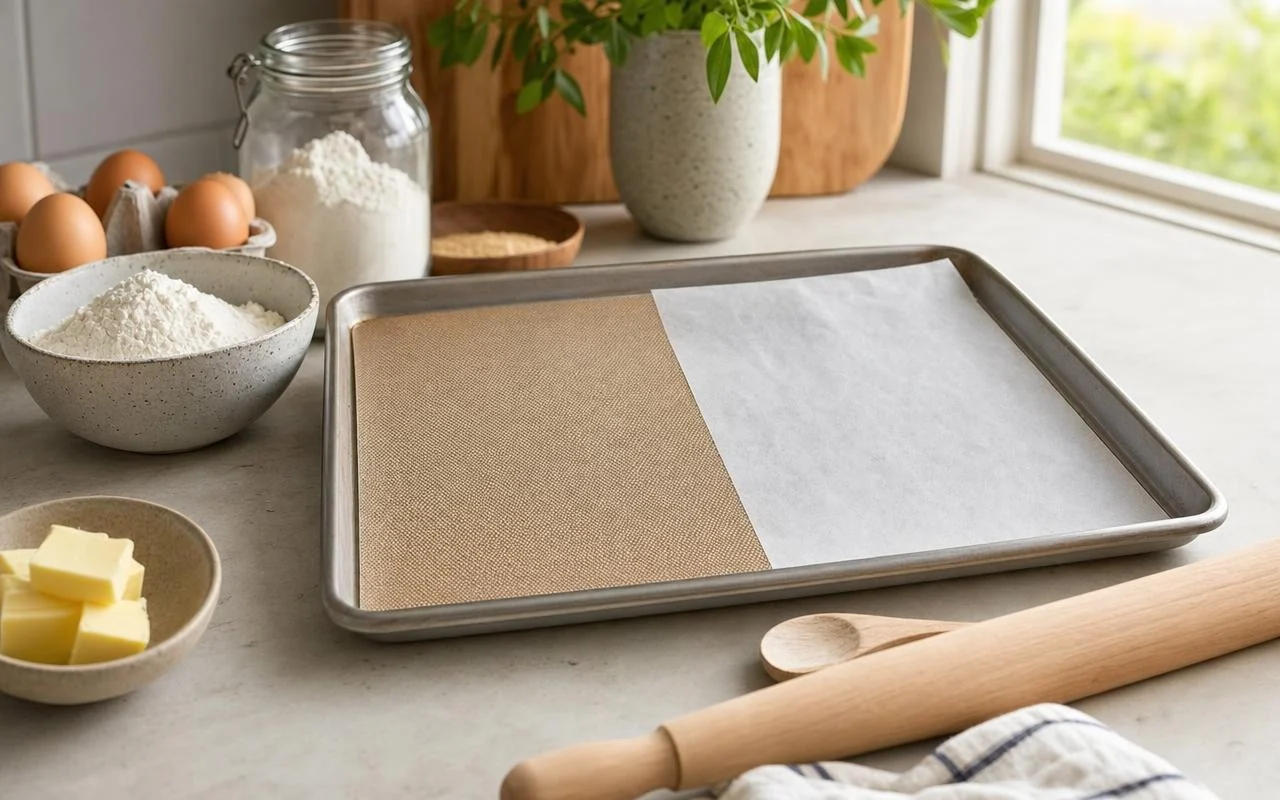
The roll of parchment paper often comes out for the slightest cookie sheet, a gratin, or a few roasted vegetables. We unroll it, we throw it away, without really measuring how much is used with each batch. In many kitchens, this gesture has become a reassuring reflex, almost automatic, far more than a real necessity.
Yet, several schools of pastry making and home cooking are questioning this reflex in the name of more economical cooking that is also gentler on the planet. At King Arthur Baking, Kye Ameden speaks of “7 tips for baking more sustainably” and sums up the idea in one sentence: “Planet-friendly changes you can start today,” written in an article published on April 3, 2024. That same mindset can serve as a guide to using parchment paper at half the amount.
Why reducing parchment paper changes your cooking habits
We often pull out a fresh sheet to prevent sticking, out of fear of failing the recipe or damaging the pan. In reality, many preparations tolerate a simple greasing very well, especially in deep or nonstick pans. The parchment paper then mostly serves as a comfort mat, not an indispensable shield.
Another rarely questioned point is the size of the sheets. A sheet fully covered, with large overhangs, uses much more material than a bottom accurately sized to the pan. By observing these small excesses, one quickly spots room for maneuver. The goal isn’t to deprive yourself, but to distinguish truly useful uses from reflex uses.
7 concrete habits to use parchment paper half as much
Cutting your consumption in half doesn’t rely on one big decision, but on a series of small habits, easy to install in daily life. Each one saves a few sheets, or a few centimeters, every time. Taken together, these micro-savings end up truly lightening the roll.
To get straight to the point, here are seven simple actions that many amateur cooks gradually adopt:
- Reuse each sheet as long as it remains clean and flat, for several batches of cookies or small cakes.
- Cut the paper to the exact size of the mold or pan, instead of leaving large unused overhangs.
- Grease and flour directly the loaf pans, tart pans, or cake pans, saving parchment for truly delicate recipes.
- Use one or two reusable baking mats for frequent batches, such as afternoon cookies or roasted vegetables.
- Prefer durable, well-maintained metal pans rather than disposable trays that are almost always lined with paper.
- Fill each sheet more fully by grouping compatible bake items, to avoid wasting a large sheet for only a few pieces.
- Ask yourself before tearing off the roll: “Could this bake simply be cooked greased or buttered on the sheet?” and test at least once.
Maintaining your baking sheets and organizing your cooking to say stop to parchment
The success of these practices depends heavily on the condition of your baking sheets. A clean sheet, free of burnt residues, readily accepts greased cooking without sticking. During washing up, carefully scrape off stubborn stains and thoroughly dry the metal to prepare the next batches without resorting to parchment as a default.
Organization also plays a key role. Keep reusable mats within reach, set aside a few already-used sheets for quick re-dos, decide in advance which recipes will be made without parchment: all these decisions limit impulsive gestures toward the roll. Sheet after sheet, you’ll notice the roll lasts longer, without sacrificing indulgence or cooking comfort.
