
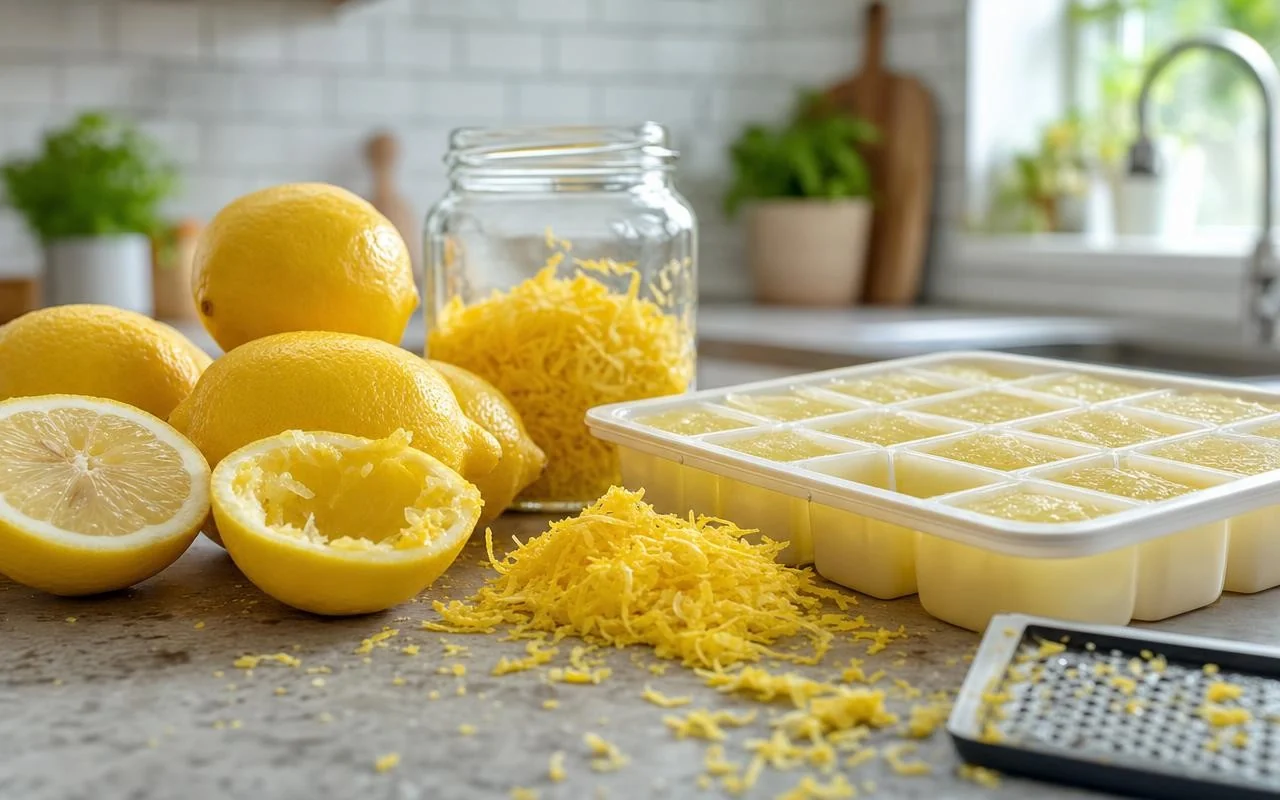
A half-lemon left forgotten in the refrigerator door, a zest grated for a cake and then nothing… Many households see their lemons dry out or mold after a few uses. So the same question keeps coming up: what if we used the freezer to save juice and zest before they go bad?
The lemon does not handle waiting well: once cut or squeezed, its aroma fades quickly and the pulp browns. Websites like Popote et Cuisine or Sauve ta bouffe stress the idea of acting as soon as the fruit is fresh. But can one really freeze lemon juice and lemon zest, and what happens to flavor and food safety?
Congeler jus de citron et zestes : impact sur la qualité et la sécurité
When a food is frozen at -18 °C, the water in it freezes and the growth of microorganisms stops. For the lemon, this halts the risk of fermentation, but the fragrance eventually diminishes. According to StillTasty, freshly squeezed lemon juice stored in the freezer retains its best quality for about three to four months. Beyond that, the acidity still offers protection, but the taste becomes more subdued.
After this period, the juice generally remains safe to consume as long as it has stayed well frozen, simply less vivid on the palate. The pages of Popote et Cuisine or Gamm Vert indeed state that you can freeze lemon juice and zest without fear, provided you maintain proper hygiene and a stable temperature. The main issue concerns mainly the method chosen to prepare and package the lemon before freezing.
How to freeze lemon juice into practical ice cubes
The most practical technique is to juice the lemons, strain or remove the seeds, then pour the juice into a clean ice-tray. The Utah State University Extension recommends leaving a small space at the top of each cavity, since the liquid expands as it freezes. Once the cubes are formed, unmold them and slide them into a well-sealed freezer bag, dated to track storage time.
These lemon juice ice cubes are easy to portion: one cube for a sauce, several for a marinade or a drink. For raw use, it is better to thaw the desired amount in the refrigerator in a small bowl. If you don’t have an ice-tray, you can use small rigid containers, always clean, hermetically sealed and filled not right to the top, to give the juice room to expand.
Congeler le zeste de citron tout en gardant le parfum
The zest concentrates the essential oils of the lemon, hence the strongest aroma. Sauve ta bouffe suggests choosing lemons from organic farming for the zest, or thoroughly rub non-organic fruits under warm water to limit waxes and residues. They are dried, then finely zested with a Microplane-type grater, avoiding the white pith, which is very bitter.
Several organizations, including the Utah State University Extension and The Kitchn, then suggest freezing this zest as-is. You can gather it into a small well-sealed freezer bag or divide it into small portions for easier use. At -18 °C, it retains a good fragrance for three to four months, enough to flavor cakes, fish dishes, or herbal teas. If the aroma becomes rancid or the color browns noticeably, it is safer to discard it, since some germs like Listeria monocytogenes do not always alter appearance.
