
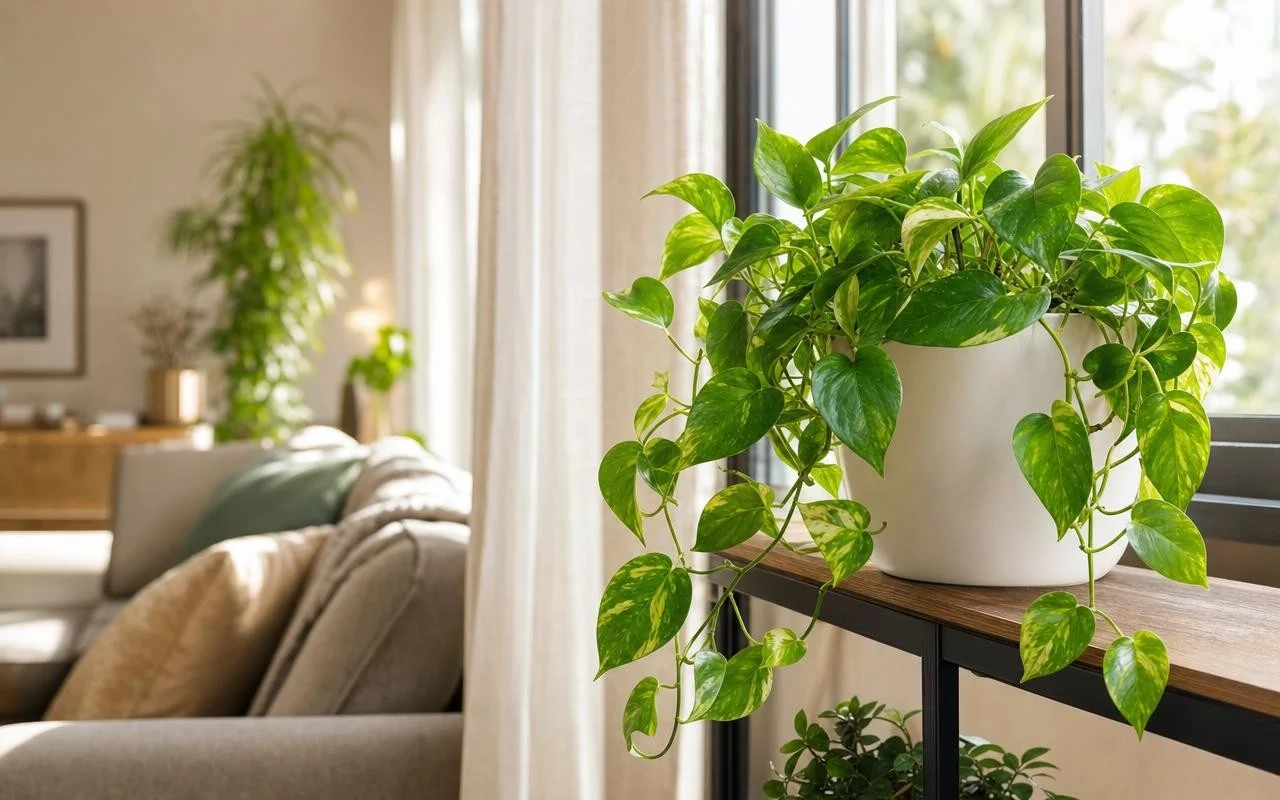
New leaves that keep getting smaller, stems that sprawl, and that creeping doubt: is your pothos lacking water? Many homeowners reach for the watering can at once. Yet, indoor plant specialists reiterate that this reflex often makes the situation worse. Epipremnum aureum, the famous pothos or pothus, forgives watering oversights, but signals very quickly another kind of imbalance.
Originating from tropical regions of the Pacific, this vine grows in the wild under a leafy canopy where light remains abundant yet filtered. At home, when the environment deviates too much from this pattern, the plant slows down, produces fewer leaves, and especially smaller forms. The good news is that this disturbance is typically correctable with a few simple steps.
Small leaves on pothos: light is the culprit
Specialist pothos guides are clear: when it stays away from a window for a long time, the internodes lengthen and new leaves emerge smaller. The Real Jardín Botánico de Kew describes Epipremnum aureum as a tropical, tolerant species, capable of living in varied conditions, which does not mean that all of them favor healthy growth. In a dark room, the pothos survives, but it slows its growth.
Before blaming the watering, several specialists therefore recommend checking the light. Some telltale signs include: stems stretching toward the window, greater distance between two leaves, variegation patterns that fade on speckled varieties. A simple water shortage is more likely to be noticed by the overall condition of the foliage and the substrate, not by new leaves shrinking.
Where to place a small-leaf pothos
To restore energy to a small-leaf pothos, experts recommend bright indirect light, without hours of burning sun. Concretely, place the pot between 50 centimeters and 2 meters from a well-exposed window. One orientation provides soft light in the morning. On the south or west side, a light veil or stepping back from the glass prevents leaf burns on the leaf blade.
The pothos also appreciates a stable temperature above 16 degrees Celsius, with an ideal range around 18 to 29 degrees. Another lever to enlarge the leaves is to let it climb a stake. Cultivation guides remind that this vine, when it can cling, produces larger leaves than when it trails downward. A simple coconut or wooden stake, planted at the center of the pot, suffices to guide the stems with soft ties.
Watering and substrate for a small-leaf pothos
The reflex to water more as soon as the leaves shrink often leads to overwatering. Horticulturists’ recommendations go in the opposite direction: let the substrate dry slightly between waterings. Just press a finger into the top few centimeters of soil and weigh the pot. If the surface is dry and the container light, water thoroughly until water escapes from the holes, then empty the saucer. In summer, this interval is about 5 to 10 days.
To allow roots to breathe and sustain a healthy leaf surface, guides recommend a draining mix: 60% potting soil for green plants, 20% perlite or fine pumice, and 20% bark or coconut fiber. A pot with drainage holes, repotted every 1 to 2 years when the root ball becomes very dense, helps prevent the problems of stunted leaves caused by lack of space. With light fertilization every 4 to 6 weeks in the growing season, new shoots generally end up broadening, a sign that conditions have improved.
