
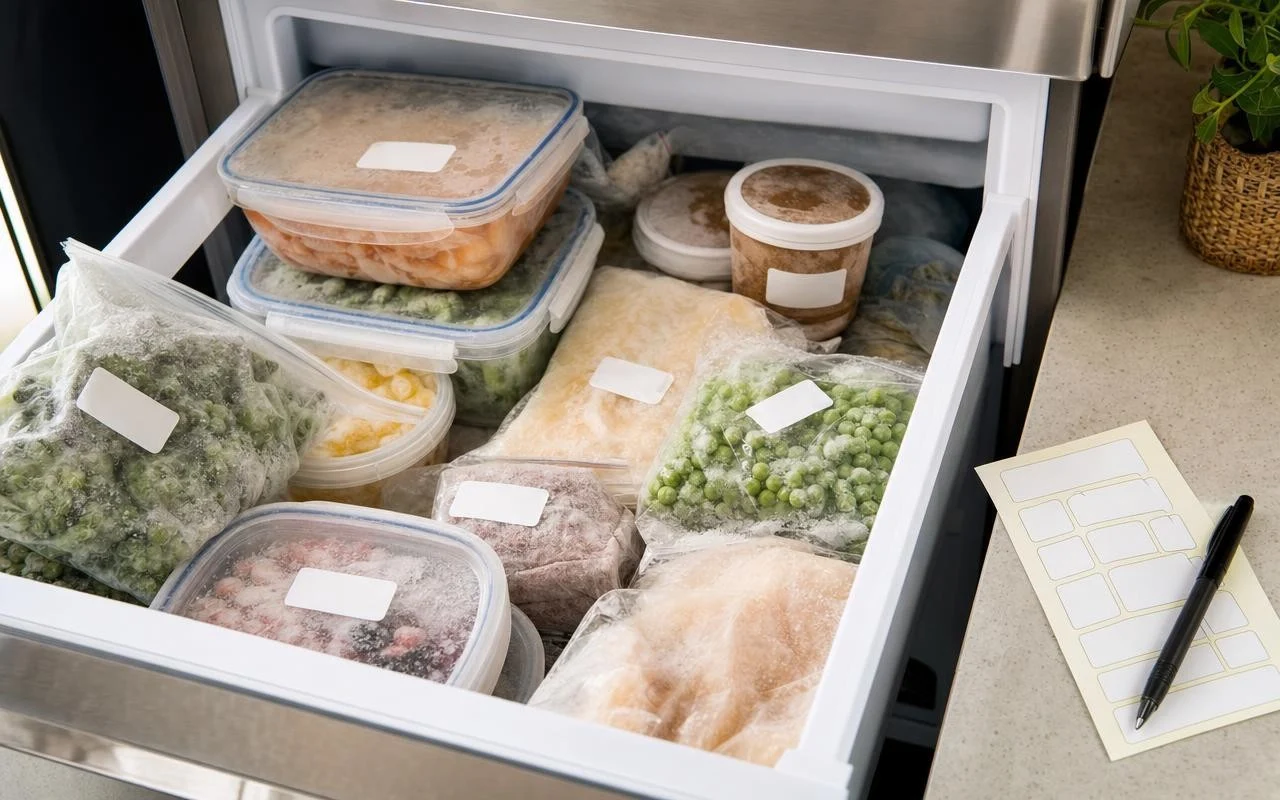
In many kitchens, the freezer acts as a safety buoy: as soon as a dish lingers, it goes into the cold and we hardly speak of it. When a use-by date approaches, the temptation is strong to apply the same logic. We tell ourselves that extreme cold will “reset the counters” and prevent waste. In reality, the story is quite different.
Between DLC and DDM, the labels multiply and it becomes easy to get lost. Yet these two dates do not carry the same weight: one concerns quality, the other safety. When you contemplate freezing a food at the last moment, this nuance changes everything. The red line is precisely this famous DLC.
DLC, DDM: Read dates carefully before freezing a food
According to the DGCCRF, pre-packaged products carry either a minimum durability date or a use-by date. The DDM concerns taste or nutritional quality, not immediate risk. The administration notes: “Provided that their packaging has not been altered, foods whose DDM has passed can be consumed without risk by the consumer.” A package of biscuits with an expired DDM thus does not pose the same issue as a tray of meat with a short DLC.
For foods that are “microbiologically highly perishable,” the law requires a DLC. Service-Public.fr recalls that this date marks the moment from which consumption can become dangerous to health. Beyond this, bacteria may have reached levels capable of causing intoxication. And as soon as a package is opened, the DGCCRF specifies that the DLC loses its meaning: the initial protection disappears, so prudence must increase.
Why freezing does not catch up with a food whose DLC has been reached
The Ministry of Agriculture recalls that “most microorganisms survive freezing.” Cold does not sterilize a food; it merely halts the situation. If you freeze meat on the day the DLC is reached, while bacteria have already proliferated a lot, you lock in a high level of risk. The DGCCRF is categorical: “Never freeze a product whose use-by date is close, reached or past.”
Another pitfall is the cold chain. Service-Public.fr notes that a break can make a food dangerous even before the DLC: long shopping trips, fridge too warm, door frequently opened. Meanwhile, bacteria multiply. The Ministry of Agriculture illustrates this phenomenon with a bacterium that divides every twenty minutes: after three hours at room temperature and then three hours before actually freezing, the population can be multiplied by 1,024. The freezer then only freezes a food that is already heavily contaminated.
The right reflexes for freezing a food before the DLC
The safety indicated by a DLC is valid only if storage conditions have been respected from start to finish. To limit waste without taking risks, the Ministry of Agriculture recommends freezing “as a precaution and not at the end of the DLC.” In plain terms, do it a few days before the date, when you know the item will not be eaten. A few simple habits help secure this domestic freezing.
In practice, it is better to freeze meat or fish while still well before their date, rather than relying on the last moment. A product whose DLC is exceeded, even by one day, must be discarded, not transferred to the freezer. Conversely, a food with a passed DDM, with intact packaging and a normal appearance, can be eaten and, if needed, frozen, the question mainly revolving around taste loss. These benchmarks, reiterated by the DGCCRF in a note updated on December 17, 2025, provide a clear framework for sorting your fridge without putting your health at risk.
