
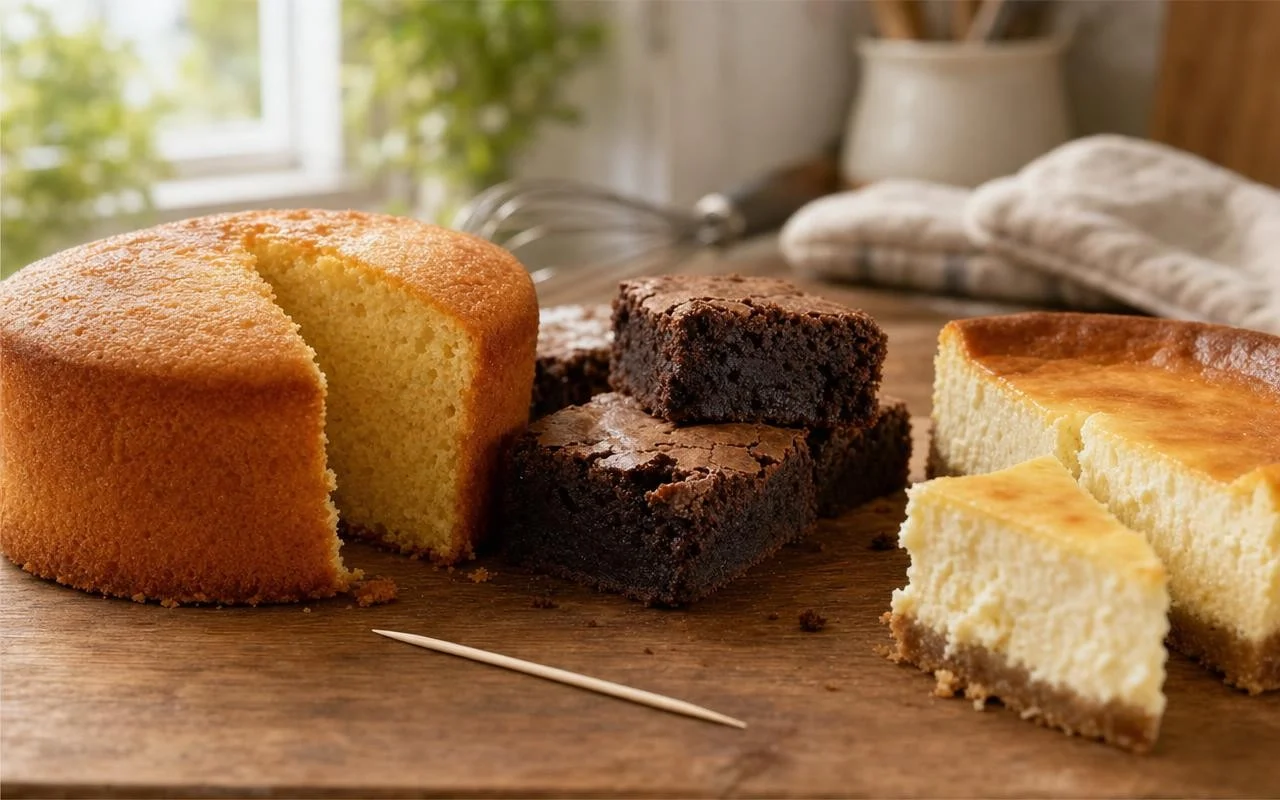
Almost everyone, or nearly everyone, has already stuck a small wooden toothpick into the center of a cake to check whether it’s baked. This gesture has become automatic, passed down from parent to child as if obvious. If the toothpick test comes out clean, you remove the pan from the oven; otherwise you keep baking. Yet this grandmother’s trick doesn’t tell the whole story.
Homemade pastries have become filled with gooey cakes, ultra-tender brownies, creamy cheesecakes or airy genoises, each with its own ideal texture. In this context, a simple dry or damp stick is no longer enough to judge doneness. It can even push you toward overbaking or taking a dessert out too early. So, in which cases does the toothpick truly mislead?
The toothpick test and what it truly reveals about cake doneness
The principle of the toothpick test seems simple: you insert the stick into the center of the cake, check whether any batter sticks to it, and decide. In reality, this test measures only one very partial thing: the presence of still-fluid batter at a specific spot. It says nothing about the overall structure of the crumb or the interior moisture.
On a yogurt cake or a plain sponge, this method works somewhat, because you are looking for a baked, fairly dry crumb. A toothpick that is almost clean, with a few crumbs, often corresponds to a well-cooked cake. But as soon as the desired texture becomes moister, richer or denser, the tool loses reliability. It begins to give misleading signals.
The cakes for which the toothpick test goes wrong the most
First trap: brownies and molten chocolate cakes. Their center should remain dense and moist, sometimes almost creamy. A toothpick stuck in there will inevitably come out with damp crumbs. If you wait for it to come out completely dry, the brownie will have already lost its fudgy edge and become dry and crumbly. The same problem for a fondant chocolate cake: the gooey center is precisely what you’re after.
Another tricky case is cheesecake or thick flans. The topping, based on cheese or eggs, sets as it cools. A toothpick may come out clean while the center still trembles, which is normal. Extending the baking until a toothpick is perfectly dry often yields a grainy texture and a cracked surface. In cakes rich in fruit or chocolate chips, the toothpick can traverse a piece of fruit or a melted chip: it comes out with juice or chocolate on it, while the batter is cooked. And in a crown mold like a bundt pan or in a very large cake, the toothpick simply won’t reach deep enough to reflect the slowest-to-cook zone.
What methods to prefer for checking doneness without the toothpick test?
Bakers often prefer to combine several cues. The most reliable remains the baking thermometer, inserted at the center of the cake: it provides a precise indication of the heat reached at the core. Without entering into numbers, each dessert family has an ideal temperature that guarantees a cooked but still moist center. Alongside this tool, visual signs matter a lot: edges slightly pulling away from the pan, a matte surface rather than a shiny one, a well-golden color.
To the touch, many cakes respond well to the spring-back test: gently press the center; it should rebound rather than leave a fingerprint. For cheesecake, one observes rather a slight wobble in the middle while the edges are set. And if one wants to keep the toothpick test, it is better used as a clue among others: accept a few damp crumbs for a brownie, aim for a nearly dry stick for a genoise, prick in several spots and always cross-check with what you see and what you feel under the fingers. It is this blend of cues that allows you to pull the cake at the exact moment, not a single toothpick.
