
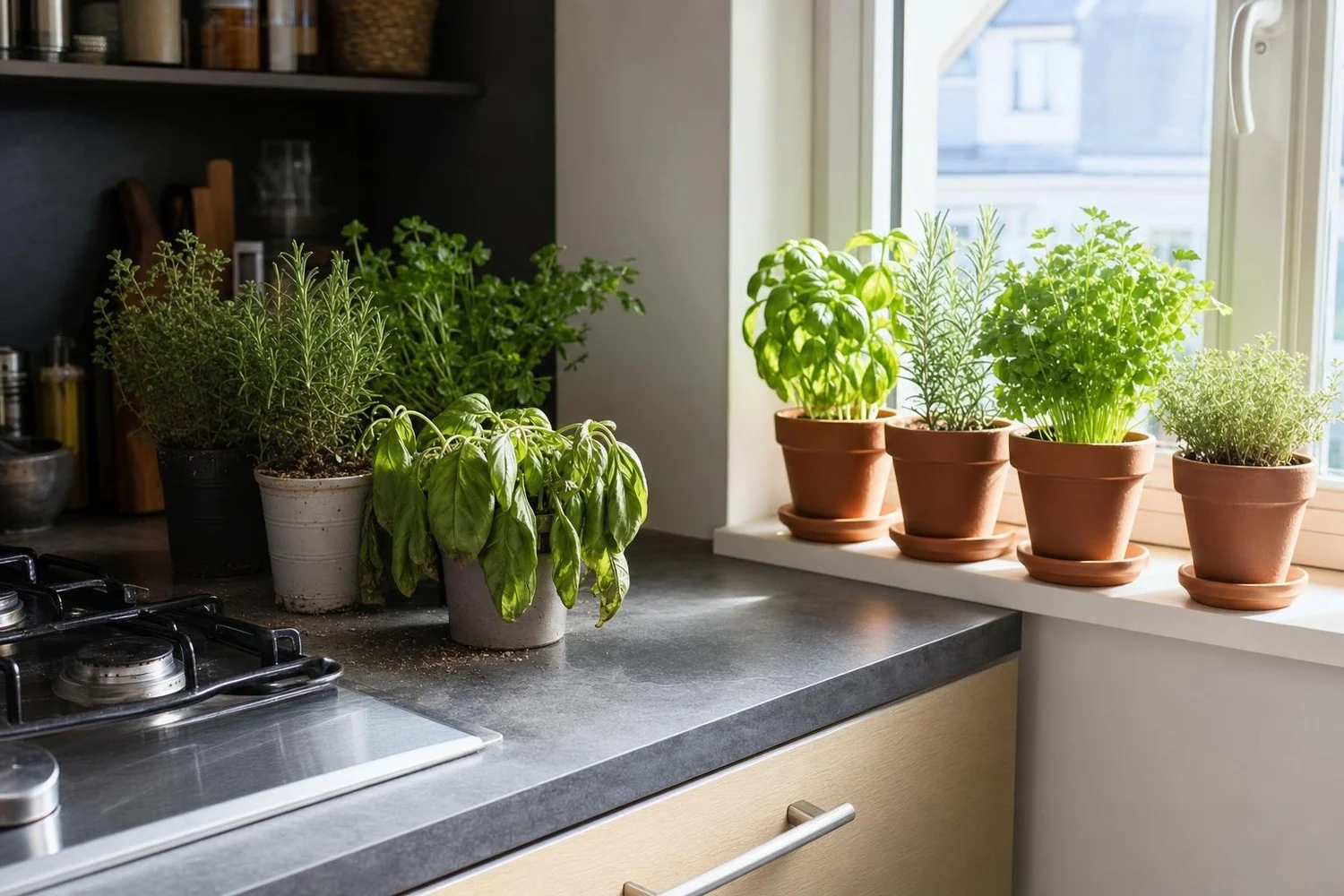
Your supermarket basil plant looked perfect on the worktop, then, in a matter of days, it sagged for no obvious reason. Many people conclude they simply aren’t good with plants. In an article picked up by AOL, the authors reassure readers: “We have some good news: your herbs aren’t dying because you’re a ‘bad plant parent’. They are probably dying because the modern kitchen is a fairly hostile place for plants.”
So the issue isn’t so much you as the room itself. Between low light far from windows, dry air created by the stove and oven, decorative pots with no drainage holes, and crowded supermarket clumps, the kitchen accumulates handicaps, notes the Missouri Botanical Garden. University of New Hampshire Extension observes that these constraints are enough to cause a plant to wither, even when you water it carefully.
Why your aromatic herbs die in the kitchen: light and dry air
Light is almost always lacking. Gene Caballero, gardener and co-founder of GreenPal, reminds us that most herbs need 6 to 8 hours of direct sun per day. Yet such light levels are only reached at the edge of a well-lit window, according to Iowa State University Extension specialists. According to Catherine Trudeau, “it is very rare for an indoor space to receive enough light for leaf scorch to become a real concern.”
Kitchen air also works against your plants. The Missouri Botanical Garden notes that many herbs prefer humidity around 50% or higher. The warm drafts from stoves, ovens, or a vent rapidly dry the leaves: brown-edged foliage near the gas burner, curling leaves, and premature leaf drop are often signs of air that is too dry rather than a lack of water.
Watering, drainage and pots: the traps that doom your herbs
On the water front, Gene Caballero is unequivocal: “the biggest mistake I see people make with herbs is overwatering.” Woody herbs like rosemary, thyme, or sage come from dry soils and “don’t like roots that are constantly wet.” The University of New Hampshire Extension recommends waiting until the top 2–3 centimeters of soil have dried before watering again.
The container matters almost as much as the water. Catherine Trudeau recommends: “Always choose containers with drainage holes at the bottom.” Vie Pratique shows that the self-watering pot keeps the clump damp, which suffocates the roots. Carmen Perr and Le Parisien advise simple terracotta pots and replanting supermarket herbs, which “will become 3 to 10 times larger than when they were bought,” Trudeau notes.
Repotting, pruning and a rescue plan for a kitchen basil
To save a kitchen basil, specialists from the University of New Hampshire Extension advise beginning with repotting. Gently remove the clump from the small plastic pot, separate it into several tufts and plant 2 or 3 plants per greased, pierced terracotta pot in a light, well-draining potting soil. Then place the pot near a bright window; if sunlight is lacking, a grow-light can compensate for 14 to 16 hours a day.
Finally, adopt a new routine. Water only when the soil surface feels dry to the touch and always empty the saucer so the roots don’t sit in water. Keep the pot away from direct heat sources. And above all, harvest often: for Gene Caballero, “not cutting your herbs is one of the fastest ways to lose them.” Regularly pinch the tips of basil, parsley or mint and use those stems in cooking.
