
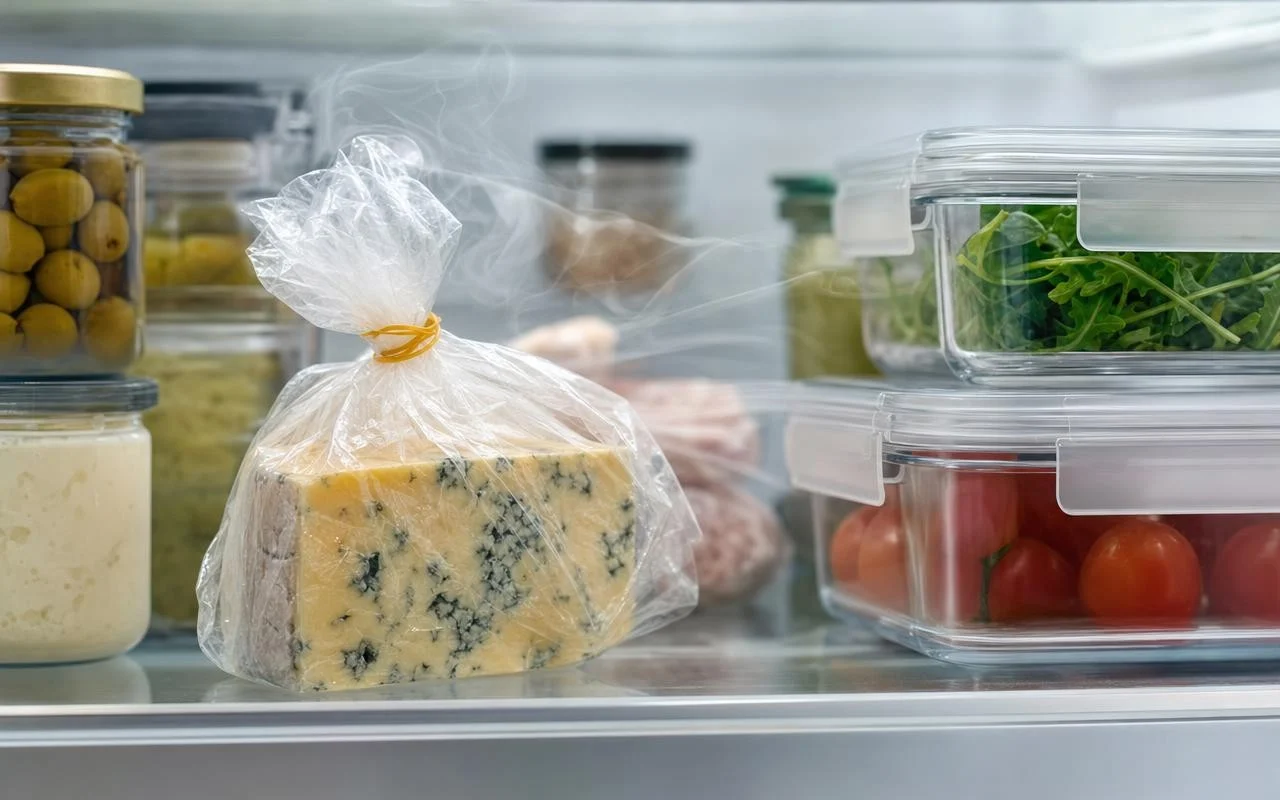
Open your refrigerator and smell a cloud of cheese, garlic or fish, even though the bag is tightly sealed with a elastic: a familiar scene. We think we’ve “reclosed” the food, yet the odor has invaded everywhere, even into butter and yogurt. Why does this simple gesture almost never manage to retain the most stubborn scents?
Washed-rind cheeses like Époisses or Livarot, fish leftovers, half-cut onion: some foods are true odor-diffusion champions. On the other hand, a rubber band seems reassuring and practical. Yet, storage guidelines remind that these products release highly volatile molecules, and health authorities insist on packaging that is really closed. The difference lies in a detail invisible to the eye, but very clear to the nose.
Elastic and odorous food: why air still circulates
A rubber band tightens the top of a bag, but it does not create a continuous seal. The plastic wrinkles, forms corners and small air tunnels that remain open, even if the knot looks very tight. The molecules responsible for the odor are tiny; they slip through these interstices like a chimney. As long as air passes, the odor passes too, and the food is not truly isolated from the rest of the refrigerator.
This air passage not only poses a problem of smell. It also accelerates the drying out of the product and fosters cross-odor contamination between foods. Added to this is the hygiene question: a poorly protected food more easily receives splashes or drips from other goods, such as raw meat or fish. “The more a ready-to-eat food stays in the refrigerator, the more the bacterium Listeria can multiply, especially if the temperature rises above 4 °C,” recalls the U.S. Food and Drug Administration.
Closing an odorous food: cover and seal rather than tighten
In 2023, the U.S. Food and Drug Administration reiterated a simple rule: “Store foods covered. Keep refrigerated foods in covered containers or resealable storage bags and check daily whether leftovers show signs of spoilage,” it recommends. The aim is to create a continuous barrier, using a covered container, a sealed box or a resealable bag, while keeping the refrigerator at 4 °C or below and the freezer at -18 °C.
Cheese specialists echo this principle at home. For washed-rind cheeses like Époisses or Livarot, they often advise keeping the original paper packaging, then placing everything in a slightly ajar airtight box. This double envelope limits the diffusion of odors in the fridge while letting the cheese breathe. A completely airtight closure would risk trapping too much moisture, causing condensation and altering the texture.
Three simple solutions to close an odorous food on a daily basis
For everyday use, a few very simple solutions protect an odorous food far better than a rubber band.
- Resealable zip-top bag: the closure that clips across the full width greatly reduces air exchanges around the food.
- Airtight container: the rigid wall and the lid seal form a true barrier, practical for saucy dishes and very fragrant cheeses.
Yet some habits still perpetuate the problem: a bag already pierced tightened with a rubber band, film simply folded under a plate, a lidless box left on a shelf. The odor ends up escaping, even if you think you’ve blocked it. And the absence of odor does not guarantee safety. “Keep in mind that a food can make you very sick even if it does not seem spoiled by its appearance, smell, or taste,” notes the agency. Relying on real closures and a clean fridge limits both unpleasant odors and health risks.
