
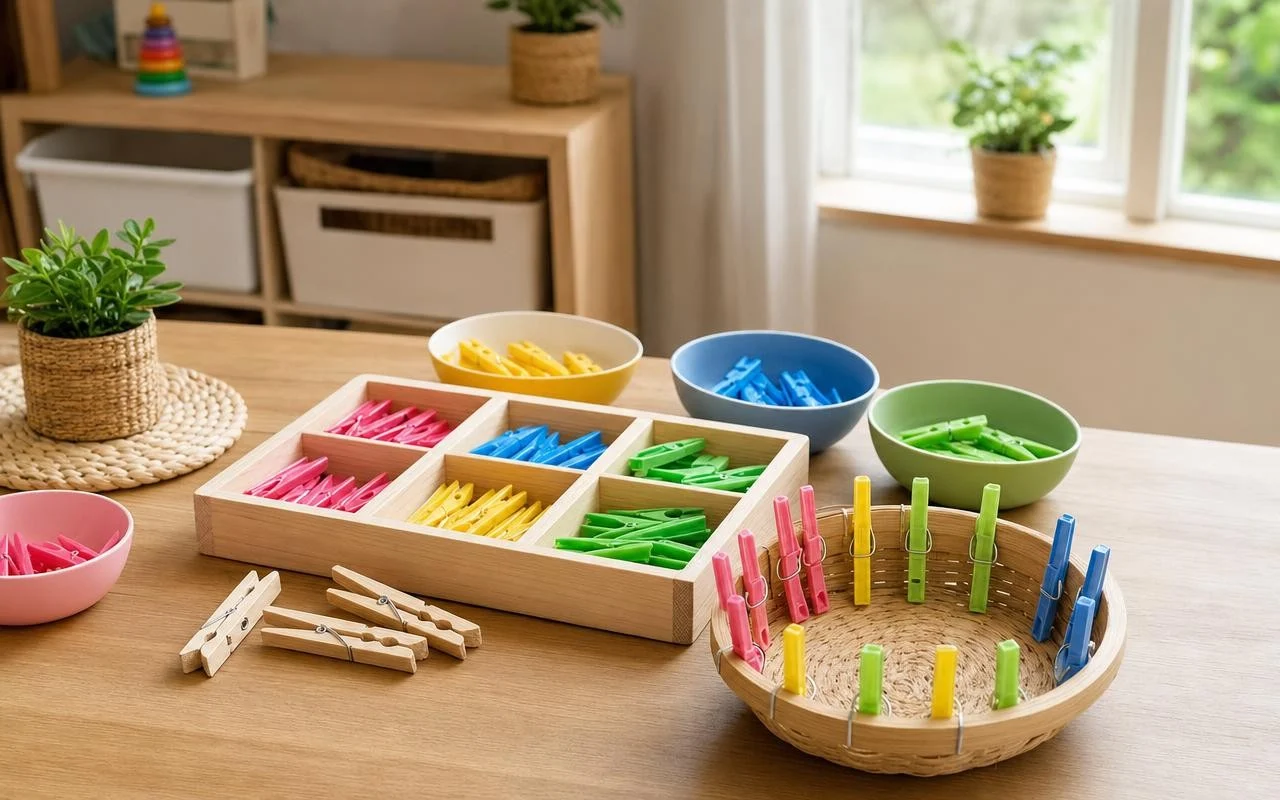
Your child grabs the clothespins, tries to open them, bangs them on the table, and you waver between encouraging this discovery and tucking them away. These small objects strengthen the hand, refine eye–hand coordination, and prepare for writing, but they can also prove frustrating, even dangerous if introduced too early or with unsuitable materials.
In Maria Montessori’s pedagogy, clothespins fit into a path of fine motor development: the child begins by transferring with their hands, then with a spoon, before moving on to clothespins to grip and move objects. Age guidelines exist, but they are mainly based on developmental stages and on safety rules related to small parts and the risk of ingestion. And the first question to ask is simple: which pinching tool are we really talking about?
Clothespin Fine Motor Activity: Which Tools for Which Level of Difficulty?
We often refer to the clothespin, but not all pins require the same effort. The mini wooden or plastic clothespins, very flexible, engage little of the hand. Transfer-style tongs resembling small kitchen tongs, connected like linked rods, are easy to close. Classic clothespins, however, compel the child to use a three-finger grip (thumb–index–middle) and demand more strength and precision.
In Montessori-inspired practical life activities, the progression follows the child’s abilities: around 12 to 15 months, they transfer with their hands, then with a small spoon or a pitcher. The pinching tool comes last, up to about 4 years old, to refine hand–eye coordination. The aim isn’t to go fast, but to offer the tool at the moment when the hand and attention are ready.
Clothespin Fine Motor Activity: From What Age to Start?
Development specialists, such as the journal Enfances et psy or the Kaleido organization, place the emergence of the thumb–index pinch at around 9 to 12 months: the baby then grasps small objects between the tip of the thumb and index finger. This is not yet sufficient to use a spring-loaded clip. A gentle entry becomes possible around 18 to 24 months with 4 to 6 soft mini-clips, aiming only for the open–close gesture, under supervision.
For a more structured clothespin fine motor activity, most Montessori guides place the right moment around 2.5 to 3 years. This is the recommended age for transfer-with-clip activities, where the child moves objects from one bowl to another, and for clothespin-on-a-support games. By about 3 years, one can introduce the famous pin-and-pom-pom trays or color sorting, with the clothespin remaining a key tool until about 4 years old.
Safety, Small Objects and Signs That Your Child Is Ready for Clothespins
Safety remains the non-negotiable point. The CPSC, the American Consumer Product Safety Commission, reminds us that toys for children under 3 years should not contain small removable parts. In 2019, it recalled light-up wands whose battery caps detached: a child swallowed a button battery removed from the toy and had to undergo surgery. These batteries can burn the esophagus in about two hours.
Before pulling out the clothespins, observe your child closely. If they enjoy transferring, already spontaneously use the thumb–index pinch, handle objects without bringing them to the mouth, and can stay focused for a few moments, you can offer small challenges: clip 4 to 6 clothespins onto the edge of a basket, then transfer large caps between two bowls, before moving on to the pom-poms or color sorting.
