
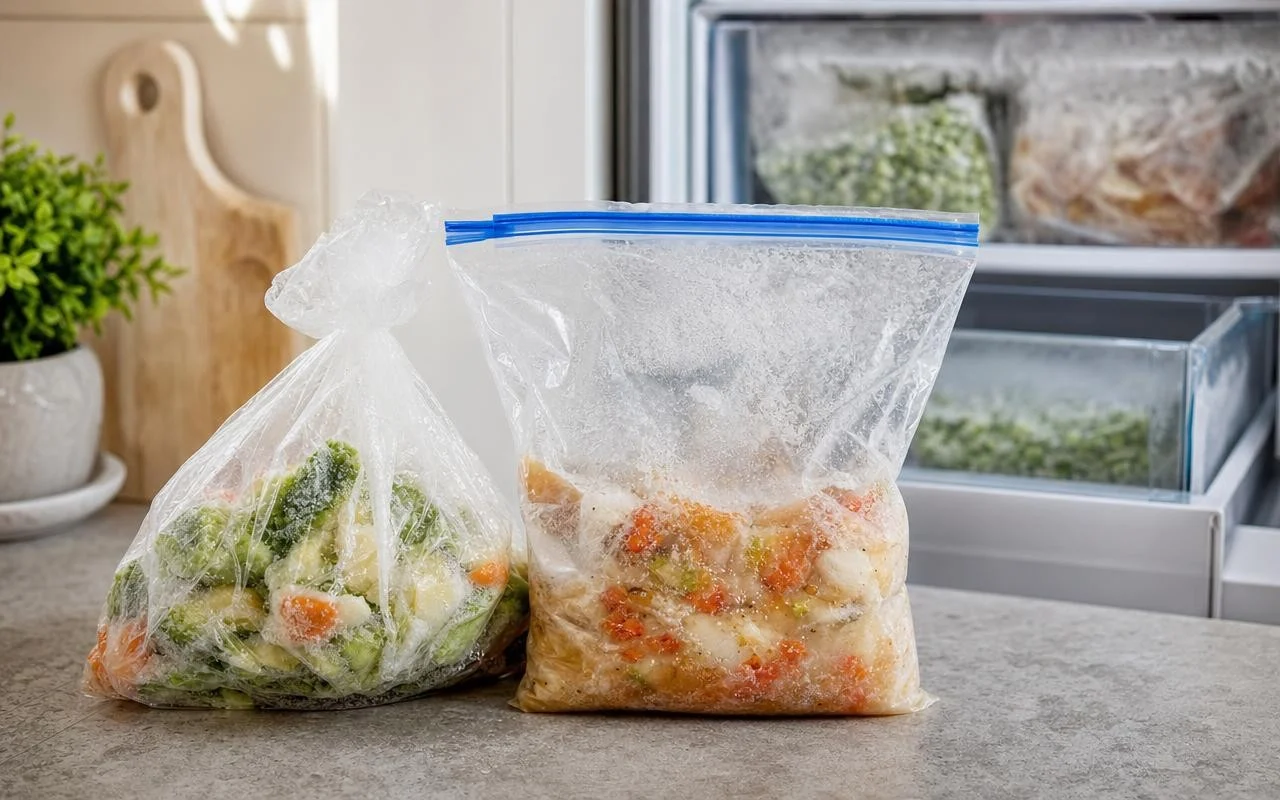
In many kitchens, an entire drawer is filled with plastic bags: freezer bags, storage bags, and small formats for snacks. They look alike, they fit together, and one quickly tells oneself that a plastic bag is as good as another for freezing a few leftovers. It’s tempting, especially when you want to avoid buying several different references.
In practice, this shortcut is not neutral. Bags intended for freezing are not just a bit thicker: they are designed for a very specific use, tested for negative temperatures and long contact with foods. Understanding this difference helps avoid unpleasant surprises when taking containers out of the cold. The boundary between the two categories is not as blurry as it might seem.
Freezer bag or storage bag: what the law provides
According to the Directorate-General for Competition, Consumer Affairs and Fraud Control (DGCCRF), plastics intended for food contact are governed by European Regulation No. 10/2011. This regulation sets a list of allowed substances and, above all, migration limits into the foods. The global migration limit is fixed at 10 mg/dm² of contact surface, with a value of 60 mg/kg for materials intended for infants and young children.
The DGCCRF documents also remind that these materials must be used under the conditions specified: type of food, temperature, duration of contact, single-use or repeated-use. This information appears either in a conformity declaration between professionals or on labeling intended for the general public. A storage bag intended for pantry or refrigerator storage is therefore not necessarily evaluated or authorized for prolonged freezing at -18 °C.
Thickness, durability and closure: what really changes at the freezer
Physically, a freezer bag is not simply a thicker version of a storage bag. Bags specifically designed for the freezer generally show a thickness of roughly 40 to 80 microns, whereas a standard bag hovers around 15 to 20 microns according to the site MesListesDeCourses. This gap affects resistance to cold, to impacts in the drawers, and to the possible edges of frozen food.
Another key difference is the barrier to air and moisture. High-quality freezer bags use less porous plastic and a more refined closure, often a robust zipper, which limits micro-entries of air for months. A thin storage bag, less hermetic, allows more air to circulate inside the freezer, which speeds up drying and ice crystal formation. In store aisles, a few cues help identify packaging suited to cold conditions:
- clear freezing mention;
- snowflake symbol;
- thickness indicated in microns.
Air, freezer burn and proper daily use of bags
Food safety authorities explain that the infamous freezer burn occurs when air reaches the surface of frozen foods. Water slowly evaporates, the surface dries, develops grayish or whitish patches, and the texture becomes fibrous. This defect affects taste but does not render the food dangerous by itself, provided it was frozen and stored correctly.
To limit this phenomenon, agricultural extension services describe a simple rule: keep air out and moisture in. Hence the value of a thicker, well-sealed material, filled to the maximum and then carefully expelled of its air before sealing. At home, reserve storage bags for pantry or refrigerator storage, and choose bags labeled for freezing for anything that must stay cold for several weeks, which greatly reduces unpleasant surprises.
