
When the heatwave settles in, many borders scorch in a matter of days. Waterings multiply, tanks run dry, and water becomes a real headache. In this context, some gardeners recall the old farm lessons, full of flowers without automatic irrigation. One plant in particular stole the show in the heart of summer.
Long neglected and then quietly reintroduced into garden centers, this perennial holds its own where many others give up: poor soils, pebbles, scorching slopes. It begins to bloom in spring and continues until the first frosts, with flexible stems studded with tiny delicate flowers. Once established, it is content with rainfall. Its secret fascinates more and more fans of the dry garden.
Gaura, the old-time perennial that endures the heat without watering
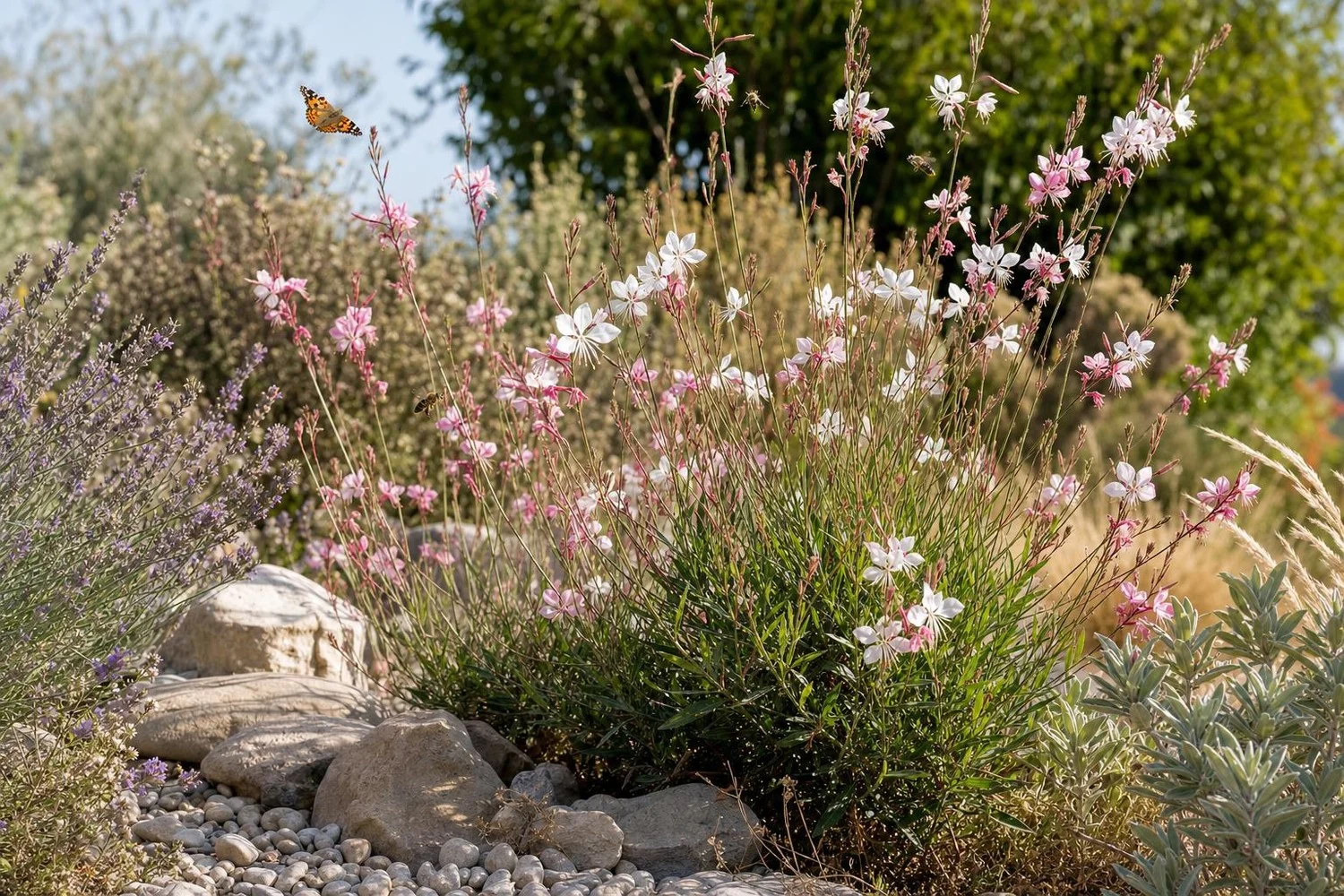
This discreet plant is gaura, often nicknamed butterfly plant for the light look of its bloom. Under its old botanical name Oenothera lindheimeri, it already appeared among the hardy species chosen for rustic courtyards. Its slender stems carry, from May to frost, a multitude of small white or pink flowers that continually renew themselves.
Born from proven horticultural practices, this perennial was chosen precisely for its resistance. Articles in Mon Jardin Ma Maison remind that its root system sinks deep, somewhat like a taproot, to capture moisture far beneath the dry surface. Its finely cut foliage limits evaporation, allowing it to stay cool even in full sun while other plants falter.
Long blooming period and water thrift: why gaura persists without irrigation
The cultivation sheets cited by Mon Jardin Ma Maison describe a bloom that starts around May and lasts until the first frosts, sometimes extending into December depending on the region. So that’s about eight months of flowers on the same clump. When the exposure is in full sun and the soil well-draining, this bloom remains surprisingly steady, giving a colorful bed from spring to fall.
The ‘no-watering’ promise does not mean it goes completely without care. Experts specify that gaura should be watered generously at planting, then a few times during the first year, while its roots take hold deeply. Once well established in the ground, in poor but very well-draining soil, it then relies on rainfall, even in dry periods. In a pot, or during a truly exceptional heatwave, an occasional watering is still useful.
Planting gaura correctly and pairing it for a durable drought-tolerant bed
To fully enjoy this butterfly plant, experts recommend a sunny, full exposure. The ideal soil remains poor, stony, very well-drained, like a gravel bed or a rockery at the foot of a wall. Before planting, loosen the soil to about 30 cm and mix in a portion of gravel or pouzzolane. The plants should be spaced about 40 to 60 cm apart, in spring or early autumn, with a generous watering right after placement.
In terms of upkeep, gaura proves just as economical: a clean back cut to 10 or 20 cm in height at the end of winter is enough to spur new shoots on fresh stems. Its lifespan is around three to five years, but it sometimes self-sows and can be replaced easily. Its flowers attract bees and butterflies, especially if paired with other drought-loving champions such as Achillea millefolium (yarrow), Nepeta, Erigeron, Perovskia, or Cistus.
Sources
- Modes & Travaux
“Farewell to faded flowers in the garden: this sublime blue perennial is the indispensable ally for keeping blooms vibrant under heat.”
