
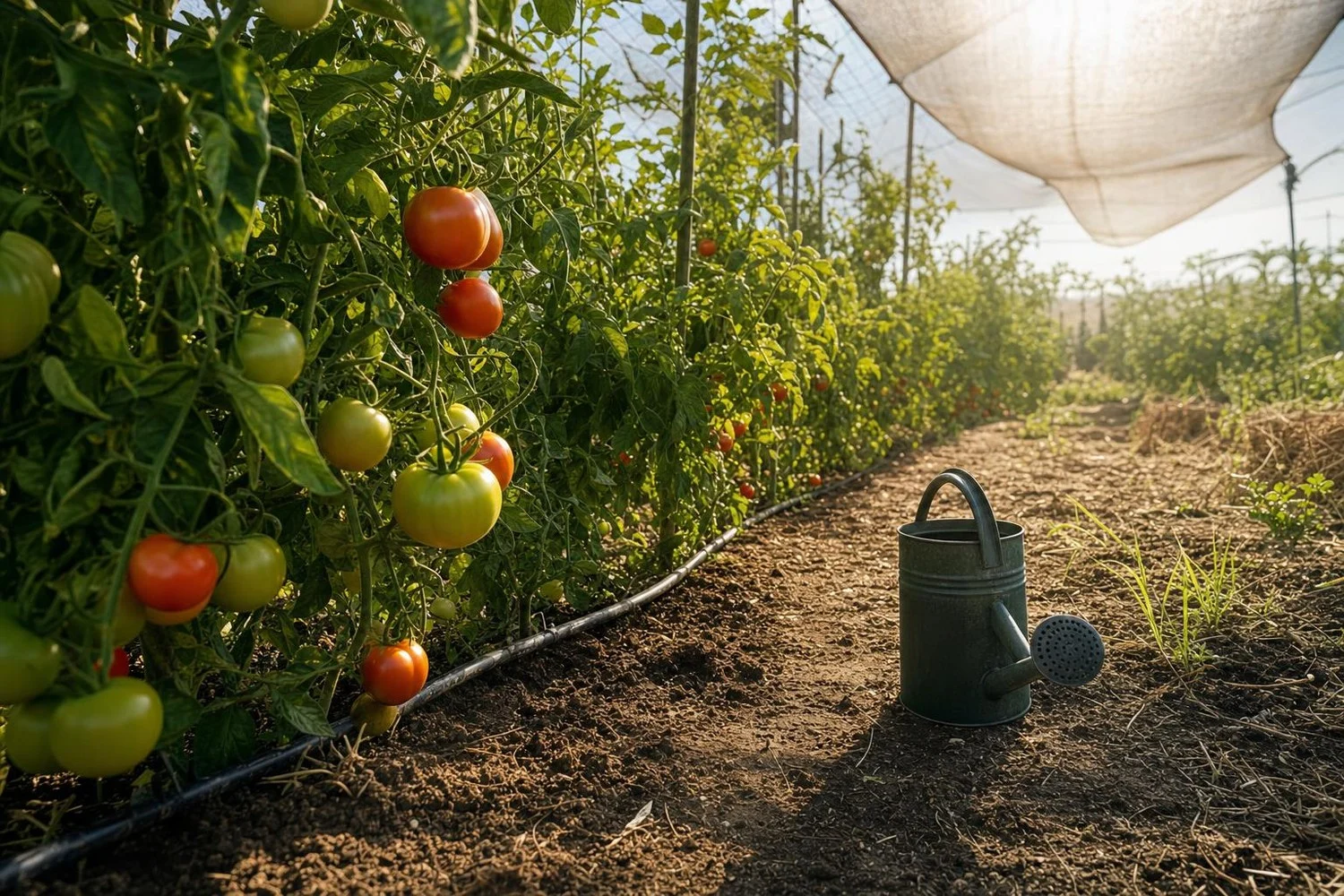
In many gardens, the scene repeats itself: during heatwaves, we extend the hose, open the faucet a little wider, and flood the feet of the tomato plants, convinced that we are saving them from thirst. Yet, despite these repeated baths, the fruits stay tiny, green, hard, and the leaves appear even more droopy in the middle of the afternoon.
Farmers, for their part, are wary of this reflex to water tomatoes more when it is very hot. They know the real problem does not always stem from a lack of water, but from the temperature that slows down the entire plant. Their secret lies in a few targeted actions, almost opposite to our habits.
Quand la canicule bloque vos tomates, même si vous les arrosez plus
Tomatoes love heat, but only up to a point. Around 21 to 28 °C, they grow and fruit beautifully. As soon as the thermometer stays above 30 °C for several hours in a row, the stomata on their leaves close to limit evaporation, photosynthesis slows, and the plant enters survival mode. The leaves soften at noon, then stand back up in the evening: this deceptive signal makes you think they are thirsty, whereas it is mainly the sun that is harming them.
Beyond 32 to 35 °C, another consequence: pollen becomes largely sterile, flowers abort, and the small fruits already formed stop growing. You end up with clusters that are stiff, green, and unripe, even if the soil is moist. In this context, watering tomatoes during a heatwave without thinking is like persisting with a treatment that does not address the real cause of the blockage.
Arroser plus les tomates en pleine chaleur : des erreurs qui aggravent tout
When one stubbornly adds water several times a day, the potting soil becomes saturated. The roots breathe poorly, the plant suffers more stress, and cryptogamic diseases, such as late blight, find ideal conditions. A watering in the middle of the afternoon, at the moment when the air is scorching, largely evaporates before even reaching the root zone: you consume a lot of water for a very small benefit.
Another common pitfall: small, shallow daily waterings. They only keep the top few centimeters of soil moist, which encourages roots to stay on the surface, where the soil heats the most. The same problem occurs with a thick mulch of fresh clippings: the fermentation raises the temperature and, as it dries, this layer forms a waterproof crust that makes water run off. It’s better to let this grass dry for a few days in the sun to obtain a truly protective dry-grass mulch.
Le protocole des maraîchers : ombrage léger et bon arrosage des tomates en canicule
First and foremost before any new watering, professionals check whether the soil is really dry by inserting a finger or a tool 5 cm deep. If the soil remains cool, there is no need to add more water. During periods of intense heat, they favor a thorough but spaced watering of the tomatoes, early in the morning, ideally before 9 a.m., or at the start of the evening when the air cools down. The water is poured at the base, in a basin, without wetting the foliage, with 5 to 10 cm of dry mulch (straw, dead leaves, very dry grass) to limit evaporation.
The remaining key gesture, often forgotten by amateurs: the shade net for tomatoes. A light mesh, stretched between noon and the late afternoon above the row, lowers the perceived temperature by a few degrees and prevents sunburn. In the morning and late afternoon, it is removed to allow the useful sunlight. In practice, a heat wave is managed with a small routine:
- At dawn: check the moisture at 5 cm, water deeply if needed, leave the mulch in place.
- Late morning: install the veil or a light shade above the tomatoes.
- Midday: do not touch the hose, even if the leaves hang down.
- Evening: remove the shade, observe the plants’ vigor returning and water only if the soil has truly dried.
