
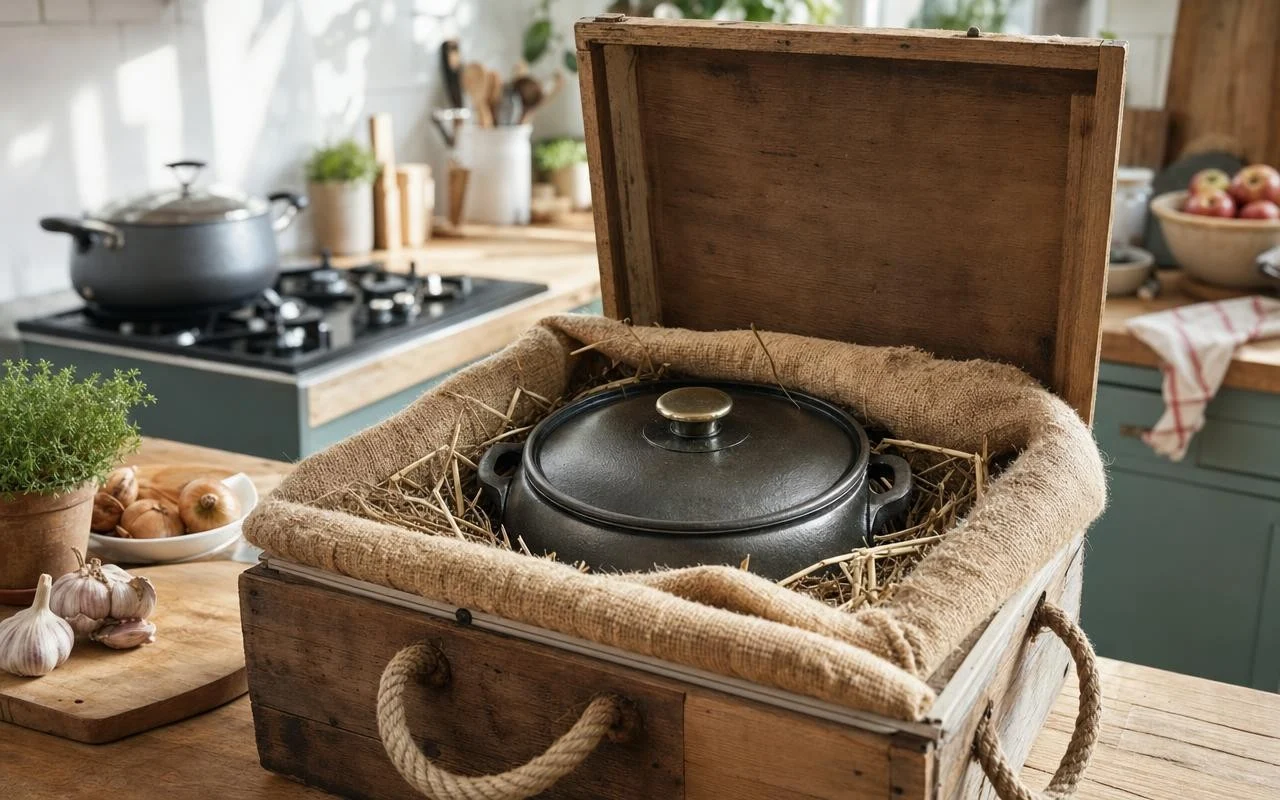
Imagine a stew that keeps simmering by itself, without flame or electricity, for hours. In Victorian-era kitchens, families managed this daily with a simple insulated box filled with scraps of cloth or straw. Today, with rising energy prices, this old idea is attracting curious cooks, campers and enthusiasts of simplicity once again.
This technique also has a global resonance. The Cicle Network notes that 2.4 billion people still lack access to clean cooking, while Sustainable Development Goal 7 seeks modern and affordable energy for all. A very low-tech solution, born in the 19th century, could help cook while consuming far less fuel. This “magic pot” works thanks to a very simple idea from physics.
Norwegian Pot: the haybox, a fireless cooking with retained heat
The Norwegian pot, or haybox, is an insulated chamber that finishes the cooking of a dish using only the heat already stored. You bring the dish to a boil for a few minutes on the fire, then immediately place the steaming pot into the insulating box. No more flame, no more electricity: the retained-heat cooking, sometimes called fireless cooking, does the rest and can reduce fuel use by 20% to about 80% of fuel depending on insulation.
The principle did not originate in England but in Germany, where Karl von Drais built insulated cooking boxes at the start of the 19th century. The real breakthrough came at the Paris Exposition Universelle of 1867 with a demonstration dubbed in English Norwegian automatic kitchen, which one can translate as “Norwegian automatic kitchen.” In Victorian households, then during wars, girls were even taught to make a haybox with a biscuit tin and straw. On the science side, it’s the same principle as a thermos or a wool sweater: the still air trapped in the insulation limits conduction, convection and radiation of heat.
How to use a Norwegian haybox today, step by step
Practically, the method still follows the same sequence: fill an appropriately sized pot with a tightly fitting lid, bring to a boil and let it simmer for a few minutes on the fire, between 5 and 20 minutes depending on the dish. Without waiting, place the hot pot into a chamber (thick cardboard, cooler, wooden crate) leaving at least 7.5 cm of insulation on all sides, ideally 10 cm if using towels or light blankets.
Then pack firmly around the pot with hay, straw, wool blankets, towels, dry newspaper, sawdust or even an old sleeping bag. The important thing: a dry insulating material, because humidity drives heat away. Dishes that cook for a long time and with a lot of liquid are the most suitable. A few practical time benchmarks from experience:
- White rice: 5 minutes of boiling, 1 to 1.5 hours in the box.
- Soaked dried beans: 15 to 20 minutes on the fire, then 3 to 4 hours insulated.
- Whole potatoes: 15 minutes on the fire, 2 to 3 hours in the haybox.
- Porridge or oats: brought to a boil in the evening, 6 to 8 hours overnight.
Food safety and ecological interest of the Norwegian haybox
On the hygiene side, one point really matters: the bacterial danger zone between 4 and 60 °C, where bacteria multiply very quickly. A well-insulated haybox keeps dishes above 60 °C for about 4 to 5 hours. One should never return a dish that is already warm or opened to “keep it hot,” as the box then becomes an ideal incubator. For meats, the elderly, pregnant women or young children, it is better to reheat the dish to at least 74 °C using a kitchen thermometer, rather than relying on residual heat.
In terms of energy, this kind of cooking follows the same logic as improved stoves, capable of reducing biomass use by 20% to 75% for the same service. The Cicle Network also notes that 3.7 million people die each year due to the use of fossil fuels for cooking. By stopping the fire completely after the boil, the Norwegian pot adds an additional level of sobriety, whether cooking with gas, induction or wood, at home, while camping or during a power outage, with a simple DIY box or a commercially available thermal cooker.
