
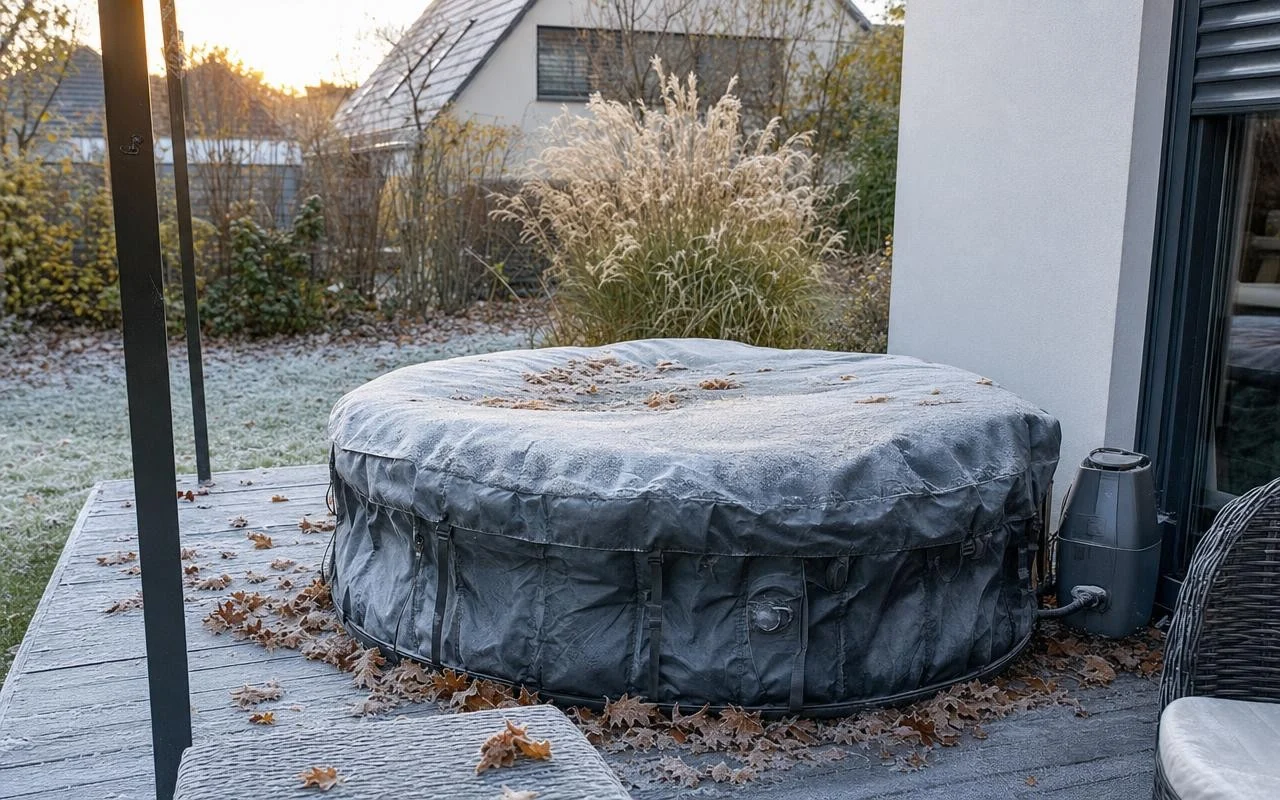
One spring morning, I reassembled my inflatable spa that had spent the winter in its shelter. Upon unfolding it, the fabric felt stiffer, certain air bladders showed strange creases, and a musty smell rose up. I had stored it with care, convinced I had followed the right method.
A few months earlier, I had chosen to enjoy the bubbles for as long as possible. I therefore postponed the winterization until the first frosty mornings, telling myself there would always be time to drain it afterward. Draining done, the spa deflated, folded, and tucked away in a covered space: everything seemed under control. It was only in spring that I discovered where the mistake lay.
Hibernation of the inflatable spa: when waiting for the first frosts becomes a trap
An inflatable spa does not react the same way as an inground pool. Its flexible liner structure does not tolerate temperature swings well, and the humidity that sets in during autumn. The longer you wait, the colder and more water-saturated the air becomes, which complicates the evaporation of even the tiniest drop trapped in a crease. Specialists recommend starting the winterization at the very beginning of autumn, around October, rather than waiting for the hard freezes.
In my case, I delayed week after week, until well into November. Some days remained mild, but the nights were cool and damp, preventing a true complete drying of the fabric after draining. I folded the spa while some corners were still slightly damp, without realizing it. Once enclosed in its cover, that cold, damp mix worked, slowly, throughout the winter.
In spring, signs of a late winterization of the inflatable spa
When unfolded, the diagnosis became clear. Some areas of the liner had stiffened, as if carded, while others showed a light grayish veil typical of mold. The odor, too, was no longer that of fresh plastic: a musty scent, almost like laundry that never dried properly. These clues reveal a storage done while the fabric still held water, trapped in tight folds.
It is not just an aesthetic issue. A material that has dried unevenly and grown cold becomes weakened, especially at the marked folds. When refilling, micro-leaks can appear at the welds, or the fabric may crack faster than expected. In my case, the root cause remains the same: a winterization started too late, combined with a somewhat rushed folding on a surface that wasn’t fully dry.
The right method to winterize an inflatable spa without surprises
To avoid this scenario, the procedure remains fairly simple, provided you start it during the first weeks of October, when the air is still dry enough to help the liner dry. The essential steps are outlined in all specialized guides.
- Fully drain the spa, using the valve and a hose or a small pump.
- Allow the structure to dry for several days in a sheltered, dry place.
- Fold without damaging the material, avoiding overly tight creases.
- Store the spa in its cover and keep it in a dry, ventilated, frost-free space.
Some people prefer to keep their spa filled with water all winter. Manufacturers talk about four-season models that can automatically maintain water around 25 to 30 °C so it does not drop toward 4 °C, a threshold where damage can occur. Anti-freeze systems exist, activated when the temperature falls below 6 °C to protect the pump and piping. This option requires a well-insulated cover, shelter, regular water checks, and a higher electricity bill. For a standard model without an anti-freeze function, the safest bet is often to drain, dry, and store before moisture and cold set in.
