
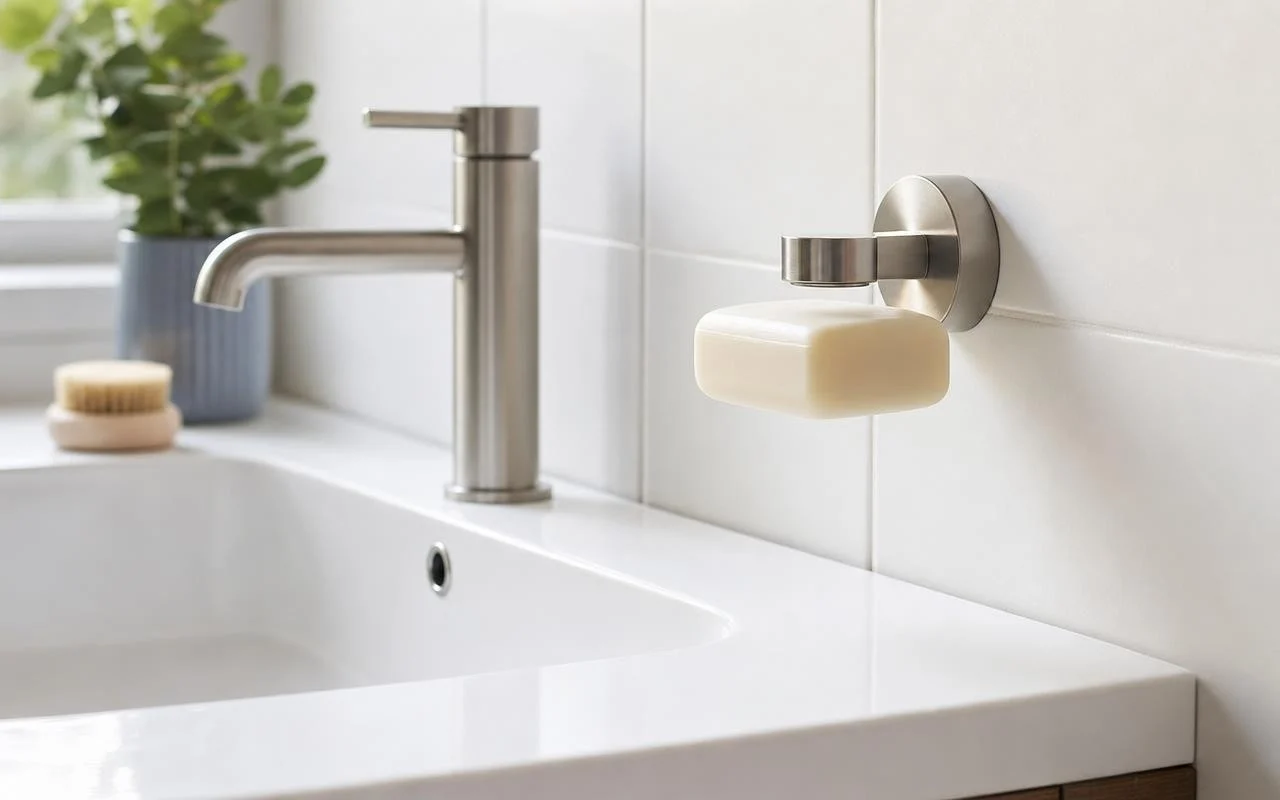
Every morning, the scene on the rim of my basin was the same: a soap bar that softened and slid, an opaque ring stuck to the ceramic, and that soapy paste impossible to rinse. My pretty stoneware soap dish mostly kept a sticky halo that I would have preferred to do without.
Looking at modern bathrooms, where the vanity top remains uncluttered, I realized the problem came less from the soap than from the dish placed beneath it. New designs eliminate this soap holder in favor of fixed or recessed systems; I wanted the same effect while keeping my preferred solid soap.
Why the placed soap dish ends up dirtying the sink
Soap left in a dish stays damp, it stews in a pool of water, forms a slimy film and attracts limescale and bacteria. Over time, this small puddle loaded with residues ends up marking the ceramic or resin with a dull ring, highly visible in light-colored bathrooms.
On the decoration side, the impact is immediate. Wall-mounted basins, large vanity tops in engineered stone or Corian, and fine fittings demand clean surfaces. An object placed right in the middle of the edge breaks the line and chews away precious centimeters, especially in small bathrooms.
My magnetic wall-mounted soap holder screwed to the wall: the halo-free solution
So I replaced the dish with a magnetic wall-mounted soap holder, screwed into the grout of the tile next to the faucet. A small metallic capsule sinks into the soap, which then sticks to a magnet fixed on the wall; the soap bar literally floats in midair, just below the faucet, with no support on the edge.
Immediate effect: no more sticky halo on the sink, no more soap paste to scrub. The soap dries on all its faces between uses, the vanity stays smooth and a quick wipe with a sponge suffices. Visually, the fittings stand out better and this magnetic soap holder almost disappears.
Choosing the mounting for your magnetic wall-mounted soap holder
Before pulling out the drill, I compared the different mounting options. Some models sit with a suction cup, others with a strong adhesive, others again with a small plate to screw on; the right choice really depends on the surface around the sink.
- Suction cup: for smooth and non-porous surfaces like glossy tile, earthenware, enamel or Plexiglas. It adheres poorly on polished concrete, natural stone, wood or textured tiles.
- Adhesive: handy when you don’t want to drill. Manufacturers recommend degreasing the wall, for example with white vinegar, then pressing firmly and waiting 24 hours before hanging the soap; some models claim a maximum load around 120 g.
- Screwed plates: suitable for supports where suction and adhesive grip poorly. Prefer to aim into a tile joint to limit the risk of cracking, with a drill bit suited to it.
The technical sheets from several brands indicate load capacities between 160 and 180 g for a magnetic support, provided the surface is smooth and clean. If the system peels off, cleaning the suction cup and the tile often fixes the problem. For those who want a completely bare plan, there is also the built-in soap dispenser, with a hole about 34 mm in the countertop and a reservoir of 300 to 500 milliliters under the sink.
