
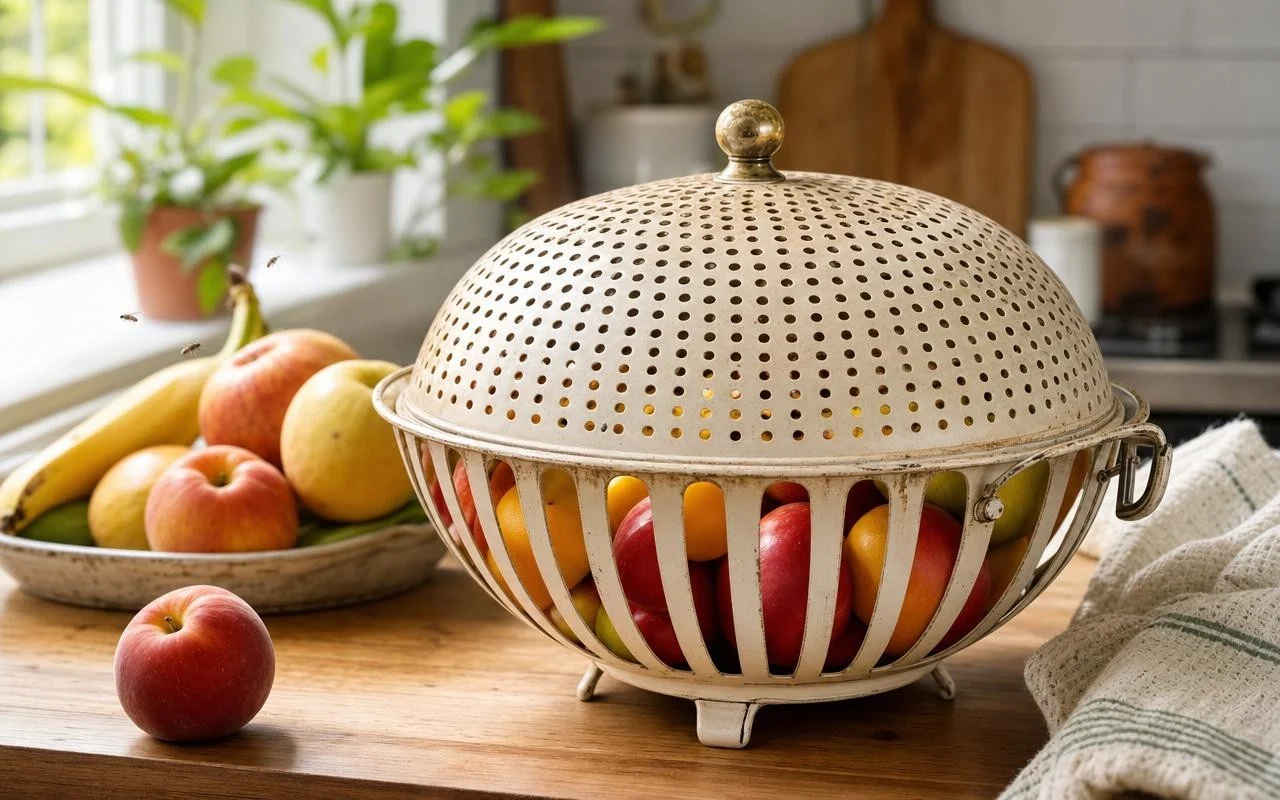
It was thought to be a relic of holidays spent with grandparents, sitting on the kitchen table or hanging on the wall. Yet the vintage cap-lid fruit basket is making a true comeback, both in flea markets and in new decorative collections. While its retro look in bamboo, metal, or wicker is appealing, another argument has people talking: its touted effectiveness against fruit flies.
Because in summer, tiny insects swarm into kitchens as soon as fruit begins to stain the tray. Many people turn to vinegar bowls or homemade traps. In this context, this simple-mesh cloche, seemingly straightforward, promises to limit raids over the basket. The question remains: how far does this physical barrier really work against fruit flies?
Why do fruit flies circle around the fruit basket in summer
Fruit flies that invade the kitchen are often drosophila, also known as fruit flies. Entomologists at the University of Kentucky explain that we see them mainly from late summer into early autumn, because they are attracted to the scents of very ripe or fermenting fruit. An open basket filled with bananas, peaches, or apricots therefore represents an ideal food source and a breeding ground for them.
The heat intensifies this phenomenon. When temperatures rise, fruits ripen faster and emit more sugary aromas. According to the USDA’s Food and Nutrition Service, certain fruits like bananas produce a lot of ethylene, a gas that speeds up the ripening of neighboring fruits. 60 Millions de Consommateurs also notes that bananas accelerate the ripening of apricots. More overripe fruit means more fermented odors, hence more drosophila circling the countertop.
The slotted dome of the vintage basket, a simple but effective barrier
To curb this easy access, Marmiton highlights the vintage fruit basket equipped with a slotted cap. The principle is straightforward: a fine-mesh dome covers the fruits and prevents insects from reaching the flesh, while still allowing air to circulate. The fruits breathe, continue to ripen without condensation, but the fruit flies cannot land to lay eggs.
This system does not remove insects from the home; it mainly reduces their contact with food. The result: fewer eggs, fewer larvae, and a noticeably diminished sense of invasion around the table. DIY store models, such as a 28.5 cm diameter by 24 cm tall metal basket available at Leroy Merlin, rely on fine meshes to block even the smallest insects. Outdoors, the same dome also protects against wasps, while remaining decorative on a garden table.
Choosing well and using your retro basket to keep fruit flies away
For this measure to work, the choice of model matters as much as how you use it. A basket that is too large encourages the pile-up of fruit and thus overripeness, whereas a size suited to your weekly consumption helps reduce waste. Breathable materials such as wicker, fine metal, or slatted bamboo allow air to circulate more freely. Some models, like the KANELMOTT multi-tier basket from IKEA sold around €35, rely on several levels and a ventilated lid to further improve air flow.
Finally, a few criteria really make a difference.
- Size adjusted to the amount of fruit you consume each week
- Breathable material (wicker, fine metal, bamboo) to prevent condensation
- Articulated lid, easy to open and close daily
- Very fine mesh, essential to slow even the smallest drosophila
Then comes the operating instructions. Close the lid after each use, remove any damaged fruit daily, and separate bananas from fruits that are delicate like apricots or peaches, as advised by 60 Millions de Consommateurs, to greatly limit fermented odors. The FAO also reminds us that good aeration around fruit reduces the risks of spoilage. A clean kitchen, an emptied sink, and a properly used caped mesh fruit basket: combined, these steps noticeably reduce the presence of fruit flies around fruit in summer.
Sources
- JLM
“Elle revient dans toutes les cuisines cet été : cette corbeille déco adorée de nos grands-mères éloigne à coup sûr les moucherons”
