
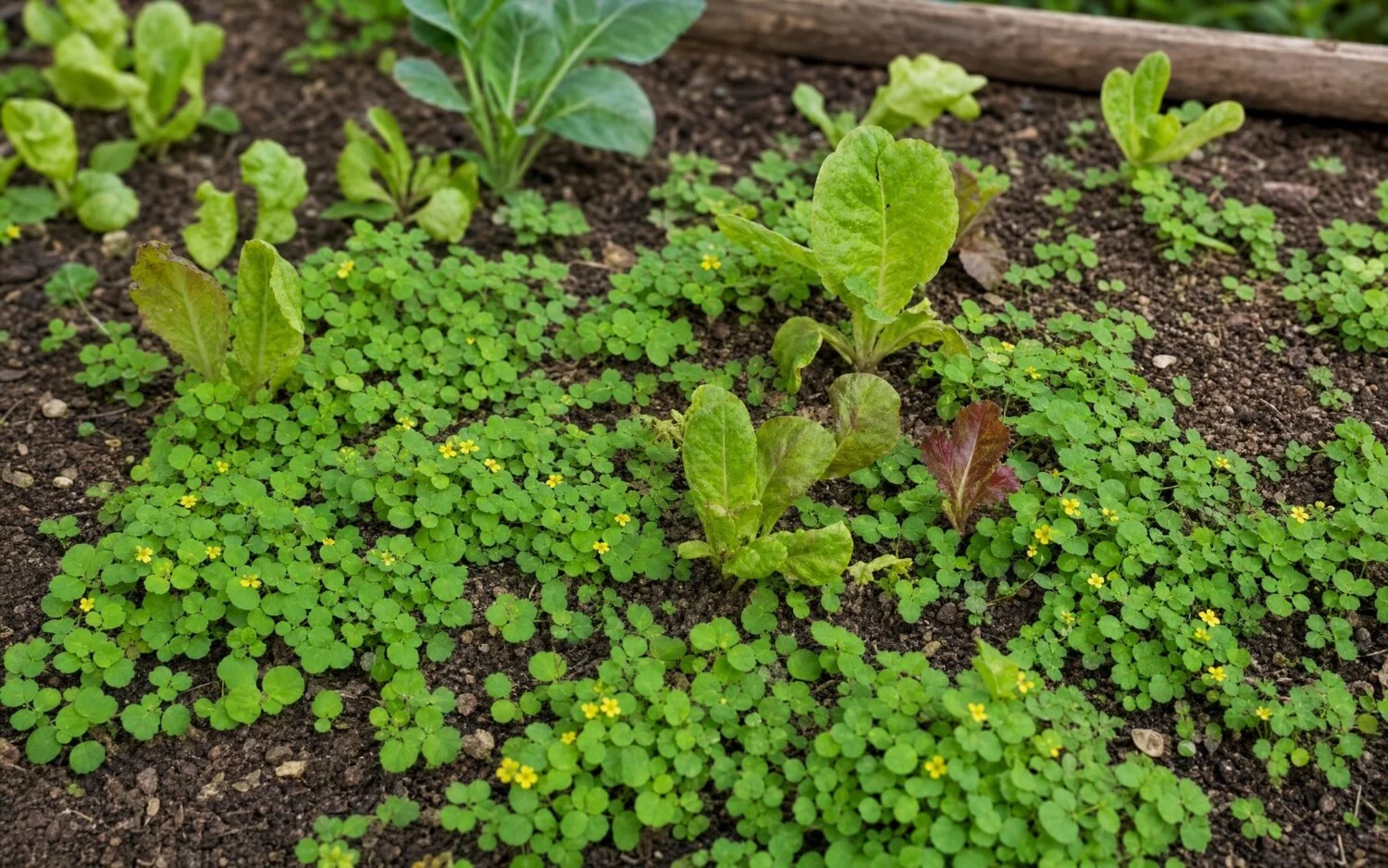
For several weeks now, a small plant with heart-shaped leaves is massively carpeting flowerbeds, pathways, and even vegetable plots. Many gardeners mistake it for an harmless clover and let it take hold, charmed by its soft green mats and its tiny yellow flowers dotting the ground.
Behind this charming ground-cover look hides, however, a tough opponent. This “fake clover” is none other than Oxalis corniculata (Oxalis corniculata), an weed from the Oxalidaceae family that loves our French gardens and spreads from spring to autumn at a remarkable pace.
Recognizing Oxalis corniculata, this invasive faux clover
Oxalis corniculata forms a very low carpet, usually limited to 5 to 8 cm in height. Its leaves are composed of three heart-shaped leaflets, light green, sometimes leaning toward purple depending on the varieties. The creeping stems run along the soil surface, root in places, and allow the plant to thread between stones, in the joints of paving, at the base of hedges, or in the middle of established crops.
Its five-petaled yellow flowers appear from June and renew themselves through autumn, which fuels the confusion with a simply flowering clover. To distinguish this invasive faux clover, a few precise clues help a lot:
- leaves with three leaflets clearly heart-shaped, often thinner than those of white clover;
- small bright yellow flowers with five petals, carried on slender stalks;
- creeping stems that root in places, forming a true carpet;
- elongated pods standing upright after flowering, ready to project their seeds.
Why Oxalis corniculata spreads in the garden so quickly
If Oxalis corniculata poses so many problems, it is because of its double reproductive strategy. It propagates through its fine, brittle roots, but especially through its highly fertile seeds. The pods, when ripe, burst open and launch the seeds far from the plant. The Royal Horticultural Society describes “a ejection mechanism that sends seeds away from the plant,” which explains the sudden appearance of plants well beyond the original clump.
Its creeping root system seriously complicates manual weeding. Roots snap with the slightest misstep, and every fragment remaining in the soil regrows. A simple pass of a rototiller or cultivator fragments these roots even more and disperses the plant across the entire plot. In the vegetable garden, this low carpet smothers seedlings, competes with young vegetables for water and nutrients, and occupies the tiniest bare patch of soil.
How to get rid of Oxalis corniculata without spending the whole summer on it
There is no miracle solution that eliminates it in one go, but a combined strategy lets you regain control. Manual pulling remains the foundation: tackle young plants, when the soil is slightly moist, using a small gouge or a fine tool to extract as many roots as possible. In pots or planters, it is better to empty the entire container, carefully sort the clump, and not leave on the soil any tufts that already bear pods.
Prevention plays a key role. A mulch layer of 5 to 7 cm thickness (brown cardboard covered with straw, wood chips, or decorative gravel) strongly limits the germination of oxalis seeds. Densifying plantings, sowing a green manuring crop in the off-season, and filling gaps between paving stones further reduce attack zones. In paths and joints, boiling water or a natural vinegar-based herbicide act on the above-ground parts, to be used on mineral surfaces to avoid harming crops or soil life.
Some gardeners add flame weeding or products based on pelargonic acid for gravelly areas, always strictly following the usage instructions. Despite its reputation as an invader, Oxalis corniculata remains non-toxic and can even serve as temporary ground cover on fallow land or an unused patch, where it protects the soil from erosion and provides shelter for small beneficial insects.
The real difficulty mainly concerns seedling beds and young vegetable plantings, which are much more sensitive to its competition. In these zones, regularly controlling this “faux clover” and limiting its flowering becomes a seasonal habit almost as important as watering.
